

MBA in India vs Abroad: The Honest Comparison Nobody Else Will Give You
Every year, I get this question from at least 200 applicants: should I do my MBA in India or abroad? And every year, I watch people make this decision based on the wrong factors. They compare IIM Ahmedabad’s fee structure to Wharton’s tuition and conclude that an MBA in India vs abroad is a cost question. It’s not. It’s a career architecture question – and the answer depends entirely on what you want your next 20 years to look like.
I’ve spent 19 years on both sides of this equation. I have a Darden MBA. I’ve guided applicants into IIM-A, ISB, Stanford, Wharton, Booth, Kellogg, INSEAD, and 50+ other programs across India and abroad. I’ve seen what happens to careers after both choices – not just in year one, but in year five, year ten, year twenty. And I’m going to give you the comparison that no ranking list, no Quora thread, and no school brochure will.
Let’s get into the real mba in india vs abroad comparison.
Should I Do MBA in India or Abroad? The Question Behind the Question

Before you compare schools, costs, or salaries, you need to answer one question honestly: should I do mba in india or abroad based on where I want to build my career for the next two decades? Not the next two years. The next two decades.
Here’s why this matters. If your goal is to work in India – in Indian consulting, Indian FMCG, Indian banking, Indian startups – then an IIM-A or ISB MBA is not just competitive with a global MBA. For that specific goal, it might be better. The alumni network is deeper in India. The recruiters are local. The brand recognition with Indian employers is unmatched.
But if your goal involves working outside India – even for a few years – then the equation shifts completely. MBB firms don’t recruit from IIMs for their New York or London offices. Google’s product management rotational program in Mountain View doesn’t interview IIM graduates. Goldman Sachs Singapore doesn’t visit ISB’s campus. An Indian MBA, no matter how prestigious, gives you a powerful domestic career. It does not give you a global one.
I saw this play out in the most dramatic way possible with one of our clients, Ashutosh
He cracked both IIM Ahmedabad and Stanford’s MSx program – arguably the best MBA in India and one of the best in the world, simultaneously. The confusion was real. And I’ll be honest – I was proud that our work had created a situation where the “problem” was choosing between two extraordinary options.
What settled it was something you won’t find in any ranking. When Ashutosh started connecting with Stanford alumni – people who had been through MSx – he noticed something. Their ambitions were fundamentally global. These weren’t people optimizing for the next promotion at an Indian company. They were building ventures across continents, leading global teams, thinking about problems at a scale that transcended any single country. He resonated with that. And it wasn’t about IIM Ahmedabad being “lesser” – IIM-A is a phenomenal institution. It was about Ashutosh’s specific vision for his life being more aligned with the global DNA of Stanford’s community.
This is the question behind the question. Not “which school is better?” but “which version of my career do I want to build?”
As I’ve covered in our complete guide to studying MBA abroad for Indian applicants, the decision isn’t about prestige. It’s about career architecture.
MBA India vs USA: Where the Gap Is Widest
The mba india vs usa comparison is the most common one I get, and it’s where the differences are sharpest. Let me break this down honestly.
Recruiting depth. At an M7 US school – Harvard, Stanford, Wharton, Booth, Kellogg, Columbia, Sloan – you’ll have 200-400 companies recruiting on campus. Consulting, tech, finance, healthcare, energy, non-profit. At IIM-A, the number of recruiters is large too, but the variety is narrower and overwhelmingly domestic. The mba india vs usa gap in recruiting diversity is significant for anyone targeting a global career.
Career switching power. This is where US MBA programs dominate. Switching from IT to consulting, from engineering to product management, from banking to venture capital – US MBA programs are designed for these transitions. They have the brand recognition with recruiters, the alumni in those roles, and the curriculum to support radical career pivots. Indian MBA programs are stronger at accelerating you within your current trajectory than pivoting you into a new one.
Salary ceiling. Post-MBA salaries at M7 schools average $175,000-$200,000 in year one. Post-MBA salaries at IIM-A average ₹32-35 lakhs. Yes, purchasing power parity matters. But if you’re calculating the absolute earning potential over a 20-year career – especially if you plan to work in the US, Middle East, or Singapore for even part of that time – the US MBA creates a permanently higher salary trajectory.
Where India wins in this comparison. Speed and cost. IIM-A’s two-year program costs ₹23-25 lakhs. A two-year US MBA costs ₹1.5-2.5 crore all-in. If you’re confident your career will stay in India, the ROI math favors IIM-A overwhelmingly. And the CAT pathway – one exam, one application cycle – is far simpler than the GMAT + essays + interviews + visa process for US schools.
Here’s what I’ve seen across 19 years of tracking our clients post-MBA. The divergence between Indian MBA and US MBA career trajectories isn’t gradual – it’s exponential. At the 5-year mark, our clients who went to M7 or T15 US programs are typically in senior manager or director roles earning $250,000-$350,000 at McKinsey, Google, Amazon, or Goldman Sachs. Our clients who went to IIM-A or ISB at the same 5-year mark are in similar seniority titles but earning ₹50-70 lakhs – excellent by Indian standards, but 3-4x lower in absolute terms. By year 10, the gap widens further because the US MBA grads have had access to equity compensation, carried interest, and global leadership roles that simply don’t exist at the same scale in India. I’m not making a value judgment here – I’m sharing a pattern. If you’re building a career in India, the IIM path is exceptional. If you want global optionality, the data over two decades is unambiguous.
MBA India vs UK and MBA India vs Canada: The Middle Ground
Not every international MBA conversation is about the US. The mba india vs uk and mba india vs canada comparisons have both surged – UK for its one-year programs that cut both time and cost, Canada because of immigration pathways.
UK: Speed and Specialization
London Business School, Oxford Said, and Cambridge Judge offer one-year MBAs. That means one year of tuition (₹55-75 lakhs), one year of living costs, and one year of opportunity cost – roughly half the total investment of a US MBA. The UK’s Graduate Route visa gives you 2 years of post-study work. For applicants who want international exposure without a ₹2 crore commitment, the mba india vs uk tradeoff is compelling.
The limitation: the UK recruiting market is smaller. Consulting and finance are strong from LBS. But the breadth of tech recruiting you’d get at Stanford or Booth simply doesn’t exist in London at the same scale.
Canada: Immigration as Strategy
The mba india vs canada decision is increasingly driven by one factor: permanent residency. Canada’s PGWP (Post-Graduation Work Permit) gives you up to 3 years of work authorization, and the PR pathway from there is well-established. Schools like Rotman, Ivey, and Schulich are solid programs. The total cost (₹50-80 lakhs) sits between Indian and US price points.
But I want to be direct. If your primary reason for choosing Canada over the US is “easier immigration,” make sure the career opportunities match your ambitions. Toronto and Vancouver have strong finance and tech markets. They are not New York or San Francisco. The trade-off is real.
I also want to add something here about timing, because it changes the mba india vs uk and mba india vs canada calculation significantly. A one-year UK MBA means you’re back in the job market 12 months sooner than with a two-year US program. That’s not just one year of saved tuition – it’s one year of earned salary. For a 30-year-old Indian professional earning ₹25 lakhs, the opportunity cost difference between a one-year and two-year program is ₹25 lakhs plus the salary they’d earn in that second year post-MBA. Canada sits in the middle – programs range from 12 to 20 months, and the PGWP work permit gives you up to 3 years to establish yourself before applying for PR. For applicants whose primary goal is permanent settlement outside India, the mba india vs canada equation often favours Canada over both the US and UK purely on immigration math.
MBA India vs Abroad Cost: The Full Financial Picture
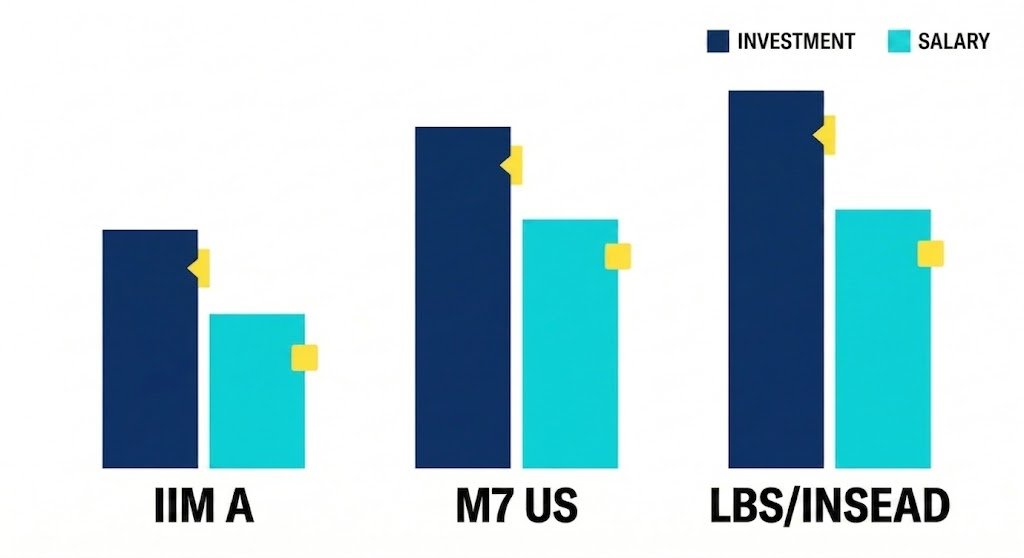
The mba india vs abroad cost comparison is where most people start – and where most people get it wrong. They compare tuition numbers and stop. That’s like comparing two jobs by looking only at the base salary and ignoring the bonus, equity, and growth trajectory.
Here’s the real mba india vs abroad cost picture:
Cost Component | IIM-A (2 years) | M7 US (2 years) | LBS/INSEAD (1 year) |
Tuition | ₹23-25L | ₹1.4-1.6 Cr | ₹55-75L |
Living Costs | ₹4-6L | ₹40-60L | ₹15-25L |
Opportunity Cost | ₹30-50L | ₹30-50L | ₹15-25L |
Total Investment | ₹57-81L | ₹2.1-2.7 Cr | ₹85L-1.25 Cr |
Avg. Year-1 Salary | ₹32-35L | ₹1.4-1.7 Cr | ₹80L-1.2 Cr |
Payback Period | 2-3 years | 3-5 years | 2-4 years |
Look at the payback period row. Despite costing 3-4x more, US MBAs pay for themselves within 3-5 years because the salary differential is so massive. An IIM-A grad earning ₹35 lakhs needs 2 years to recoup ₹60-80 lakhs. A Wharton grad earning ₹1.5 crore needs 3-4 years to recoup ₹2.3 crore. By year 5, the Wharton grad is ahead in absolute terms – and the gap only widens.
But – and this is critical – that math only works if you actually land the high-paying international role. If you go to a T25 US school and end up returning to India because the visa didn’t work out, your ROI collapses. School selection is everything.
Here’s how I advise every PythaGURUS client to think about this decision. Don’t compare one school with another – compare every school with no MBA at all. Ask yourself: if this is the only admit I have, and I don’t get into any other program, would I still go? If the answer is yes, the school belongs on your list. If the answer is no, drop it – regardless of its ranking. This principle cuts through the noise of India vs abroad cost debates because it forces you to evaluate each option against your current career trajectory, not against each other.
On the financial side, I tell clients to build what I call a three-variable ROI model. Variable one: your realistic post-MBA salary based on your target role and geography – not the school’s published average, but what people with YOUR background actually earn (an Indian IT engineer going into US consulting has a very different salary trajectory than the average M7 grad). Variable two: scholarship probability – and this depends heavily on which round you apply, how many competing admits you have, and how badly the school wants your profile. Variable three: visa probability – because a $180,000 job in the US has very different ROI math than a ₹30 lakh job in India if your H-1B doesn’t come through. When you model all three variables honestly, the India vs abroad cost question stops being about sticker price and starts being about expected value. And expected value is what I’ve built school lists around for two decades.
MBA India vs Abroad Salary: What 20 Years of Data Shows
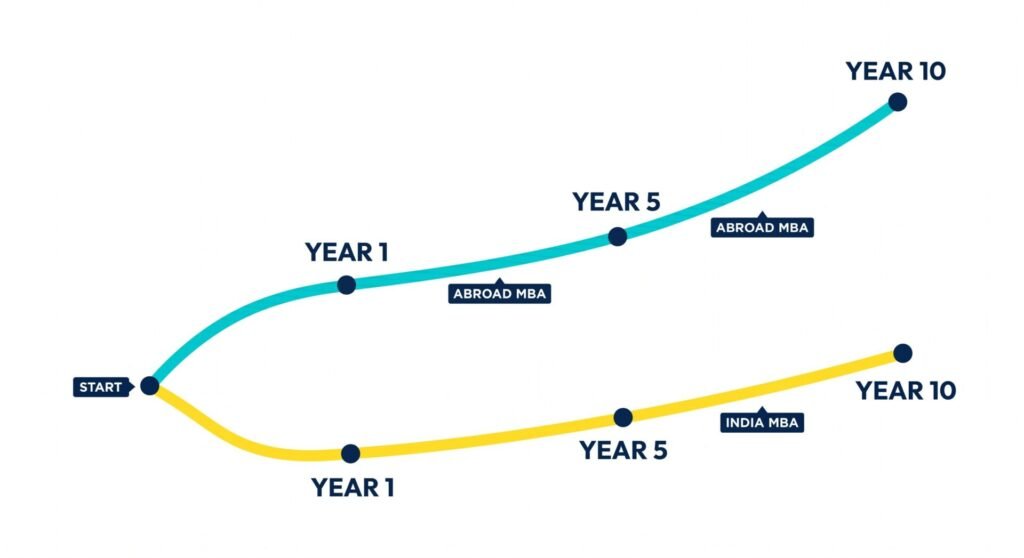
The mba india vs abroad salary comparison gets distorted because people look only at year-one numbers. Year-one numbers are misleading. Here’s why: the salary growth curve after an international MBA is steeper than after an Indian MBA, which means the gap compounds over time.
At the 5-year mark, the average M7 MBA grad is earning $250,000-$350,000 (₹2-3 crore). The average IIM-A grad at the 5-year mark is earning ₹50-70 lakhs. That’s a 3-4x gap. At the 10-year mark, M7 grads who went into consulting or finance are often at $400,000-$600,000+. IIM-A grads at similar experience levels are at ₹1-1.5 crore. The mba india vs abroad salary gap doesn’t close over time. It widens.
Now, I want to be fair. If you stay in India, the ₹1-1.5 crore salary at the 10-year mark from an IIM-A degree is extraordinary by Indian standards. You’ll live exceptionally well. The question is whether you’re optimizing for comfort within India or for maximum earning potential globally.
I also want to add something here that changes this calculation for many applicants. Scholarships. I’ve seen PythaGURUS clients receive ₹40-80 lakhs in scholarships at T15 and T25 schools. When you subtract a ₹60 lakh scholarship from a ₹2 crore total cost, suddenly the ROI of an international MBA looks very different – closer to the ROI of an IIM-A, but with 3-4x the salary ceiling.
And here’s something that the mba india vs abroad salary conversation almost never accounts for: equity compensation. At the 5-year mark, an M7 grad in tech or PE isn’t just earning a base salary – they’re holding RSUs, stock options, or carried interest that can double or triple their total compensation. A product manager at Google earning $280,000 in base might have another $150,000-$200,000 in stock vesting annually. An IIM-A grad in a similar seniority at an Indian tech company might have ESOPs, but the absolute value is a fraction of what US equity packages deliver. This is the compounding effect nobody talks about – the mba india vs abroad salary gap isn’t just about what you earn. It’s about what you accumulate. Over a 15-year career, the wealth gap between an international MBA grad and an Indian MBA grad – even when both are in senior leadership – can be ₹5-10 crore or more. That’s not a salary difference. That’s a generational wealth difference.
MBA Abroad Benefits Over India: Beyond the Salary
The mba abroad benefits over india that actually matter aren’t the ones you’ll find in brochures. Let me share the ones I’ve seen transform careers over two decades.
Global employability. An Indian MBA makes you employable in India. An international MBA makes you employable everywhere. This isn’t a marketing claim – it’s a structural reality. The mba abroad benefits over india include the ability to work in the US, UK, Singapore, Dubai, or Europe. That geographic optionality compounds over a career.
Network quality and diversity. My Darden class had students from 40+ countries. Former military officers, startup founders, investment bankers, non-profit leaders. The diversity of perspective in every classroom discussion, every study group, every case competition was transformative. Indian MBA classrooms – even at IIM-A – are predominantly Indian engineers and consultants. The peer learning dynamic is different.
Communication and executive presence. This is the benefit nobody talks about but every international MBA grad recognizes. After two years of debating case studies in a room with Americans, Europeans, Latin Americans, and Africans, Indian professionals develop a communication style that is direct, confident, and globally calibrated. This single skill – executive communication – is worth more than any technical course in the curriculum.
Credibility signal. Fair or unfair, a Wharton or INSEAD on your resume opens doors that an IIM degree simply doesn’t – especially outside India. Board seats, advisory roles, investor conversations, global leadership positions – these opportunities flow disproportionately to graduates of internationally recognized programs.
Spousal and family career optionality. This is the mba abroad benefits over india that nobody discusses but every married applicant thinks about. When you do an MBA abroad, your spouse typically gets a dependent visa with work authorization. In the US, the H-4 EAD allows your spouse to work. In Canada, spouses get open work permits. In the UK, dependent visas now allow full-time work. This means your household income can effectively double in the first year post-MBA. Compare that with an IIM-A MBA where both spouses stay in the same Indian job market. The mba abroad benefits over india aren’t just about your career – they’re about your family’s career. I’ve seen couples where both partners were earning ₹15-20 lakhs in India, and within 2 years of one partner’s US MBA, their combined household income was $300,000+. That transformation is not possible through an Indian MBA alone.
What MBA India vs Abroad Quora Discussions Get Wrong
I read mba india vs abroad quora threads regularly. Some have genuine insights from real MBA graduates. Most are a mess of anonymous opinions, outdated data, and confirmation bias. Here are the three biggest myths I see repeated on mba india vs abroad quora discussions:
Myth 1: “IIM-A is equivalent to a top-20 US school.” Within India, yes. Globally, no. IIM-A is an outstanding institution with a powerful domestic brand. But in the US, Europe, or Southeast Asian job markets, an IIM-A degree doesn’t carry the same recognition as a Booth, Kellogg, or INSEAD degree. This isn’t a quality judgment – it’s a brand recognition reality.
Myth 2: “You can always come back to India after a US MBA if the visa doesn’t work out.” True in theory. Painful in practice. Coming back to India after a US MBA often means taking a significant salary cut and competing for roles where you’re “overqualified” on paper but “under-networked” in the domestic market. Plan your geography before you apply, not after.
Myth 3: “The cost difference makes Indian MBA the obvious choice.” Only if you ignore scholarships, salary differentials, and career trajectory. As I showed in the cost section above, the payback period for a US MBA is 3-5 years. After that, you’re earning at a permanently higher level. The “obvious” choice depends entirely on your 20-year career plan, not your year-one balance sheet.
Myth 4: “Indian IT professionals can’t get into top MBA programs abroad.” This is the most damaging myth on mba india vs abroad quora threads, and it stops hundreds of qualified applicants from even trying. Yes, Indian IT professionals are in the most over-represented pool. Yes, the competition within that pool is fierce. But “competitive” is not “impossible.” I’ve personally guided dozens of TCS, Infosys, Wipro, and Cognizant engineers into Wharton, Kellogg, Ross, Fuqua, and Darden – with scholarships. The issue isn’t that IT professionals can’t get in. It’s that most IT professionals apply with identical essays, identical career goals, and identical positioning. When you differentiate your narrative – when you show the admissions committee what makes you different from the other 300 Indian IT engineers in their applicant pool – the doors open. The profile isn’t the problem. The strategy is. Stop reading anonymous Quora threads for validation and start building an application that makes you impossible to ignore.
Frequently Asked Questions: MBA in India vs Abroad
Q: Is IIM-A better than a T25 US MBA school?
For an India-based career, IIM-A is likely better – stronger brand with domestic recruiters, deeper alumni network in Indian companies, and lower cost. For a global career, most T15 US schools will outperform IIM-A in terms of international recruiting access and salary outcomes. T25 schools are a closer comparison and depend on the specific school and your career goals.
Q: Can I work in the US after an Indian MBA?
Technically possible but extremely difficult. US companies rarely sponsor H-1B visas for candidates from Indian MBA programs. Without the on-campus recruiting infrastructure that US schools provide, you’d need to independently find an employer willing to sponsor you – which happens, but is the exception, not the rule.
Q: What if I get into ISB but not an M7? Should I go to ISB?
If your career plan is India-focused, ISB is an excellent choice – one-year format, strong placements, and a rapidly growing global reputation. If your plan requires US or European employment, I’d recommend reapplying to international schools in the next cycle rather than defaulting to ISB. The recruiting infrastructure gap is real.
Q: Is it worth spending ₹2+ crore on an MBA abroad when IIM-A costs ₹25 lakhs?
It depends on your 20-year career plan, not your year-one budget. If you’ll work globally, yes – the salary differential pays back the cost within 3-5 years. If you’ll stay in India permanently, the ROI math is much closer, and IIM-A may genuinely be the smarter financial choice.
Not Sure Which Path Is Right for You?
The mba in india vs abroad decision is the most consequential one you’ll make in your career planning. General comparisons can only take you so far. Your specific profile – your work experience, test scores, career goals, financial situation, and geographic preferences – requires a specific strategy.
If you want an honest assessment of whether an Indian MBA or an international MBA is the right move for your specific situation, that’s what our Comprehensive Profile Analysis is for. No fluff, no generic advice – just a clear-eyed evaluation from someone who has guided 2,700+ applicants through exactly this decision.