
Best MBA Colleges Abroad for Indian Students: The School-by-School Breakdown
I’ve guided applicants into over 50 different business schools across 12 countries in 19 years. And the single most common mistake I see Indian applicants make when searching for the best mba colleges abroad for indian students? They start with rankings. They open the FT or QS list, look at the top 10, and build their school list from there. That’s how you end up applying to schools that will never admit your profile, missing schools that would have given you a full scholarship, and wasting ₹2-3 lakhs in application fees on a poorly constructed list.
The best MBA colleges abroad for indian students aren’t the “best” schools on a ranking table. They’re the schools where your specific profile – your work experience, your GMAT Focus score, your career goals, your nationality – gives you the highest probability of admission, the best career outcomes, and the strongest scholarship offers. That’s a very different list for a TCS engineer than it is for a McKinsey India consultant.
Let me give you the school-by-school breakdown that no ranking will.
Top MBA Universities Abroad: The Tier System Indian Applicants Need
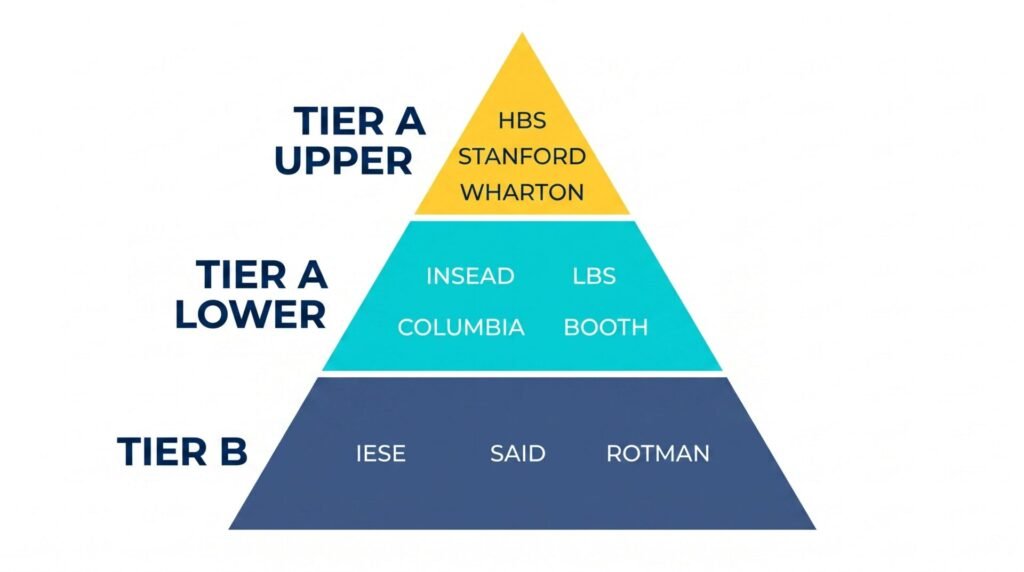
When I evaluate top mba universities abroad for Indian clients, I don’t follow linear rankings. Rankings change every year without anything fundamentally changing inside the programs. Instead, I use a cluster system – three tiers, each with an upper and lower segment – that groups schools by the career outcomes they actually deliver.
Here’s how top mba universities abroad break down for Indian applicants:
Upper Tier A: Harvard, Stanford, Wharton, Booth, Kellogg, Columbia, Sloan. Plus INSEAD and LBS internationally. These are the programs where MBB consulting, Big Tech product management, and bulge-bracket investment banking recruit most aggressively. Indian admit rates are low (5-8% of the class is typically Indian), and you need a GMAT Focus score of 705+ to be competitive.
Lower Tier A: Tuck, Yale SOM, Ross, Fuqua, Darden, Stern, Haas, Anderson. Plus HEC Paris, IESE, and Cambridge Judge. These schools place Indians extremely well into consulting and tech, often with stronger scholarship offers than Upper Tier A. My Darden experience taught me that these programs deliver 90% of the career outcomes of M7 schools at a significantly lower competitive bar for Indian applicants.
Tier B: Tepper, McCombs, Kenan-Flagler, Emory Goizueta, Marshall, Olin, Kelley, Rotman, Schulich, Mannheim, ESMT Berlin. These are the programs where strong Indian applicants can secure major scholarships – ₹40-80 lakhs – while still accessing solid consulting and tech recruiting. Don’t sleep on Tier B. Some of our strongest ROI outcomes have come from applicants who strategically targeted these schools.
I also want to add something here that changes how Indian applicants should think about this tier system. The admit rates vary dramatically across tiers for Indian profiles. At Upper Tier A, an Indian male from IT with a 705 GMAT Focus score might have a 5-8% chance of admission. At Lower Tier A, that same profile might have a 15-25% chance. At Tier B, it could be 30-40% – with a ₹40-60 lakh scholarship attached. I’ve seen applicants waste an entire application season because they only targeted Upper Tier A schools and got rejected across the board. Meanwhile, a strategically built list across Lower A and Tier B would have given them 3-4 admits with strong financial packages. The tier system isn’t about settling. It’s about maximizing your probability of an outstanding outcome.
Top 10 MBA Colleges Abroad for Indian Students
Every Indian applicant wants a top 10 mba colleges abroad list. So here’s mine – but with an important caveat. This isn’t the “best schools in the world.” This is the top 10 mba colleges abroad specifically for Indian professionals, factoring in Indian admit rates, post-MBA career outcomes for Indians, scholarship availability for international students, and recruiting strength in roles Indians typically target.
School | Country | Duration | Indian Fit | Top For | Scholarship |
Wharton | USA | 2 yr | Strong | Finance, Consulting | Merit + Need |
Booth | USA | 2 yr | Strong | Finance, Analytics | Merit |
Kellogg | USA | 2 yr | Strong | Consulting, Marketing | Merit + Need |
INSEAD | France/SG | 1 yr | Excellent | Consulting, GM | Merit |
LBS | UK | 1.5 yr | Strong | Finance, Consulting | Merit |
Ross | USA | 2 yr | Excellent | Consulting, Tech | Strong Merit |
Fuqua | USA | 2 yr | Excellent | Consulting, Healthcare | Strong Merit |
Darden | USA | 2 yr | Excellent | Consulting, GM | Strong Merit |
Tuck | USA | 2 yr | Strong | Consulting, PE | Need-based |
Tepper | USA | 2 yr | Excellent | Tech, Analytics | Very Strong Merit |
Notice something? Harvard and Stanford aren’t on my top 10 for Indian students. That’s not because they’re bad schools – obviously. It’s because the admit rate for Indian applicants at HBS and Stanford GSB is brutally low, the scholarship availability is limited relative to the cost, and the incremental career outcome over Wharton, Booth, or Kellogg doesn’t justify the dramatically lower admission probability. I’d rather have an Indian applicant get into Kellogg with a ₹50 lakh scholarship than get rejected from Stanford.
This is a contrarian view. Most consultants would never leave Harvard off a “top 10” list. But I’m not building a list for a ranking website. I’m building one that maximizes outcomes for Indian professionals.
Let me share some real numbers. One of our clients, Anchal,(Watch her Success Story Video here) got her first interview invite from Michigan Ross and almost dismissed it as a fluke – because she’d just received two rejections from Tuck and Duke without even getting an interview. I told her to shut out the noise and focus on what’s ahead. She went to Ross with a 100% scholarship. Had she not applied to that school – had she built her list based only on the schools she “felt” were right – she would have missed a life-changing outcome. We’ve seen similar patterns at Fuqua and Darden, where Indian applicants who were rejected from M7 schools ended up with strong admits and scholarships of ₹40-70 lakhs at these programs. Another client, Alisha( Watch her MBA Consulting Success Story Video), came from an IT background – the most over-represented pool – and secured ₹4.6 crores in cumulative scholarships across her admits. Salika, another IT professional, secured ₹3.17 crores. These aren’t outliers. These are the outcomes that happen when your school list is built on data and pattern recognition, not on ranking tables.
Best Affordable MBA Colleges Abroad That Deliver Strong Returns
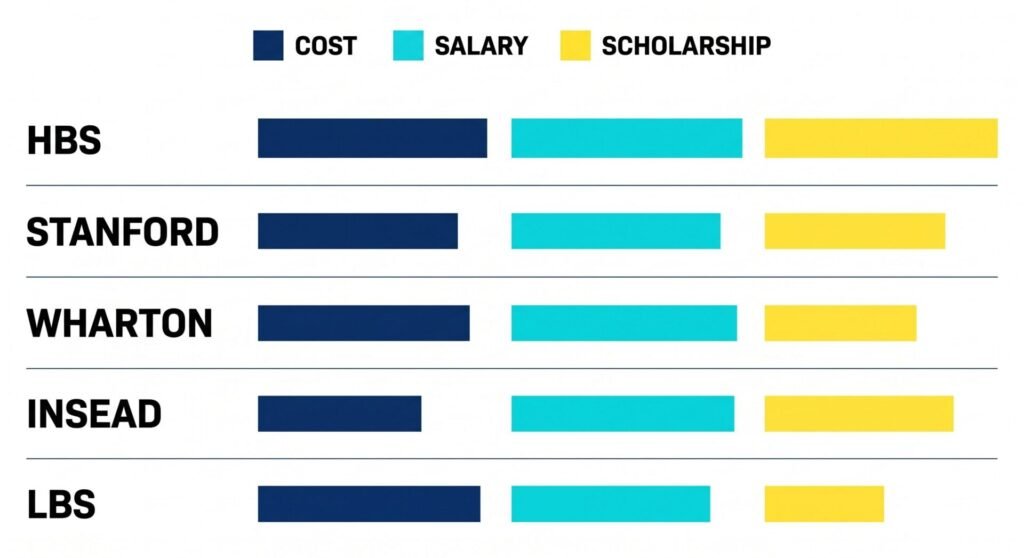
The best affordable mba colleges abroad aren’t the ones with the lowest sticker price. They’re the ones where the gap between cost and post-MBA salary closes fastest. When I evaluate the best affordable mba colleges abroad for Indian clients, I look at three things: net cost after realistic scholarship offers, post-MBA salary for the roles Indians typically pursue, and payback period.
Here are the programs that consistently deliver the strongest value:
Tepper (Carnegie Mellon): Aggressive merit scholarships for Indian applicants. I’ve seen offers of $60,000-$100,000. Strong tech and analytics recruiting in Pittsburgh. Net cost after scholarship: ₹60-90 lakhs for a program that places you into $140,000+ roles.
Fuqua (Duke): Excellent scholarship culture. Durham’s low cost of living helps. Consulting placement is outstanding – Fuqua consistently sends 30%+ of its class into MBB and Big 4. Net cost with typical Indian scholarship: ₹70-100 lakhs.
Darden (UVA): I’m biased here – it’s my alma mater. But the bias is earned. Darden’s case-method pedagogy, tight-knit community, and strong consulting placements make it one of the best value propositions in the T15. Scholarships for Indian applicants are competitive, and Charlottesville’s living costs are a fraction of New York or Boston.
INSEAD: One year. That alone makes it affordable relative to two-year US programs. Total investment of ₹85 lakhs-1.1 crore, but you’re back earning within 12 months. For Indians targeting consulting or general management, INSEAD’s ROI is hard to beat.
German programs (Mannheim, ESMT Berlin): Near-zero tuition at some programs. Living costs of ₹10-15 lakhs for the full program. The trade-off: smaller recruiting networks and often Germany-focused careers. But for applicants on a tight budget who want European exposure, these are genuinely strong options.
Here’s the pattern I’ve noticed over two decades. The applicants who get the best financial outcomes aren’t the ones who got into the highest-ranked school. They’re the ones who strategically applied to 3-4 schools where their profile was a strong fit and then negotiated scholarships using competing admits as their strongest card. One competing admit from a peer-ranked school can increase your scholarship offer by ₹15-25 lakhs. That’s why I recommend 8-10 applications across tiers – not because you need 10 options, but because the scholarship negotiation game requires multiple offers on the table.
Best MBA Programs for Indian Students by Career Goal
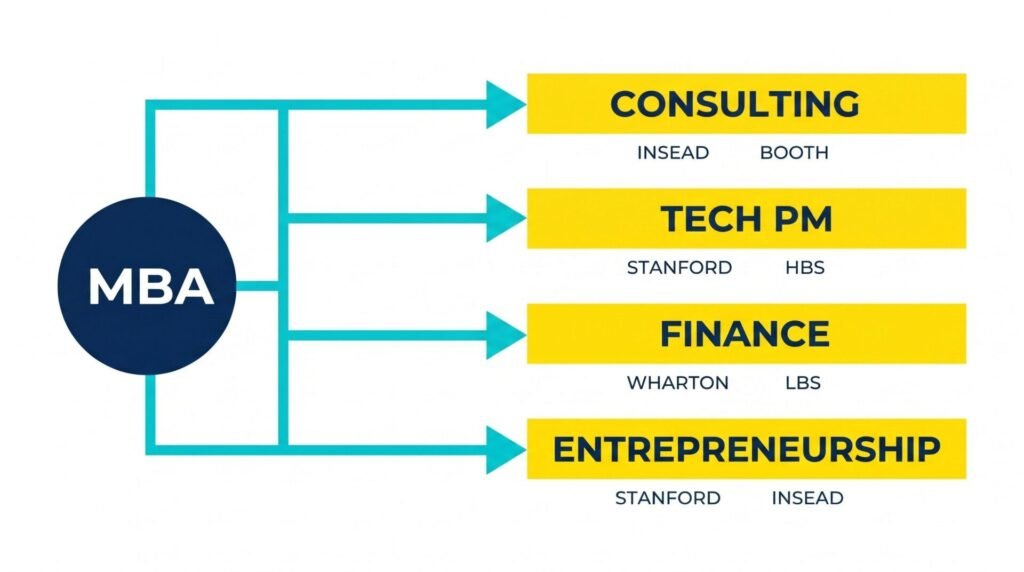
The best mba programs for indian students depend entirely on what you want to do after graduation. A school that’s perfect for consulting is mediocre for tech. A school that’s amazing for finance is wrong for entrepreneurship. Here’s the career-specific breakdown of the best mba programs for indian students:
For Management Consulting (MBB + Big 4): Kellogg, Booth, INSEAD, Fuqua, Darden, Ross. These schools send 25-35% of their graduating class into consulting. The on-campus recruiting pipelines are deep, and Indian alumni in consulting are plentiful – which means you have warm contacts for networking and referrals.
For Tech Product Management: Booth, Sloan, Haas, Ross, Tepper. West Coast proximity matters for Haas. Booth and Sloan have strong tech recruiting despite their East Coast/Midwest locations. Tepper’s analytics focus is increasingly attractive to tech recruiters looking for data-savvy PMs.
For Investment Banking and Finance: Wharton, Booth, Columbia, Stern. Wharton is the undisputed leader here. Columbia and Stern benefit from being in New York. Booth’s analytical rigour translates perfectly to finance roles.
For Entrepreneurship: Stanford GSB, HBS, INSEAD, Haas. If your post-MBA plan involves starting a company, the alumni networks and startup communities around these schools are unmatched. Stanford and HBS have the deepest venture capital connections. INSEAD’s global network is invaluable for cross-border ventures.
For General Management (Global Roles): INSEAD, LBS, Kellogg, Darden. If you want to lead teams across geographies rather than specialize in one function, these programs excel at producing generalist leaders. INSEAD and LBS have the most international class compositions, which matters if you’re building a global career
Here’s something I tell PythaGURUS clients that surprises them every time. I think Indian applicants massively over-target Columbia and Stern because of the “New York” brand, while under-targeting Ross, Fuqua, and Darden – schools that actually place Indians better into consulting and tech roles, with significantly higher scholarship generosity. I’ve also seen applicants fixate on one-year European programs because they seem “cheaper” and “faster,” while ignoring two-year US programs where the extra year of summer internship experience and on-campus recruiting gives you a dramatically stronger placement outcome. After 19 years of tracking where Indians actually land jobs and what they actually earn, I can tell you that the schools ranked #10-#20 in the US often deliver similar outcomes for Indian professionals compared to several schools ranked in the top 5 – because the scholarship offers are larger, the class sizes allow for more Indian admits, and the career services teams are more hands-on with international students. The rankings don’t capture any of this. My cluster system does.
Best B-Schools Abroad for Indian Students: What Matters Beyond Rankings
When I help Indian applicants identify the best b schools abroad for indian students, I push them past the ranking obsession. Here’s what actually matters when you’re choosing the best b schools abroad for indian students – and what rankings completely miss:
Indian alumni strength in your target role. A school might rank #8 globally but have almost no Indian alumni in private equity. Another school might rank #20 but have 50+ Indian alumni in consulting who actively recruit from their alma mater. The alumni network in your specific career path matters more than any ranking.
Visa and immigration outcomes for Indians. Some schools have dedicated career services for international students. Others effectively abandon you after graduation. Ask any school: what percentage of your international MBA graduates secured work authorization in the host country within 6 months of graduation? The answers will shock you.
Class composition and cultural fit. If you’re one of 80 Indians in a class of 900 (like at some M7 schools), the community feels very different from being one of 15 Indians in a class of 280 (like at Tuck or Darden). Neither is better – but know which environment you’ll thrive in before you apply.
I also want to add something here about interview and application style, because this varies dramatically across the best b schools abroad for indian students. Some schools – Wharton, for example – use a team-based discussion format for interviews. INSEAD requires four separate interviews. Kellogg uses student-led interviews. Darden’s interview is heavily case-method oriented. If you’re someone who thrives in structured, one-on-one conversations, Kellogg and Darden will feel natural. If you’re stronger in group dynamics, Wharton’s TBD format is your advantage. Knowing these differences before you apply – and practicing for each school’s specific format – can be the difference between an admit and a waitlist.
And then there’s the cultural question. At LBS, you’ll be in a class that’s 95% international – Indians are one nationality among 70+. At a school like Ross or Fuqua, Indians make up a larger percentage of the international cohort, which means a stronger community but less extreme diversity. Neither is objectively better. But knowing which environment brings out your best performance matters more than any ranking number.
Top Ranked MBA Colleges Abroad and Best MBA Universities in World: Cutting Through the Noise
Every year, applicants ask me: “What are the top ranked mba colleges abroad?” And every year, I give the same answer: it depends on which ranking you’re looking at, and none of them tell the full story. The best mba universities in world according to FT look different from QS, which looks different from US News, which looks different from Bloomberg.
Here’s my honest take on rankings after two decades in this industry. Rankings are useful as a starting point – they separate the top 50 from the next 200. Beyond that, they’re noise. The difference between the #12 and #18 school on any ranking is statistically meaningless. It changes every year based on methodology tweaks, not actual changes in program quality.
What I tell Indian applicants: use rankings to build your initial awareness of which schools exist. Then throw the rankings away and evaluate each school on the factors that actually determine your career outcomes – recruiting relationships in your target industry, visa outcomes for Indians, scholarship generosity for your profile type, and alumni network strength in your target geography.
The whole idea is this: the “best” school for you is the one that gets you from where you are to where you want to be in your career – with the strongest financial package and the highest probability of admission. That’s a personalized calculation, not a ranking table.
Let me give you a real example of how rankings mislead. Last year, a school jumped 6 spots in the FT ranking purely because its alumni reported higher salary increases – not because the school improved its curriculum, added better recruiters, or changed anything about the student experience. The following year, it dropped 4 spots because a different methodology weight shifted. Nothing changed inside the school either time. Yet applicants flooded that school with applications during the “good” year and avoided it during the “bad” year. That’s the danger of ranking-driven decision-making.
What doesn’t change year to year? Which companies recruit on campus. Which alumni respond to networking requests from current students. How the career services team supports international students with visa sponsorship. How generous the financial aid office is with Indian applicants. These are the factors I’ve tracked for 19 years, and they’re the ones that actually predict your post-MBA outcomes. Rankings predict nothing except next year’s applicant volume.
Frequently Asked Questions: Best MBA Colleges Abroad
Q: Which MBA college abroad is easiest to get into for Indian students?
“Easy” is the wrong frame. The question should be: which schools admit Indian profiles like mine at the highest rates? Tier B schools like Tepper, Emory, McCombs, and Rotman tend to have higher acceptance rates for strong Indian applicants and offer generous scholarships. But “easy to get in” and “good career outcomes” aren’t always correlated – pick schools strategically, not lazily.
Q: Is it better to go to an M7 school without a scholarship or a T25 school with a full ride?
This depends on your career goal and financial situation. For MBB consulting or bulge-bracket banking, the M7 brand matters significantly – take the debt. For tech, general management, or if you plan to return to India, the T25 with a full scholarship often delivers better net ROI. I’ve seen both paths work brilliantly and both paths fail.
Q: Do MBA rankings really matter for Indian students?
They matter as a rough filter – staying within the top 50 globally ensures baseline recruiting quality. Beyond that, the specific school’s strength in your target career path, its track record with Indian placements, and its scholarship culture matter far more than whether it’s ranked #14 or #22.
Q: How many schools should Indian students apply to abroad?
I recommend 8-10 programs across 2 rounds. Out of those, 4-5 should be done with deep strategic guidance and the rest can be self-managed using essays from the first batch. Your list should span 2-3 adjacent tiers – never put all your applications into M7 schools only. That’s a recipe for a wasted year.
Find the Right Schools for Your Profile
Lists are useful. But the best mba colleges abroad for indian students are different for every applicant. Your GMAT Focus score, your work experience, your career goals, your budget – all of these determine which schools are reaches, which are targets, and which will offer you the strongest scholarship packages.
If you want a school list built specifically for your profile – not copied from a ranking table – that’s what our Comprehensive Profile Analysis delivers. An honest, data-backed assessment from someone who has placed 2,700+ applicants into schools across 12 countries.