
Fully Funded MBA Scholarships for Indians Abroad: The Real Playbook
Over 19 years, PythaGURUS clients have secured over ₹200 crores in cumulative MBA scholarships. That’s not a marketing number – it’s the sum of thousands of individual scholarship wins, each one the result of strategic positioning, not luck. And I’m going to tell you something that contradicts what most scholarship guides say: fully funded mba scholarships for Indians abroad are rare, but near-full-funding is far more common than you think – if you know how to play the game.
The problem? Most Indian applicants treat scholarships as something that happens to them. They apply, hope for the best, and accept whatever the school offers. That’s leaving lakhs – sometimes crores – on the table. Fully funded mba scholarships for Indians abroad require a deliberate strategy that starts months before you submit your first application.
MBA Abroad Scholarship: What Actually Exists for Indian Students
Let me start by clearing up the confusion around mba abroad scholarship options. The mba abroad scholarship world for Indian applicants has three distinct layers, and confusing them is the first mistake people make.
Layer 1: School-funded merit scholarships. This is where 80% of your scholarship money will come from. Schools like Ross, Fuqua, Darden, Tepper, Kellogg, and Emory award merit-based scholarships ranging from $20,000 to full tuition ($160,000+). These aren’t random acts of generosity – schools use scholarships strategically to attract the candidates they most want in their class. If a school wants your profile badly enough, they’ll pay to get you.
Layer 2: External scholarships. Fulbright, Chevening, Forte Foundation (for women), Inlaks Shivdasani, Narotam Sekhsaria – these are competitive and prestigious but cover a small fraction of total MBA scholarships awarded to Indians. Don’t build your financial plan around winning a Fulbright. Build it around school-funded aid, and treat external scholarships as a bonus.
Layer 3: Need-based aid. Available primarily at US schools with large endowments – Harvard, Stanford, Wharton, Booth. If your family’s financial situation qualifies, need-based aid can be substantial. But most Indian applicants from IT or consulting backgrounds earn enough that they don’t qualify for significant need-based support. Merit is your primary weapon.
Free MBA Abroad for Indian Students: The Truth About Full Funding
Is a free mba abroad for indian students actually possible? Can you find funded mba programs that cover your full tuition? Let me be direct: a completely free MBA – zero tuition, zero living costs, everything covered – is extremely rare. But a free mba abroad for indian students in terms of tuition is absolutely achievable at the right schools with the right profile. And funded mba programs that cover 50-100% of tuition are more common than most people realize.
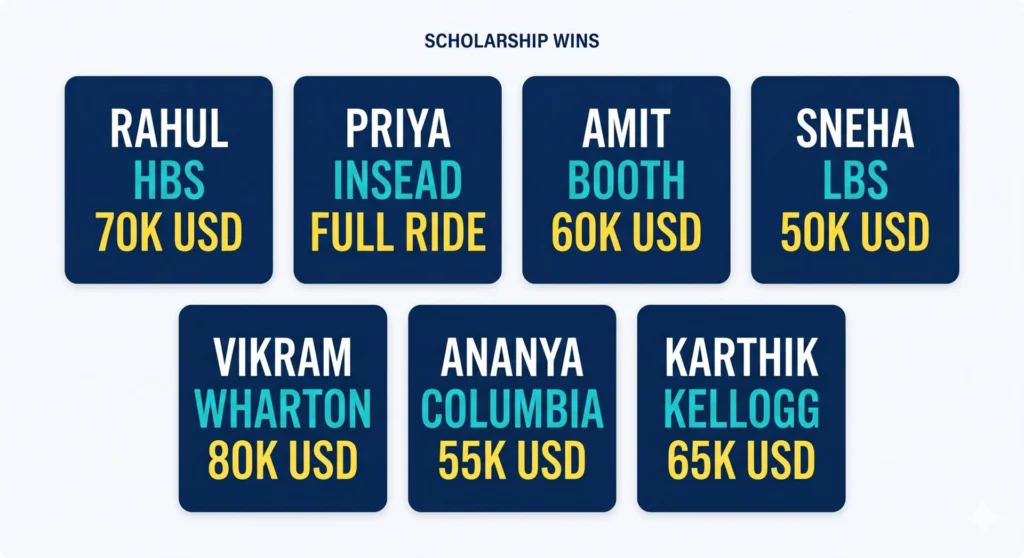
Aanchal’s 100% scholarship at Ross is proof. So is Mansi’s 90% scholarship at Carlson. These aren’t anomalies – they’re the result of strategic school selection and aggressive scholarship negotiation.
Here’s my contrarian take on this. Most applicants aim for the highest-ranked school they can get into and hope for scholarships. I flip this. I help clients identify schools where their profile is so strong that the school needs them more than they need the school. That’s when the money flows. A client who’s a “reach” applicant at Booth might be a “must-have” at Tepper or Emory – and that’s where the full-tuition offers come from.
The whole idea is this: a free MBA abroad isn’t about finding a school that gives everyone money. It’s about finding the school where YOU are the candidate they’ll pay to attract. That requires honest self-assessment, strategic school selection, and the willingness to target schools where your profile is at the top of their admitted class – not the bottom.
Here’s how I think about scholarship-optimized school selection at PythaGURUS. I use my cluster system – three tiers (A, B, C) each with an upper and lower segment – and I deliberately place 3-4 schools from the tier where my client’s profile sits in the top quartile of admitted students. Why? Because schools use scholarships as a negotiation tool. If they feel your profile is so strong that you might say no to them because you have competitive offers from peer or higher-ranked schools, they’ll sweeten the deal. They’re essentially asking: “Can this person say no to us? But can they say no to us PLUS $70,000?” That’s the psychology I design school lists around.
The checklist I use to predict scholarship potential comes down to four things: employability (do your essays show a clear, credible career path that makes the school look good in their employment report?), transferable skills (can the admissions committee see the seeds of your post-MBA career in your pre-MBA work?), leadership evidence beyond your job title, and the depth of your networking and research about each school. When all four are strong, scholarships follow. When even one is weak, the school might admit you but won’t pay to attract you. This is why our process starts with goals and employability before we even think about which schools to target.
Scholarships for MBA in USA: School-by-School Breakdown for Indians
The scholarships for mba in usa are the largest in absolute terms – and also the most strategic. Let me break down how scholarships for mba in usa actually work, because most Indian applicants don’t understand the mechanics.
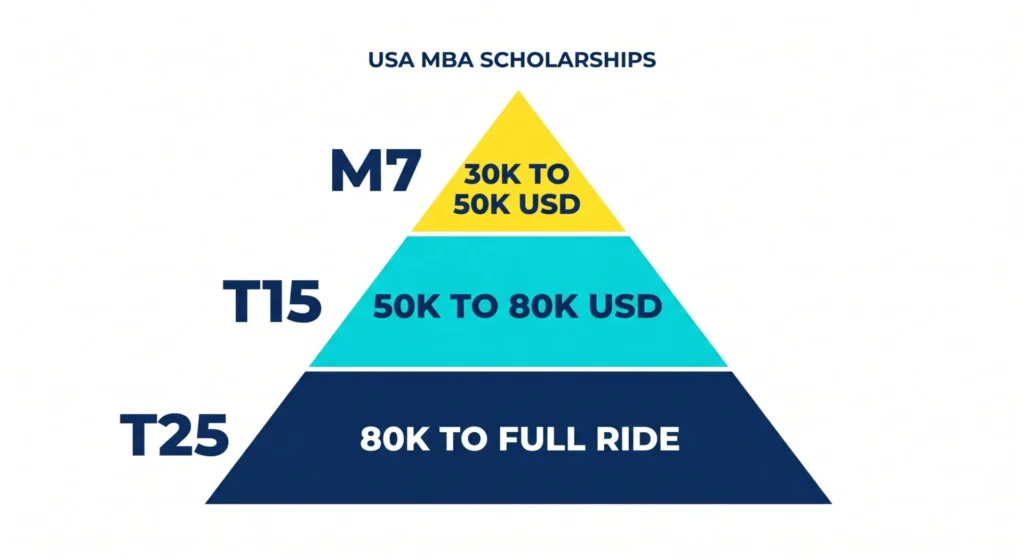
M7 schools (Harvard, Stanford, Wharton, Booth, Kellogg, Columbia, Sloan): Scholarship culture varies dramatically. Harvard and Stanford are primarily need-based – if you’re an Indian professional earning ₹25+ lakhs, you may qualify for less than you expect. Booth, Kellogg, and Wharton offer substantial merit scholarships – $20K to $80K is common for strong Indian profiles. Columbia is historically less generous with international scholarships.
T15 schools (Ross, Fuqua, Darden, Tuck, Yale SOM, Stern, Haas): This is the sweet spot for Indian scholarship seekers. These schools compete aggressively for top Indian talent using merit money. Ross gave Aanchal 100% ($160K). Darden gave Preejit ₹1.1 crores. Stern gave Jheel $50K. The key: apply Round 1, have competing admits, and negotiate.
T25 schools (Tepper, McCombs, Kenan-Flagler, Emory, Georgetown, Carlson): The most generous tier for Indians. These schools routinely offer $60K-$100K+ to attract strong Indian applicants who might otherwise go to higher-ranked programs. Lamia got $80K at McCombs. Anisha got $110K at Emory. Mansi got 90% at Carlson. If your goal is maximizing financial aid, this tier is gold.
School Tier | Typical Merit Range | Need-Based? | Best For Indians | Negotiation Power |
M7 | $20K-$80K | HBS/Stanford yes | Brand + career | Low-Moderate |
T15 | $40K-$160K | Limited | High value + merit | High |
T25 | $60K-$120K | Rare | Max scholarship | Very High |
I also want to add something here about timing, because it directly affects scholarships for mba in usa. Round 1 applicants consistently receive larger scholarship offers than Round 2 applicants at the same schools. Why? Because schools have a fixed scholarship budget for the year, and they want to lock in their strongest candidates early. By Round 2, a significant portion of the merit scholarship pool has already been allocated. By Round 3, it’s essentially gone. I’ve seen identical profiles – same GMAT, same industry, same career goals – receive $40K more in Round 1 than Round 2 at the same school. That’s not a coincidence. It’s budget mechanics.
And here’s a tactical point most applicants miss: if you’re admitted to two peer-ranked US schools with different scholarship offers, you can negotiate. Schools have specific budgets reserved for matching competitive offers. A professional, transparent email sharing your competing admit and its scholarship amount will get you a response 60-70% of the time. Sometimes it’s an additional $10-15K. Sometimes it’s $30K+. Either way, it’s the highest-ROI email you’ll ever send.
Scholarships for MBA in Europe and Merit Scholarships for MBA Abroad
The scholarships for mba in europe work differently from the US. European schools tend to offer fewer but larger merit scholarships for mba abroad, and the competition is structured differently. Let me walk you through the key differences in how merit scholarships for mba abroad work across European destinations.
INSEAD: Offers 40+ named scholarships ranging from EUR 10,000 to full tuition. The application process is separate from admission – you apply for specific scholarships after receiving your admit. Indian applicants have historically done well with the INSEAD Deepak Sharma and Judith Connelly scholarships.
London Business School: Merit scholarships of GBP 15,000-40,000 are common. The Forte Foundation scholarship is available for women. LBS also offers region-specific scholarships that Indian applicants can target
HEC Paris: Offers generous scholarships for their MBA program, with some full-tuition awards. The HEC Foundation manages several scholarship funds specifically for international students.
German programs: The scholarship story in Germany is different – tuition is already near-zero at many public universities, so the “scholarship” is effectively built into the program structure. ESMT Berlin and Mannheim do offer additional merit awards.
I also want to add something here about the Forte Foundation specifically, because it’s one of the most powerful scholarship sources for Indian women applicants. Forte partners with 50+ top business schools globally and offers fellowships worth $20,000-$100,000. Both Lamia (Georgetown Forte, $50K) and Mansi (Carlson Forte Fellowship) benefited from this. If you’re a woman applicant, Forte should be on your radar for every school that participates.
One more European option worth knowing about: IESE Business School in Barcelona offers substantial merit scholarships for international students, and Cambridge Judge in the UK has been increasingly generous with Indian applicants in recent admission rounds. The European scholarship world rewards applicants who demonstrate genuine international ambition and cross-cultural leadership – not just strong test scores. If your profile tells a compelling global story with clear cross-border career goals, European schools will pay serious attention – and pay up.
How to Get MBA Scholarship Abroad: The Strategy That Works

Here’s the honest truth about how to get mba scholarship abroad: it’s not about writing a scholarship essay. It’s about engineering your entire application – school list, timing, positioning, and negotiation – to maximize your financial outcome. Let me share how to get mba scholarship abroad using the approach we’ve refined over two decades.
Step 1: Build a scholarship-optimized school list. Apply to 8-10 schools across 2-3 tiers. Include 3-4 schools where your profile is in the top quartile of their admitted class. These are your scholarship schools – where you’ll get the biggest offers because the school wants you more than you need them. Also check which schools offer need based scholarships mba aid alongside merit – schools like HBS and Wharton offer both, which means you can stack them.
Step 2: Apply Round 1 to your scholarship targets. Round 1 has the most scholarship money available. By Round 2, many scholarship budgets are partially depleted. By Round 3, they’re nearly gone. If scholarships matter to you – and they should – Round 1 is not optional.
Step 3: Negotiate with competing admits. This is where most Indian applicants leave money on the table. When you have admits from peer-ranked schools, you can negotiate. “School A offered me $80K. Can you match or improve on this?” Schools expect this. They have budgets allocated specifically for negotiation. I’ve seen clients increase their initial offers by ₹15-30 lakhs through a single negotiation email.
Step 4: Consider need-based scholarships mba options. If your family’s financial situation qualifies, need based scholarships mba programs at schools like Harvard, Stanford, and Wharton can be substantial. The CSS Profile and institutional financial aid forms are worth completing even if you’re unsure about eligibility. The worst that happens is they say no. The best that happens is ₹20-50 lakhs in additional aid you wouldn’t have gotten otherwise.
Here’s the negotiation approach I’ve refined over two decades. First, never negotiate with just one admit. The entire strategy depends on having competing offers – which is why I recommend 8-10 applications across tiers. Once you have 2-3 admits with scholarship offers, the negotiation begins. I coach clients to send a specific, professional email that does three things: (1) expresses genuine enthusiasm for the school – this isn’t a bluff, and schools can smell insincerity; (2) transparently shares the competing offer amount and school name – schools expect this and have budgets specifically allocated for matching; and (3) asks a direct question: “Is there any additional financial support available that would help me choose [your school]?” Keep it one email. Keep it respectful. And send it within 2 weeks of receiving the initial offer.
The results are consistent. About 60-70% of the time, schools respond with an improved offer – sometimes ₹5-10 lakhs more, sometimes ₹20-30 lakhs more. The remaining 30-40% say their initial offer is final, and you move on. The worst that happens is they say no. The best that happens – and I’ve seen this dozens of times – is that a single email adds ₹15-30 lakhs to your scholarship. That’s the highest ROI email you’ll ever write in your life.
Frequently Asked Questions: MBA Scholarships Abroad
Q: What GMAT Focus score do I need for a full scholarship?
There’s no fixed score that guarantees a full scholarship, but a 705+ on the GMAT Focus Edition makes you competitive for substantial merit awards at T15-T25 schools. At M7 schools, even a 735 won’t guarantee a full ride – other profile factors (work experience, leadership, diversity) matter as much. Aanchal’s 100% scholarship at Ross wasn’t just about her test score – it was about how her entire profile was positioned.
Q: Can Indian IT professionals get significant MBA scholarships?
Absolutely – but it requires stronger differentiation because of the over-represented pool. Indian IT applicants need to show impact beyond technical delivery, genuine leadership, and clear post-MBA goals that go beyond “I want to switch to consulting.” When this is done well, scholarship outcomes for IT professionals are just as strong as for any other background.
Q: Should I apply to lower-ranked schools just for scholarships?
Only if the school genuinely delivers the career outcome you want. A full scholarship at a school ranked #50 that doesn’t recruit for your target role is a bad deal. A 50% scholarship at a school ranked #20 that places 30% of its class into consulting is a great deal. Always evaluate scholarship + career outcome together, never scholarship alone.
Q: When should I start planning my scholarship strategy?
12-18 months before your target application deadline. Scholarship strategy is school list strategy – and your school list should be finalized 6+ months before Round 1 deadlines. The research, networking, and profile-building that maximize scholarship outcomes take time. If you’re targeting need based scholarships mba programs specifically, the financial aid forms have their own separate deadlines that you need to track.
Build Your Scholarship Strategy
Finding fully funded mba scholarships for Indians abroad isn’t about luck. It’s about strategy – the right school list, the right timing, the right positioning, and the right negotiation approach. Every element has to work together.
If you want a scholarship-optimized school list built for your specific profile – one that maximizes both your admission probability and your financial outcome – that’s what our Comprehensive Profile Analysis delivers. An honest, data-backed plan from someone who has helped clients secure over ₹200 crores in MBA scholarships.