MBA in UK for Indian Students: The Complete Guide
The UK has become the second most popular MBA destination for Indian professionals – and after guiding hundreds of applicants into LBS, Oxford, Cambridge, Warwick, and Cranfield over 19 years, I can tell you exactly why. The one-year format means you’re back earning 12 months sooner. London puts you at the centre of global finance, consulting, and tech. And the 2-year Graduate Route visa has transformed what mba in uk for indian students actually means in practice – it’s no longer a fly-in, study, fly-home proposition.
But mba in uk for indian students isn’t a universal win. The schools, the costs, the career outcomes, and the visa realities vary enormously depending on which program you choose and what you’re optimizing for. I’ve seen applicants thrive and I’ve seen applicants struggle – and the difference almost always comes down to fit, not rankings. Let me give you the honest picture. For the full context on planning your MBA abroad, start with our comprehensive guide to studying MBA abroad
Best MBA Colleges in UK for Indian Students: The Honest Tier List
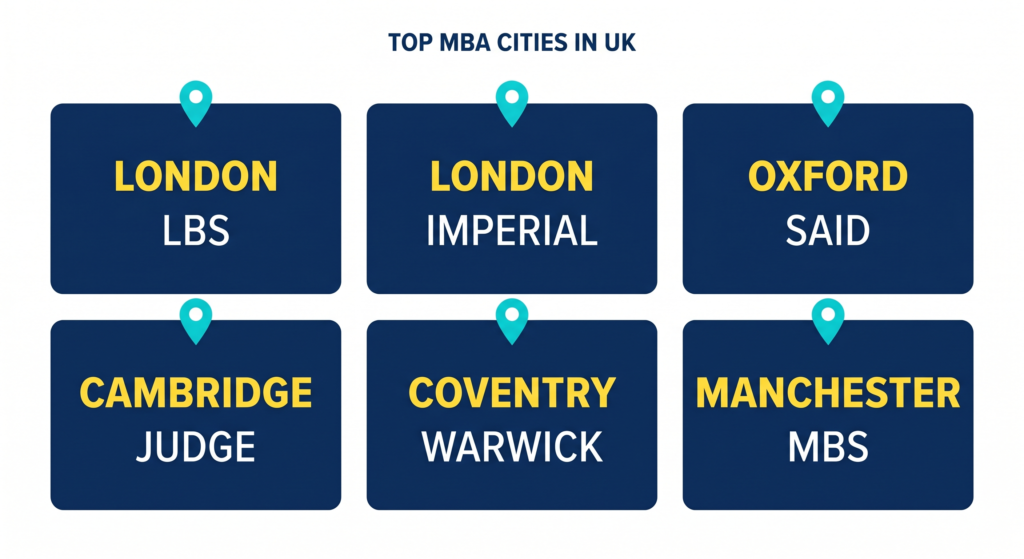
Every Indian applicant wants the best mba colleges in uk for indian students ranked clearly. So here’s my honest tier list of best mba colleges in uk for indian students – not based on generic rankings, but on what actually matters: career outcomes for Indians, scholarship availability, and global brand power.
School | Tuition (GBP) | Duration | Class Size | FT Rank | Strongest For |
LBS | 100,600 | 15-21 mo | ~500 | Top 5 | Consulting, finance, global leadership |
Oxford Said | 72,100 | 1 year | ~330 | Top 10 | Strategy, entrepreneurship, brand power |
Cambridge Judge | 67,000 | 1 year | ~200 | Top 15 | Tech, healthcare, social enterprise |
Imperial | 57,200 | 1 year | ~90 | Top 30 | Finance, analytics, London location |
Warwick | 47,800 | 1 year | ~80 | Top 35 | Consulting, general management |
Cranfield | 40,500 | 1 year | ~70 | Top 60 | Operations, supply chain, defence transition |
My honest take: LBS is the clear #1 for Indians targeting global careers. Oxford and Cambridge are #2 and #3 – nearly interchangeable in brand power, with Oxford slightly ahead for finance and Cambridge for tech. After that, there’s a meaningful drop in international recognition. Imperial, Warwick, and Cranfield are excellent for UK-specific careers but limited for global mobility. For the full global comparison, see our guide on best MBA colleges abroad for Indian students.
I also want to add that the best mba colleges in uk for indian students aren’t always the highest-ranked ones. I’ve seen Indian applicants with strong operations backgrounds thrive at Cranfield because its supply chain and operations focus matched their experience perfectly. And I’ve seen Indian applicants with finance backgrounds get better outcomes from Imperial than from higher-ranked schools that don’t have the same London City connections. Match the school to your career, not to a ranking table.
MBA in UK Fees: What Indian Students Actually Pay
The mba in uk fees conversation starts and ends with one fact: UK MBA programs are significantly cheaper than US programs, primarily because the one-year format means you pay one year of tuition instead of two. But mba in uk fees vary enormously across schools, and the gap between LBS and Cranfield is wider than many applicants realize.
The top tier (LBS): GBP 100,600 for the 15-21 month programme (approximately ₹1.05 crore). This is premium pricing, but LBS competes directly with M7 US schools in career outcomes. It’s the only UK school I’d put in that conversation.
The prestige tier (Oxford, Cambridge): GBP 67,000-72,100 for the 1-year MBA (₹70-75 lakhs). The Oxford and Cambridge brands are globally unmatched – these names open doors everywhere. And at ₹70-75 lakhs all-in (tuition + living), you’re paying roughly half of what a comparable US T15 MBA would cost.
The value tier (Imperial, Warwick, Cranfield, Manchester): GBP 40,000-57,000 range (₹42-60 lakhs). Strong UK placement, good value for money, but significantly less global brand recognition. These schools deliver excellent ROI if your career plan centres on the UK market.
I also want to add something here about the hidden costs that inflate the fees beyond the tuition number. London living costs run GBP 1,500-2,000 per month – that’s GBP 18,000-24,000 for a full year (₹19-25 lakhs). Visa fees (GBP 363), the Immigration Health Surcharge (GBP 1,035 per year), and travel add another ₹2-3 lakhs. Budget a total of ₹90-130 lakhs for an LBS or Oxford MBA, and ₹60-85 lakhs for Warwick or Cranfield. Outside London, living costs drop 20-30%, which is a real saving.
And here’s a practical tip about mba in uk fees that saves Indian applicants real money: the exchange rate timing. GBP-INR fluctuates significantly – a 5% swing on a GBP 70,000 tuition payment is ₹3.5 lakhs. I’ve seen families save ₹2-4 lakhs by converting rupees to pounds in phases over 3-4 months rather than making one large transfer. Also, most UK schools allow you to pay tuition in instalments – typically 2 or 3 payments spread across the academic year. This means you don’t need the full amount upfront. Ask the school’s finance office about instalment options before you start planning your funding. And if you’re taking an education loan, Indian banks like SBI, HDFC Credila, and Prodigy Finance all offer UK MBA-specific loan products with competitive rates.
MBA in UK Cost: Total Investment vs ROI Comparison
Looking at mba in uk cost in isolation is a mistake. The real question is: what’s the return on that cost? Let me lay out the mba in uk cost picture alongside the career outcomes, because that’s how smart financial decisions get made.
Total investment: ₹90-130 lakhs for top-3 UK schools (LBS, Oxford, Cambridge). ₹60-85 lakhs for tier-2 UK schools (Imperial, Warwick, Cranfield). Compare this to ₹1.5-2.5 crore for a US T15 MBA.
Starting salaries: LBS graduates average GBP 80,000-95,000 (₹84-100 lakhs). Oxford/Cambridge graduates average GBP 70,000-85,000 (₹73-89 lakhs). Imperial/Warwick/Cranfield graduates average GBP 55,000-70,000 (₹58-73 lakhs). These are lower than US MBA starting salaries ($150,000+ or ₹1.25 crore+), but the cost of the programme is also substantially lower.
Payback period: For an Oxford MBA costing ₹95 lakhs with a starting salary of GBP 80,000 (₹84 lakhs), the payback period is roughly 2-3 years – accounting for pre-MBA salary foregone. For a US MBA costing ₹2 crore with a starting salary of $165,000 (₹1.38 crore), the payback is 3-5 years. The UK often wins on speed of payback even though the absolute salary is lower.
Here’s my contrarian take on mba in uk cost: the UK’s one-year format creates a hidden financial advantage that most cost comparison articles miss entirely. You’re not just saving one year of tuition – you’re eliminating one year of opportunity cost. An Indian professional earning ₹25-30 lakhs who does a 1-year UK MBA gives up 1 year of income. The same professional doing a 2-year US MBA gives up 2 years. That’s an additional ₹25-30 lakhs in lost earnings on top of the higher tuition. When you factor this in, the total financial difference between Oxford and a US T15 school can exceed ₹1 crore.
One more thing on the cost front that Indian families often miss: the tax advantage. UK income tax rates for new graduates (20% on the first GBP 37,700 above the personal allowance) are lower than the combined US federal + state tax in high-tax states like New York or California. This means your GBP 80,000 take-home in London can be surprisingly close to what a $150,000 salary delivers in Manhattan after taxes. The cost comparison changes when you factor in net disposable income, not just gross salary.
For how to fund your UK MBA, see our detailed guide on MBA scholarships abroad for Indian students.
One Year MBA in UK: Why the Format Works for Indian Professionals
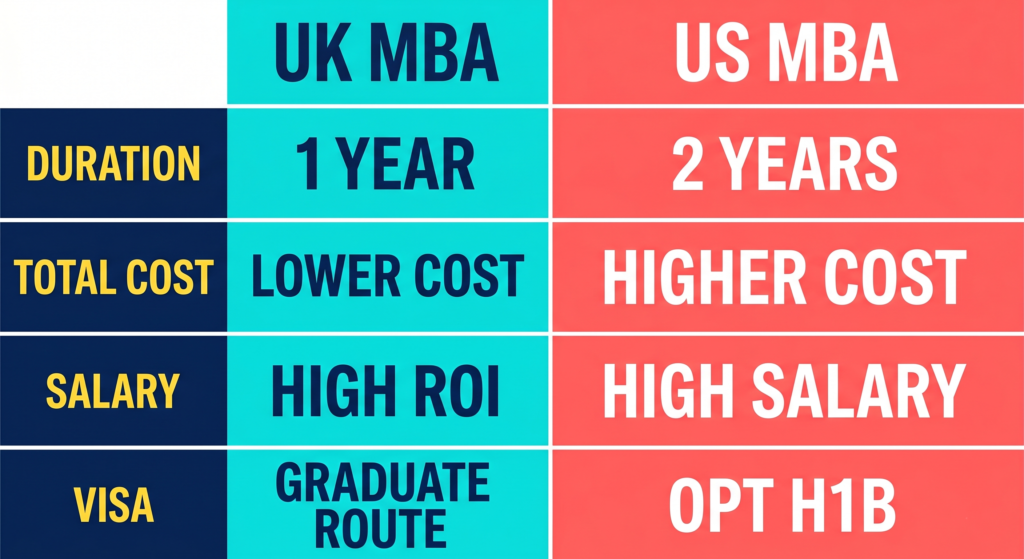
The one year mba in uk is the single biggest structural advantage of UK business education for Indian applicants. Every major UK programme except LBS runs for exactly 12 months. Here’s why the one year mba in uk format is particularly powerful for Indians – and where it has a genuine trade-off.
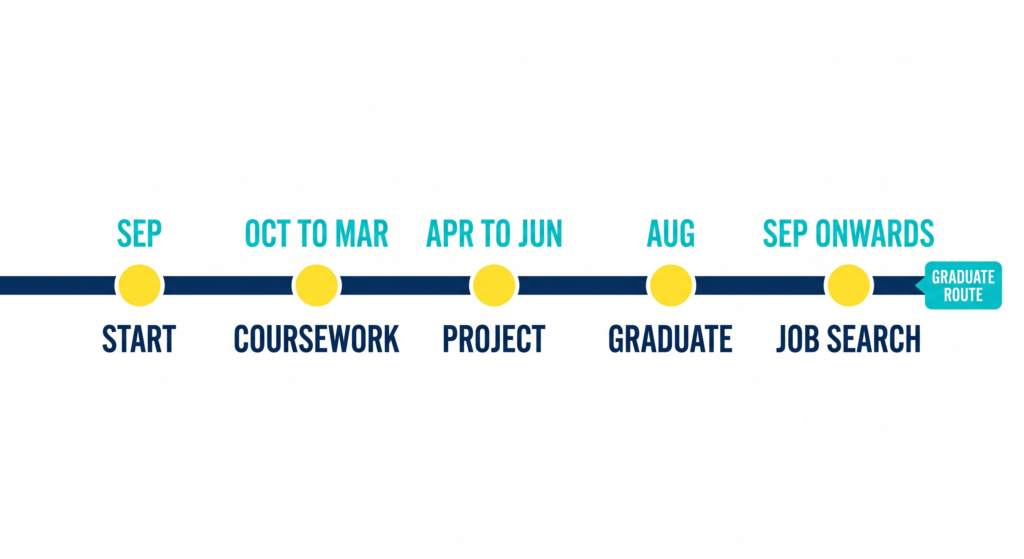
Speed to market: You start in September, finish by August, and can begin your Graduate Route visa job search immediately. Indian applicants who land a London job are earning GBP 70,000+ within 15 months of starting the programme. Their US counterparts are still in second-year classes.
Lower total cost: One year of tuition, one year of living costs, one year of opportunity cost foregone. The math is simple but the financial impact is massive. A 1-year Oxford MBA costs roughly half the total investment of a 2-year Kellogg or Fuqua MBA.
The trade-off – no summer internship: This is the one genuine disadvantage of the one year mba in uk format. US programmes include a summer internship between years 1 and 2 – your primary conversion pipeline into consulting and banking. UK MBAs don’t have this. If you’re switching careers from IT to MBB consulting, the US summer internship model gives you an audition that the UK format simply cannot replicate. For career continuers and accelerators, the UK format is ideal. For radical career switchers, weigh this carefully.
Fahd’s story illustrates this perfectly. He came from a leadership role in the Chairman’s Office of a global firm, targeting innovation and strategy in the packaged food and beverage sector. He earned admits to both LBS (15-21 months) and Darden (2 years, US). He chose LBS. Why? Because LBS’s global networks and its focus on cultural fluency aligned directly with his goal of navigating multinational F&B organizations. His networking with LBS alumni confirmed that the school’s approach to global leadership was exactly what he needed. The one-year-plus format at LBS gave him the best of both worlds – speed and depth. Sometimes the UK format isn’t just cheaper. It’s strategically better.
I also want to flag that the one-year UK format doesn’t mean less learning – it means more intensive learning. UK programmes compress the same core curriculum into 12 months through longer terms, fewer breaks, and integrated project work. The pace is demanding. But for Indian professionals who are used to intense work environments – and let’s be honest, most Indians working 50-60 hour weeks at TCS, McKinsey, or Goldman in Mumbai already have that muscle – the intensity is a feature, not a bug.
MBA in UK Eligibility: What Indian Applicants Need
The mba in uk eligibility requirements are broadly consistent across programmes, but each school has important nuances. Here’s the complete mba in uk eligibility picture for Indian applicants.
Academic requirements: A recognised bachelor’s degree – BTech, BBA, BCom, BA, BSc all qualify. UK schools don’t set hard minimum GPAs, but competitive Indian applicants typically have 60%+ (first class or strong upper second). Oxford and Cambridge favour candidates from well-known Indian universities – IITs, NITs, SRCC, St. Stephen’s – though they’ll consider strong profiles from any accredited institution.
Work experience: LBS requires 5+ years for the full-time MBA (class average is 6 years). The LBS Sloan programme requires 12+ years for senior executives. Oxford and Cambridge typically want 3-5 years. Warwick, Cranfield, and Imperial accept applicants with 2-3 years minimum. The pattern is clear: more experience generally means access to more selective programmes.
Test scores: GMAT or GRE is required by all top UK programmes. A GMAT Focus score of 685+ is competitive for LBS and Oxford. Cambridge typically wants 680+. Warwick and Imperial are competitive at 655+. The GMAT is a threshold, not a differentiator – once you’re above the competitive range, your essays, work experience, and narrative matter far more.
English proficiency: IELTS 7.0+ overall (minimum 6.5 in each component) is standard for most UK MBA programmes. TOEFL (100+) and Cambridge English certificates (CAE/CPE) are accepted as alternatives. Some schools waive the English test if your bachelor’s degree was taught in English – you’ll need a letter from your university confirming this.
Here’s what I’ve observed about how UK and US admissions work differently for Indian applicants. US schools – Wharton, Booth, Kellogg – run a holistic review that weighs your GMAT, GPA, work experience, essays, recommendations, and extracurriculars as a balanced portfolio. The GMAT often serves as the initial filter before the rest gets evaluated. UK schools – especially LBS, Oxford, and Cambridge – put much more weight on the interview and on the maturity of your career narrative. I’ve seen Indian applicants with lower GMAT scores (650-670 range) get into Oxford and Cambridge because their interview performance demonstrated genuine strategic thinking, while similar profiles got dinged at US T15 schools where the score was a harder threshold.
The other big difference: UK admissions committees tend to value international perspective more explicitly than US schools. LBS’s class is 90%+ international. Oxford’s class draws from 50+ nationalities. They’re actively looking for applicants who’ve worked across cultures, managed cross-border teams, or demonstrated genuine global ambition – not just “I want to work internationally someday.” For Indian applicants, this means your essay and interview strategy for UK schools should emphasize any international exposure you have – even if it’s just managing a US-based client while sitting in Bangalore. That counts. US schools value this too, but in the UK it’s closer to a requirement than a bonus.
One thing about mba in uk eligibility that Indian applicants consistently underestimate: the interview. UK schools, particularly Oxford and Cambridge, conduct rigorous admissions interviews that test your thinking in real-time. At Oxford Said, the interview includes a case-style component where you’re given business scenarios and asked to reason through them on the spot. At LBS, the interview often explores the depth of your career goals and school research. Indian applicants who prepare only for US-style behavioural interviews (“Tell me about a time when…”) get caught off guard by UK formats. Prepare specifically for the school’s interview style – not a generic MBA interview.
Scholarships for MBA in UK: What's Realistically Available
Getting scholarships for mba in uk is possible, but the scholarship culture in Britain is very different from the US. Let me set realistic expectations for Indian applicants.
LBS: The most generous UK school for merit-based aid. Merit scholarships range from GBP 15,000-40,000+. The Forte Foundation scholarship is available for women. LBS also offers region-specific and industry-specific awards. This is where Indian applicants have the best shot at significant financial aid.
Oxford Said: Offers the Skoll Scholarship (for social entrepreneurs – covers full tuition), the Said Business School Scholarship (partial tuition), and several university-wide awards including the Rhodes Scholarship. Oxford’s scholarship system is competitive but the amounts can be substantial.
Cambridge Judge: Offers Bursary awards, Cambridge Trust scholarships, and the Gates Cambridge (full funding – tuition, living, travel). Gates Cambridge is extremely competitive but covers everything. Other awards range from GBP 10,000-30,000.
External scholarships: Chevening (UK government – full funding for 1 year), Commonwealth Scholarships, and the Inlaks Shivdasani Foundation all fund Indian students at UK universities. Chevening is particularly strong for mid-career professionals with a plan to return to India and contribute to bilateral UK-India relations.
My contrarian take on scholarships for mba in uk: don’t choose between the UK and US based on scholarships alone. US T15-T25 schools offer larger merit scholarships than most UK schools because US schools use scholarship money more aggressively to compete for applicants. But the UK’s lower total cost means you might not need as much scholarship money to make the numbers work. Run the full math: total cost minus scholarship, then compare net ROI across 5 and 10 years. For the full scholarship strategy, see our comprehensive guide on MBA scholarships abroad for Indian students
And here’s a tactical point about scholarships for mba in uk that most applicants miss: timing. UK MBA programmes have separate scholarship application deadlines that often fall 2-4 weeks after your admission decision. Don’t wait until you’re admitted to start thinking about scholarships – research eligible awards before you apply, and prepare your scholarship essays alongside your admission essays. Some scholarships (like Chevening) have completely separate application processes that open months before the MBA admission cycle. Missing these critical deadlines is the most common way Indian applicants consistently leave significant money on the table in the UK system.
MBA in UK After Work Experience: Who Should Consider It
The question of mba in uk after work experience comes up constantly because the experience requirements vary so much across UK programmes. Here’s how I think about mba in uk after work experience for different Indian profile types.
2-3 years of experience: Target Warwick, Cranfield, Imperial, or Manchester. These schools accept younger applicants and the one-year format means you’re not losing much career momentum. Good fit for Indian engineers or analysts who want to accelerate into management roles without the 2-year US commitment.
4-6 years of experience: The sweet spot for Oxford and Cambridge. You have enough professional context to contribute to the classroom, and the one-year format gets you back into the market at a critical career inflection point – when you’re transitioning from individual contributor to manager or from specialist to generalist.
6-10 years of experience: LBS full-time MBA or the LBS Sloan Fellows programme (for 12+ years). At this level, you’re competing with a very experienced cohort and the expectations for leadership evidence are high. Indian applicants in this bracket often come from senior positions at companies like Tata, Reliance, Mahindra, Infosys, or the Indian Armed Forces.
When Mrinal, a senior professional from the Indian Armed Forces, came to us, he wasn’t sure which UK programs would value his operations and leadership background. His initial goals ranged from defence industries to logistics to consulting – too scattered for a compelling application. We worked through our General Management Goals Mastery module and used the 5 Company Rule to sharpen his narrative. Instead of vague aspirations, he focused on senior management roles at companies like Amazon and Samsung, where his experience leading 90-person teams and implementing operational systems that improved efficiency by 30% would translate directly. He secured admission to both the LBS Sloan Programme and Cranfield MBA. The Cranfield interview director told him his responses were “extremely impressive” – that’s what happens when preparation meets clarity.
Mrinal’s story is a powerful example of this last bracket. As a senior professional from the Indian Armed Forces with years of experience managing 90-person teams and leading complex operational projects, he had the substance but needed the narrative. When he first came to us, his goals were scattered across defence, logistics, procurement, and consulting. We sharpened his focus using the 5 Company Rule – targeting specific companies like Amazon and Samsung where his operations leadership would translate directly into senior management roles. His resume needed transformation too: “Led the development of an operational software platform” became “Led the design and deployment of a large-scale operational system, improving efficiency by 30% across multiple units, managing a team of 90 professionals.” That reframing – from military language to business impact language – was the difference. He secured admission to LBS Sloan and Cranfield.
The whole idea is this: the UK MBA is not one-size-fits-all. The right programme depends entirely on where you are in your career. Pick the school that matches your experience level, and the one-year format becomes a strategic advantage rather than a limitation. And that clarity about fit is exactly what admissions committees want to see in your application – applicants who’ve chosen their programme for the right reasons, not just the right ranking.
Best Universities for MBA in UK: Career Outcomes for Indian Graduates
What ultimately matters about the best universities for mba in uk isn’t the ranking – it’s what happens to Indian graduates after they finish. The career outcomes from best universities for mba in uk vary significantly by school and by the career path you’re targeting.
Consulting: LBS dominates. McKinsey, BCG, Bain, and the Big 4 all recruit heavily from LBS. Oxford and Cambridge also place well into consulting, but LBS has the deepest relationships. Indian graduates at LBS who target consulting have strong conversion rates – London offices of MBB actively want diverse international talent.
Finance: London is one of the world’s two financial capitals. LBS, Oxford, and Imperial all place well into investment banking, private equity, and asset management. If finance is your post-MBA goal, a UK MBA gives you direct access to London’s financial district.
Tech and product management: Growing rapidly in London. Google, Amazon, Meta, Microsoft, and a thriving startup scene all recruit from UK MBA programmes. Cambridge Judge has particularly strong tech placement thanks to its proximity to the Cambridge tech cluster. This is the fastest-growing sector for Indian MBA graduates in the UK.
The Graduate Route visa: This is the most important post-MBA factor for Indians. After completing your MBA, you get a 2-year unrestricted work visa – no employer sponsorship needed. You can work for any company, in any role, for 2 full years. After that, you’ll need a Skilled Worker visa (employer-sponsored). This 2-year window has made UK MBA programmes dramatically more attractive for Indians compared to even 5 years ago. For how the UK compares to other countries on work visas and immigration, see our detailed best countries for MBA for Indian students guide.
I also want to be direct about something: the UK job market is smaller than the US. London has fewer MBA-recruiting employers than New York + Chicago + San Francisco combined. This means the competition for each role is fiercer, and your networking needs to be sharper. Indian applicants who treat the UK job search the same way they’d approach a US job search – waiting for on-campus recruiting to deliver offers – often struggle. The best universities for mba in uk prepare you for this reality. At LBS, Oxford, and Cambridge, the career services teams actively coach international students on UK-specific networking, recruiter expectations, and interview styles. Use those resources aggressively. The 2-year Graduate Route visa gives you time, but time without proactive effort won’t deliver a job.
Frequently Asked Questions: MBA in UK
Q: Is an MBA from the UK worth it for Indians?
For the right profile and goals, absolutely. If you want London-based careers in consulting, finance, or tech, a UK MBA from LBS, Oxford, or Cambridge provides direct access that no US school can match. The ROI is strongest when you plan to work in the UK for at least 3-5 years post-MBA.
Q: Can I stay and work in the UK after my MBA?
Yes. The Graduate Route visa gives you 2 years of unrestricted work rights. After that, you’ll need employer sponsorship for a Skilled Worker visa. Most top MBA employers in London are willing to sponsor, but start your job search early during the programme.
Q: LBS vs Oxford vs Cambridge – which is best for Indians?
LBS for consulting and finance (deepest recruiting). Oxford for brand power and strategic roles. Cambridge for tech and entrepreneurship. If you have 5+ years of experience, LBS. If you have 3-4 years, Oxford or Cambridge.
Q: Do I need IELTS for UK MBA?
Most UK schools require IELTS 7.0+ or equivalent (TOEFL 100+). Some waive it if your bachelor’s was in English. My advice: take the test anyway. A strong IELTS score (7.5+) strengthens your application and demonstrates the communication skills UK employers expect.
Ready to Target a UK MBA?
The mba in uk for indian students decision involves school selection, cost planning, visa strategy, and career goal alignment – all working together. Getting any one wrong can cost you admission, money, or career outcomes.
If you want a profile-specific recommendation on which UK schools fit your experience, goals, and budget – and whether the UK is truly the right choice for you – that’s what our Comprehensive Profile Analysis delivers. Honest, direct advice from someone who has guided 2,700+ applicants through exactly this decision.