

Study MBA Abroad: The Definitive Guide for Indian Applicants
In 19 years of guiding applicants to study MBA abroad, I’ve watched over 1500+ Indian professionals walk through our doors at PythaGURUS – engineers from TCS and Infosys, consultants from Deloitte and McKinsey India, bankers from ICICI and HDFC, entrepreneurs from Bengaluru and Hyderabad. And the single biggest mistake I see, year after year, is this: people treat an international MBA like a shopping decision. They compare rankings, google tuition fees, ask friends which school is “good,” and then submit applications that read exactly like 5,000 other Indian applicants.
That approach gets you rejected.
An MBA abroad is not a product you buy. It’s a strategic positioning exercise that, when done right, can transform your career trajectory, your earning power, and your professional identity in ways that no domestic degree can match. When done wrong – when you pick the wrong school, write generic essays, and don’t understand how admissions committees actually evaluate Indian applicants – you’ve spent ₹20-30 lakhs on application fees, test prep, and consulting, and you have nothing to show for it.
I’m going to give you the complete, unfiltered playbook. Not the sanitized version you’ll find on study-abroad portals that are trying to sell you a university partnership. The real strategy – from someone who has a Darden MBA, has spent two decades inside the admissions machinery, and has personally guided more Indian applicants into top global MBA programs than almost anyone in this industry.
Let’s get into it.
Why MBA Abroad for Indian Students Is a Strategic Career Move
MBA abroad for Indian students isn’t about prestige. It’s not about a foreign stamp on your resume. And it’s definitely not about “global exposure” – that phrase means nothing unless you can define exactly what it changes about your career.
Here’s what an international MBA actually does for Indian professionals, and I’m being very specific because vague promises don’t help anyone make a ₹1 crore decision.
It breaks you out of the Indian applicant ceiling. If you’re a software engineer at Wipro with 5 years of experience, your career trajectory in India is predictable. Project lead, delivery manager, maybe an AVP title by year 10. Your salary might hit ₹35-40 lakhs. An MBA abroad for Indian students – from the right school, with the right positioning – puts you into consulting at McKinsey, product management at Google, or strategy at Amazon, with a starting salary of $150,000-$180,000 (₹1.25-1.5 crore). That’s not incremental growth. That’s a career category shift.
It gives you access to recruiters who will never visit your campus in India. Goldman Sachs, Bain, BCG, Apple, Meta – these companies recruit aggressively at top US and European business schools. They don’t recruit at Indian engineering colleges. The MBA isn’t just education. It’s an access pass to an entirely different job market.
It forces a transformation in how you think and communicate. I’ve seen this with hundreds of PythaGURUS clients. Indian professionals are technically excellent but often struggle with the soft skills that global companies demand – stakeholder management, executive communication, cross-cultural leadership. Two years in a top MBA program rewires how you operate in professional settings.
I also want to add something here that most consultants won’t tell you. Not every Indian applicant should do an MBA abroad. If you’re in a niche technical role that you love, earning well, and have no desire to switch functions or geographies – an MBA is a terrible investment. I’ve talked applicants out of applying when the numbers didn’t make sense for their situation.
But if you’re stuck in a career rut, if you want to switch industries, if you want access to global opportunities that your current trajectory will never provide – then studying MBA abroad is the single highest-ROI decision you’ll make.
I’ll share a number that puts this into perspective. Over two decades, PythaGURUS clients have collectively secured over ₹200 crores in MBA scholarships across tier-one global business schools. That’s not a marketing number – that’s real money that changed real careers. When I look at the pattern across 2,700+ applicants we’ve guided, the transformation is consistent: Indian professionals who were earning ₹15-40 lakhs before their MBA are now in roles paying $150,000-$250,000 within 2-3 years of graduating. Engineers from TCS, Wipro, and Infosys who were stuck in delivery roles are now product managers at Google, consultants at McKinsey, and strategy leaders at Amazon. That career shift doesn’t happen by accident. It happens because the MBA abroad – done strategically – puts you in front of recruiters and opportunities that simply don’t exist in the Indian market.
Best Country for MBA Abroad: A Data-Driven Breakdown

United States
The US remains the gold standard for MBA abroad, and it’s not close. Here’s why: The sheer depth of recruiting at US business schools is unmatched. At a school like Wharton or Booth, you’ll have 300+ companies actively recruiting on campus. Consulting firms, tech companies, private equity shops, hedge funds, startups – the variety is staggering. No other country offers this breadth of post-MBA opportunity. The downside? The best country for MBA abroad depends on your career goal, and the US is expensive. Tuition at M7 schools runs $80,000-$90,000 per year. Total cost of attendance for a two-year program: ₹1.2-1.5 crore. And the H-1B visa lottery adds uncertainty to your post-MBA work plans.United Kingdom
One-year programs at London Business School, Oxford Said, and Cambridge Judge are attractive if you want to minimize time away from the workforce. The UK’s Graduate Route visa now gives you 2 years of post-study work authorization. But the recruiting market is smaller than the US, particularly for consulting and tech. If you want McKinsey London or BCG London, it’s doable from LBS – but the number of seats is far fewer than what’s available through US schools.Continental Europe
INSEAD (France/Singapore) is the standout – a one-year program with arguably the most international class in the world. If your goal is global general management or you want to work in Europe or Asia, INSEAD is hard to beat. German public universities charge minimal tuition, and programs like Mannheim and ESMT Berlin have solid reputations. The tradeoff: recruiting networks are smaller and often Germany-focused.Canada, Australia, and Singapore
These are strong options for specific profiles. Canada offers excellent immigration pathways. Australia provides access to Asia-Pacific markets. Singapore (NUS, INSEAD Asia campus) is a hub for finance and tech in Southeast Asia. But I’ll be direct: if you’re targeting the absolute top tier of post-MBA careers – MBB consulting, Big Tech product management, investment banking at bulge brackets – the US and INSEAD give you the highest probability of landing those roles. Country Comparison Table for Indian MBA Applicants| Factor | USA | UK | Europe | Canada | Singapore |
| Duration | 2 years | 1 year | 1-2 years | 1-2 years | 1-1.5 years |
| Total Cost (₹) | 1.2-1.5 Cr | 60L-1 Cr | 40L-1 Cr | 50L-80L | 50L-90L |
| Post-Study Visa | OPT (3yr STEM) | 2yr Grad Route | Varies | PGWP (3yr) | Emp. Pass |
| Consulting | ★★★★★ | ★★★★ | ★★★★ | ★★★ | ★★★ |
| Tech | ★★★★★ | ★★★ | ★★★ | ★★★ | ★★★★ |
| Immigration | H-1B lottery | Skilled Worker | EU Blue Card | PR-friendly | Competitive |
| Indian Alumni | Very strong | Strong | Moderate | Growing | Strong |
MBA Abroad Cost: The Real Numbers Nobody Talks About
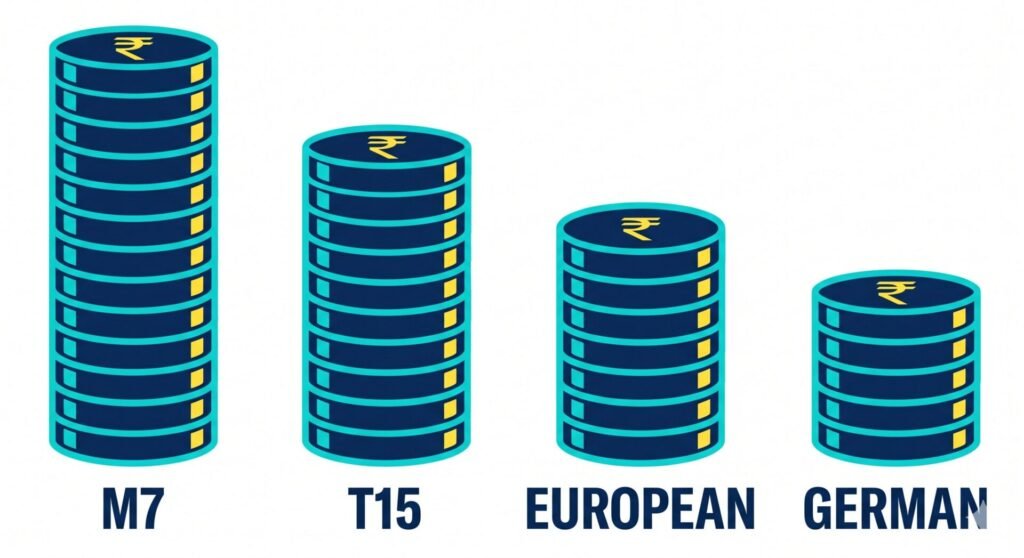
Let me give you the real MBA abroad cost picture, not the sanitized version on university websites.
When people ask me “how much does an MBA abroad cost?”, they’re usually thinking about tuition. Tuition is maybe 60% of the actual cost. Here’s the full breakdown:
Tuition ranges from ₹15 lakhs (German public universities) to ₹90 lakhs (Harvard, Stanford, Wharton per year). For a two-year M7 program, you’re looking at ₹1.4-1.6 crore in tuition alone.
Living expenses add ₹15-30 lakhs per year depending on the city. Living in New York or San Francisco while attending Columbia or Berkeley? Budget ₹25-30 lakhs per year minimum. Living in Fontainebleau for INSEAD? Closer to ₹15-18 lakhs for the full 10-month program.
Opportunity cost is the number nobody calculates but should. If you’re earning ₹25 lakhs per year in India, a two-year MBA means ₹50 lakhs in lost income. For a one-year program, it’s ₹25 lakhs. This is real money.
Application costs are another surprise. GMAT Focus Edition prep: ₹30,000-2 lakhs. GMAT exam fee: ₹25,000. Application fees: ₹15,000-25,000 per school. If you apply to 6-8 schools, you’re spending ₹2-3 lakhs before you’ve even been admitted.
Full Cost Comparison by Program Tier
Component | M7 (US, 2yr) | T15 (US, 2yr) | LBS/INSEAD | German Public |
Tuition | ₹1.4-1.6 Cr | ₹1-1.3 Cr | ₹55-75L | ₹5-15L |
Living | ₹40-60L | ₹35-50L | ₹15-25L | ₹10-15L |
Opp. Cost | ₹50L | ₹50L | ₹25L | ₹25L |
TOTAL | ₹2.3-2.7 Cr | ₹1.85-2.3 Cr | ₹95L-1.25 Cr | ₹40-55L |
Here’s the part most people miss about MBA abroad cost. The sticker price is not what you pay. Scholarships can reduce your out-of-pocket by 30-100%. I’ve had PythaGURUS clients receive scholarships worth ₹40-80 lakhs at T15 and T25 programs. One client – a Cognizant engineer with a 655 GMAT Focus score – secured a full-tuition scholarship at a T25 school worth ₹75 lakhs.
See all our scholarship stories here: PythaGURUS Scholarship Stories
The real question isn’t “can I afford an MBA abroad?” It’s “what’s my expected net cost after scholarships, and what’s my expected salary increase?” When you run those numbers, most top MBA programs deliver a 3-5 year payback period – even for Indian applicants paying international tuition.
At PythaGURUS, I use what I call the Equation of Employability to help applicants think about MBA ROI properly. It goes like this: Past + MBA = Short-Term Goals (5-7 years) + Long-Term Goals (7-15 years). Most people calculate ROI as tuition minus salary. That’s a spreadsheet exercise, not a strategic one. The real ROI question is: does this MBA move you from where you are to where you need to be in your career?
And can you demonstrate to the school – through your past experience, your specific goals, and the gaps the MBA fills – that you’re someone they can “sell” to employers? Because here’s the first secret I share with every applicant: schools will not buy you unless they know how to sell you. When I work with a client on their school list, I’m not just looking at rankings. I’m looking at which programs have the strongest recruiting pipelines for their specific post-MBA goals, which ones have historically admitted and placed people with similar profiles, and where the scholarship negotiating power is highest. That’s how one of our clients – a Cognizant engineer – ended up at a T25 school with full tuition covered. We picked the school where her profile was the strongest fit, not the one with the highest ranking.
MBA Abroad Eligibility: What Top Schools Actually Require
MBA abroad eligibility is simultaneously simpler and more complex than most applicants think. Simpler because the hard requirements are straightforward. More complex because meeting the minimum requirements gets you exactly nothing – it just means your application won’t be auto-rejected.
Let me break this into what’s actually required vs. what actually matters.
The Hard Requirements (Table Stakes)
Bachelor’s degree: Any discipline. Engineering, commerce, arts – it doesn’t matter. Indian degrees from recognized universities are accepted everywhere. Your percentage or CGPA matters far less than you think. I’ve had clients with 60% in engineering get into T15 schools. I’ve also seen 9.5 CGPA applicants from IITs get rejected from M7 programs. MBA abroad eligibility is never about your undergrad GPA alone.
GMAT or GRE score: The GMAT Focus Edition (scored on a 205-805 scale) has replaced the old GMAT format. Most top programs expect 655+ on the GMAT Focus or 325+ on the GRE. But here’s what nobody tells you – for Indian male applicants from IT backgrounds, you need 705+ just to be competitive at M7 schools. The “average GMAT” published by schools includes applicants from underrepresented backgrounds who can get in with lower scores. As an Indian applicant from an over-represented pool, you need to be above the class average, not at it.
English proficiency: TOEFL (100+) or IELTS (7.0+). If you’ve studied in English-medium schools in India and work in an English-speaking corporate environment, this is rarely a hurdle. Some schools waive this requirement for applicants who’ve worked in English-speaking environments for 2+ years.
Work experience: Most full-time MBA programs expect 3-5 years. Less than 2 years makes you a risky admit at most schools. More than 8 years and you should consider Executive MBA programs instead.
What Actually Differentiates Admitted Applicants
This is where most eligibility guides stop. But the hard requirements above are just the entry ticket. What actually determines whether you get admitted is a completely different set of factors:
Career progression trajectory. Admissions committees want to see that you’ve been promoted, given increasing responsibility, and recognized by your organization. A flat career trajectory – 5 years at TCS doing the same type of work with no promotion – is a red flag, regardless of your GMAT Focus score.
Clarity of post-MBA goals. “I want to do consulting” is not a goal. “I want to transition from IT project delivery into management consulting focused on digital transformation in the healthcare sector, and I’ve validated this through 15 networking conversations with consultants at BCG and McKinsey” – that’s a goal.
Differentiated personal story. With 500+ Indian IT engineers applying to every T15 school, your story needs to stand out. What makes YOU different from the other Indian engineer with a similar GMAT Focus score and similar work experience? This is the question most applicants cannot answer, and it’s the question that determines admission.
This is where I want to share how we actually assess profiles at PythaGURUS, because it’s fundamentally different from what most consultants do. Most consultants look at your GMAT and your company name and slot you into a tier. I look at employability. The question I’m asking is: will this school look at you as a liability or as a very strong asset? And I assess that across multiple dimensions – your career progression trajectory, the transferable skills you’ve built, the depth and specificity of your post-MBA goals, your leadership evidence both inside and outside work, and critically, whether your profile creates a story that a school can “buy” and then “sell” to recruiters.
I also use a proprietary School Cluster System – instead of following linear rankings that change every year without anything intrinsically changing inside the program, I’ve created 3 clusters: A, B, and C. Each cluster has an upper segment and a lower segment. Upper Cluster A includes M7 programs and schools like LBS and INSEAD. Lower Cluster A covers the remaining top 13-14 US schools plus HEC Paris, ISB, and IIM Ahmedabad. Based on your profile, I suggest applying to 2-3 adjacent clusters. I don’t believe in the dream-reach-safe model most consultants use. If a school has not accepted anyone with your background in the last decade, that’s not a dream school – that’s a waste of your time and money. But if a school has accepted people like you in the past and you’re scared of applying – take the shot. The worst that happens is a rejection, and you can’t reject them by not even applying.
How to Apply for MBA Abroad: The Strategic Roadmap

Most guides on how to apply for MBA abroad give you a checklist. Take the GMAT Focus Edition. Write essays. Get recommendations. Submit.
That’s like saying the way to win a chess match is to move pieces. Technically accurate. Strategically useless.
Here’s the actual strategic roadmap, based on what I’ve learned from guiding 2,700+ applicants through this process.
18-24 Months Before Application: Foundation Phase
Take the GMAT Focus Edition or GRE. Get this done early so you know your score before you start shortlisting schools. I recommend starting GMAT prep 4-6 months before your target test date. The Focus Edition is a 2-hour-15-minute exam with three sections: Quantitative Reasoning, Verbal Reasoning, and Data Insights. If you’re an Indian engineer with strong quant skills, your challenge will be Verbal and Data Insights – invest disproportionately there. If your score isn’t where it needs to be, you have time to retake (there are no lifetime limits on retakes with the Focus Edition).
Start networking – not “for the application,” but for real career clarity. Reach out to MBA alumni working in your target post-MBA role. Conduct 15-20 informational interviews. The insights you gather will directly feed into your career goals essay and will make your application 10x more compelling than someone who googled “why consulting” and wrote a generic answer.
12-18 Months Before: Strategy Phase
Build your school list. This is not about picking “the best school.” It’s about building a portfolio – 2 reach schools, 3-4 target schools, 1-2 safety schools. For Indian applicants, school selection is particularly critical because different schools have different appetites for Indian profiles. Some schools admit 80+ Indians per class; others admit 15-20. Your school list needs to account for these dynamics.
Identify your recommenders. Your recommendations can make or break your application. Choose people who know your work deeply and can provide specific examples – not the most senior person you know. A direct manager who can describe the time you led a critical project and delivered under pressure is worth ten times more than a VP who barely knows your name.
6-12 Months Before: Execution Phase
Write your essays. This is where most applications die. Indian applicants tend to write essays that are either a resume in paragraph form or a collection of generic leadership platitudes. Neither works.
Your essays need to accomplish three things: (1) show self-awareness – you understand your strengths, weaknesses, and the specific gaps an MBA will fill; (2) show career clarity – you have a specific, well-researched post-MBA plan; and (3) show personality – the admissions committee needs to feel like they know you as a human being after reading your essays.
Round selection matters. Round 1 deadlines (typically September) offer the strongest admit rates. Round 2 (January) is the largest applicant pool. Round 3 (March/April) is for exceptional candidates only – don’t apply R3 unless you have a compelling reason. For Indian applicants from over-represented pools, Round 1 is strongly recommended.
Application Timeline for Indian MBA Applicants
| Timeline | Action | Key Consideration |
| 18-24 months before | GMAT Focus/GRE prep + first attempt | Target 705+ for M7; 685+ for T15 |
| 15-18 months before | Networking (15-20 calls minimum) | Focus on target post-MBA role |
| 12-15 months before | School list + recommender selection | Portfolio: 6-8 schools across tiers |
| 9-12 months before | Essay drafts + profile positioning | Start with career goals essay |
| 6-9 months before | Final essays + submission | Round 1 preferred for Indians |
| 3-6 months before | Interview preparation | School-specific prep is critical |
| 0-3 months before | Scholarship negotiation + visa | Negotiate with competing admits |
I also want to add something here that most applicants miss completely. The application is not a form you fill out. It’s a narrative you construct. Every element – your resume, essays, recommendations, interview – must tell a consistent, compelling story about who you are, what you’ve accomplished, and where you’re going. If your resume says “operations” but your essay says “consulting” and your recommender talks about your “technical skills,” your application is incoherent.
Let me give you a real example. When Jyoti ( Watch her story here) came to us, she had a three-year gap on her resume from a failed startup, and she was terrified it would kill her application. Her initial goals were vague – “start in a mentorship-based product management role” – and her resume listed achievements without showing strategic impact. Her entire application was fragmented: her resume told one story, her goals told another, and the gap in between looked like a liability.
Here’s what we did. First, I helped Jyoti see that her failed startup wasn’t a gap – it was evidence of resilience, risk-taking, and hands-on leadership across multiple functions. We reframed her narrative completely. Her refined short-term goal became joining a tech company like Google or Amazon as a product manager, using her entrepreneurial skills to drive product innovation. Her long-term goal: leading cross-functional teams to develop AI-driven solutions in healthcare. We also transformed her resume bullets – “Revamped the app with improved UX & UI” became “Redesigned the UX/UI of PhotoSoft, driving a 50% increase in sales and a 100% boost in monthly active users by aligning product positioning with market needs.” Every element of her application now told the same story: an entrepreneur who learned from failure and was ready to scale her impact through an MBA. The result? Jyoti secured admits to Tepper (Carnegie Mellon) with a $60,000 scholarship and USC Marshall with an $80,000 scholarship – $140,000 in total scholarships. That’s the power of narrative alignment.
MBA Abroad vs India: The Honest Comparison
I’m going to say something that might surprise you coming from an MBA admissions consultant who helps people apply abroad: an MBA abroad vs India comparison isn’t always one-sided. There are legitimate reasons to choose a top Indian program over an international one.
But there are also critical differences that most comparison articles gloss over because they’re trying to be “balanced.” I’m going to be honest instead.
Where Indian MBA Programs Win
Cost efficiency for domestic careers. An IIM Ahmedabad or IIM Bangalore MBA costs ₹23-25 lakhs total. If your career goal is to work in India – in Indian consulting, Indian banking, Indian corporate strategy – the ROI of IIM-A can be exceptional. You don’t need to spend ₹1.5 crore to get a ₹30 lakh/year job in Mumbai. The mba abroad vs india debate starts and ends here for many professionals.
The CAT pathway. If you have exceptional CAT scores and can get into IIM-A, B, or C, these programs offer world-class education at a fraction of international costs. The IIM brand within India is extremely powerful.
Network depth in India. IIM alumni networks in India are unmatched. If you plan to build your career entirely in India, the domestic connections from a top IIM can be more valuable than the global connections from a T15 US school.
Where MBA Abroad Wins – Decisively
Global career access. If you want to work outside India – in the US, UK, Europe, Singapore, or Middle East – an Indian MBA will not get you there. Period. MBB firms don’t recruit from IIMs for their US or London offices. Tech companies don’t sponsor H-1B visas based on an IIM degree. The mba abroad vs india comparison is clear on this point: an international MBA is the only reliable pathway to an international career.
Career switching power. Switching from IT to consulting, from engineering to product management, from banking to private equity – these transitions are the bread and butter of top international MBA programs. They have the recruiting relationships, the curriculum, and the brand to make these switches happen. Indian MBA programs are much weaker at facilitating radical career switches, particularly across industries.
Salary differential. Post-MBA salaries at M7 schools average $175,000-$200,000 (₹1.4-1.7 crore). Post-MBA salaries at IIM-A average ₹32-35 lakhs. Even accounting for purchasing power parity, the absolute earning potential of an international MBA is 4-5x higher for the first post-MBA role.
Pedagogy and peer learning. I went to Darden, and the case-method learning, the diversity of perspectives in my classroom, and the intensity of the peer learning experience were transformative. I learned as much from my classmates – a former Israeli military intelligence officer, a Brazilian entrepreneur, a Wall Street trader – as I did from the faculty. That diversity of experience simply doesn’t exist in Indian classrooms.
MBA Abroad Benefits That Go Beyond the Degree
Let me tell you what the brochures don’t include about mba abroad benefits, because the real advantages aren’t the ones schools advertise.
Benefit #1: You learn to operate in ambiguity. Indian professionals – particularly engineers – are trained to find the “right answer.” MBA programs, especially case-method schools, force you to make decisions with incomplete information, defend your position against smart people who disagree, and adapt when the facts change. This skill is worth more than any finance or strategy class.
Benefit #2: Your professional network becomes global and permanent. My Darden classmates are now partners at McKinsey, VPs at Google, founders of funded startups, and CFOs at Fortune 500 companies. When I need an introduction, insight, or partnership, I have a network that spans 40+ countries and every major industry. This network compounds over 20-30 years. Mba abroad benefits don’t expire when you graduate – they accelerate over time.
Benefit #3: You develop executive communication skills. I cannot overstate how much this matters. Indian professionals who go through a top MBA program come back communicating differently. They present with confidence. They manage senior stakeholders without deference. They negotiate without hesitation. These soft skills are the real differentiator in career advancement – not the technical knowledge.
Benefit #4: You gain credibility that opens doors you didn’t know existed. A Wharton MBA or INSEAD MBA on your resume changes how people perceive you – whether that’s fair or not. Board seats, advisory roles, investor introductions, speaking invitations – these opportunities flow disproportionately to graduates of globally recognized MBA programs.
Benefit #5: You become permanently employable across geographies. An Indian engineer with a TCS background can work in India. An Indian engineer with a TCS background and a Columbia MBA can work in India, the US, Singapore, Dubai, London, or anywhere else. That optionality – the ability to choose where in the world you live and work – is priceless.
I want to share Amit Gupta’s story ( Check out his Story in this video) because it perfectly illustrates a benefit most people don’t anticipate. Amit already had an MBA from FMS – one of the top business schools in India – and 15-18 years of experience in agribusiness. By conventional logic, he didn’t “need” another MBA. But Amit felt stuck. He wanted to make a global impact, not just a national one. He wanted to transform supply chains for agribusiness across Africa, and his FMS degree wasn’t opening those doors.
We worked together to refine his goals from vague aspirations into a specific plan: short-term, lead supply chain transformations for global firms like Cargill or Nestle with a focus on efficiency and innovation; long-term, build and lead a global innovation division integrating cutting-edge technology with sustainable agribusiness. We positioned his 18+ years of operational experience not as “too senior for an MBA” but as exactly the kind of profile MIT Sloan values – someone who brings real-world complexity to the classroom. Amit got into MIT Sloan. And here’s the unexpected benefit: it wasn’t just the degree. It was the complete reinvention of how the global business community perceived him. He went from being a senior agribusiness professional in India to someone planning to revolutionize supply chains across an entire continent. That’s a transformation no salary number can capture – and it’s proof that an MBA abroad can redefine your professional identity at any stage of your career.
Overseas Education for MBA: Scholarships and Financial Planning
Overseas education for MBA is expensive. But it doesn’t have to be as expensive as you think – if you approach financial planning strategically.
Here’s what I tell every PythaGURUS client: your scholarship strategy starts the day you decide to pursue an MBA, not the day you submit your application. Schools don’t hand out scholarships randomly. They use them strategically to attract the candidates they most want in their class.
How MBA Scholarships Actually Work
Most top schools offer merit-based scholarships ranging from 25% to 100% of tuition. Need-based aid is available at some US schools (Harvard, Stanford, Wharton have the deepest financial aid pools). External scholarships from organizations like Fulbright, Chevening, and various country-specific foundations add another layer.
The key insight most applicants miss about overseas education for MBA scholarships: your scholarship amount is directly correlated to how badly the school wants you. If you have competing admits – especially from peer or higher-ranked schools – your negotiating power increases dramatically. I’ve coached clients through scholarship negotiations where they increased their initial offer by ₹20-30 lakhs simply by presenting competing admits strategically.
Scholarship Overview for Indian MBA Applicants
Type | Amount (₹) | Who Gets It | Key Strategy |
School Merit | 20L-80L | Strong profiles school wants | Apply R1; show specific fit |
Need-Based | 15L-Full tuition | Demonstrated financial need | Complete CSS/FAFSA honestly |
Fulbright (US) | Full tuition+living | Exceptional academics + leadership | Apply 18 months early |
Chevening (UK) | Full coverage | Leadership potential | Strong networking evidence |
Country-Specific | 10L-50L | Varies | Research early; early deadlines |
The Loan Strategy
For most Indian applicants, the realistic financial plan combines scholarships + education loans + personal savings. Indian banks (SBI, Bank of Baroda, HDFC Credila) offer education loans up to ₹1.5 crore for top programs. US-based lenders like Prodigy Finance and MPOWER offer loans without collateral for admits to top-ranked schools.
The critical mistake I see: applicants who take maximum loans without negotiating scholarships because they’re too timid to negotiate, or they don’t know they can. Every PythaGURUS client who receives multiple admits goes through our scholarship negotiation process. The results speak for themselves – we’ve helped our clients secure over ₹200 crores in cumulative MBA scholarships. My advice: never accept a financial aid package without at least one round of negotiation. Schools expect it, and the upside can be ₹10-30 lakhs with a single email.
MBA Abroad Requirements: Building a Profile That Gets You Admitted
Let me be blunt about mba abroad requirements. Most Indian applicants obsess over the wrong things. They spend months pushing their GMAT Focus score from 685 to 705 when the real gap in their application is that they have zero extracurricular leadership, no community involvement, and essays that read like a job application.
Here’s what admissions committees at top schools are actually looking for, in order of importance:
1. Professional Impact (Not Just Experience)
MBA abroad requirements include work experience, but what schools actually evaluate is impact. Did you just show up to work for 5 years, or did you change something? Did you lead a team that delivered a measurable result? Did you identify a problem nobody else saw and fix it?
I tell my PythaGURUS clients: if you can’t point to 3-4 specific instances where your intervention changed an outcome at your organization, you’re not ready to apply. Not because you’re not smart enough – because you haven’t built the evidence base that admissions committees need to see.
2. Leadership Beyond the Office
This is where 80% of Indian applicants fail. Schools want to see that you lead outside of work. Community service, nonprofit board membership, mentoring, cultural organizations, sports leadership – something that shows you care about more than your career.
And I mean real involvement, not “I volunteered at an NGO for two weekends before my application.” Admissions committees can spot performative extracurriculars instantly. You need 12-18 months of sustained involvement to make this credible.
3. A Clear, Specific, Researched Post-MBA Plan
“I want to study MBA abroad to advance my career in management” – I see variations of this in 80% of first drafts. It tells the admissions committee nothing.
Your post-MBA plan needs to answer: What specific role? In what industry? At what type of company? Why does this school’s curriculum and recruiting relationships make it the right place for that goal? And what have you done to validate that this goal is realistic – not just aspirational?
4. Test Scores (Threshold, Not Differentiator)
Your GMAT Focus score needs to cross a threshold. For M7: 705+. For T15: 685+. For T25: 655+. Below the threshold, your application gets filtered out. Above the threshold, additional points add almost zero value. A 735 does not get you admitted over a 705 if the 705 applicant has a better story and stronger impact.
This is why I always say: your GMAT Focus score is a necessary condition, not a sufficient one. Meeting the MBA abroad requirements for test scores gets your application read. Everything else determines whether you get admitted.
5. Authentic Self-Awareness
The hardest requirement to define, and the most important at schools like Stanford GSB, HBS, and Kellogg. Can you articulate your failures, not just your successes? Do you understand your blind spots? Can you talk about what you’ve learned from difficult situations without making it sound rehearsed?
Schools are building a community of future leaders. They want people who are self-aware, emotionally intelligent, and capable of growth. Your application – essays, interview, recommendations – must demonstrate this.
Here’s what we actually do at PythaGURUS to build profiles that get admitted – and this is something no other consultant in India offers. I’ve created what I call Industry Mastery Modules – rigorous, comprehensive deep-dives into specific post-MBA career paths. There’s a Management Consulting Mastery, an Investment Banking Mastery, a Product Management Mastery, a Supply Chain Mastery, and a General Management Mastery. These aren’t generic career overview courses. They’re designed to make you so conversational with admissions committees – in both your essays and interviews – that the school sees you as someone who genuinely understands the career you’re pursuing, not someone who googled “why consulting” the night before their application deadline.
On top of that, every client goes through our Alumni Networking Challenge – a structured module that forces you to conduct real conversations with MBA alumni working in your target role. Not “I’d love to connect” LinkedIn messages. Real, research-backed conversations where you ask specific questions about the gaps in your understanding of the career ahead. This does two things simultaneously: it gives you the depth of knowledge that makes your essays impossible to reject, and it builds the conviction about your goals that admissions committees can feel in every sentence you write. When I look at what separates our clients who get admitted with scholarships from applicants who get rejected, it almost always comes back to this: our clients sound like they’ve already started becoming the professional they claim they want to be. That doesn’t happen by filling out forms. That happens through the Mastery Modules, the Networking Challenge, and the deep strategic work we do together on the Equation of Employability.
The India-Specific Challenge: What International Applicants From India Must Know
I need to address this directly because it affects every Indian applicant, and most generic guides ignore it completely.
The Over-Represented Pool Problem. Indian males from IT backgrounds are the single most over-represented applicant pool at top MBA programs globally. When 300+ Indian IT engineers apply to Wharton and the school has 20-25 seats for Indian admits total, the competition within your peer group is brutal. Your 705 GMAT Focus score and 5 years at Infosys are competing against other applicants with 715 GMAT Focus scores and 5 years at Google India.
This doesn’t mean you can’t get in. It means your strategy must be sharper. Your essays must be more distinctive. Your extracurriculars must be more genuine. And your school list must be smarter – targeting schools where your specific profile is a fit, not just where the ranking is highest.
The “Why MBA” Trap. Indian applicants often struggle with the “why MBA” question because the honest answer – “I want a higher salary and a visa to work abroad” – isn’t what schools want to hear. But schools can also smell inauthenticity. The solution isn’t to fake a passion for “leadership development.” It’s to do the deep career research that leads to genuine, specific career goals that genuinely require an MBA.
The Recommender Problem. Indian corporate culture tends toward hierarchy and formal language. Recommendations from Indian managers often read as generic endorsements rather than specific, detailed assessments. If your recommender is going to write “Rahul is a very hardworking and dedicated professional,” you have a problem. You need to coach your recommenders – give them specific stories to reference, specific qualities to highlight, and permission to write in a direct, detailed style.
The Academic Record Anxiety. Indian applicants with 60-65% in engineering or low CGPAs panic about their academic records. Here’s what I’ve learned after two decades: your undergrad score matters far less than your GMAT Focus score and your professional trajectory. I’ve gotten clients with 58% in engineering into T15 programs because we built a narrative around their professional growth that made the undergrad number irrelevant. Schools care about where you’re going, not what happened in your second year of college.
Frequently Asked Questions About Studying MBA Abroad
Q: Can I study MBA abroad without work experience?
Some programs accept applicants directly after undergrad – HEC Paris, ESSEC, IE Business School, and several US deferred enrollment programs (Harvard 2+2, Stanford Deferred, Booth Scholars). But here’s my honest advice: unless you have an exceptional profile (startup founder, national-level achievement, 735+ GMAT Focus score), waiting 2-3 years will make your application dramatically stronger. Work experience gives you the stories, the self-awareness, and the career clarity that admissions committees need to see.
Q: What GMAT Focus score do I need to study MBA abroad as an Indian applicant?
The honest answer: higher than the published class average. The GMAT Focus Edition uses a 205-805 scoring scale, which is different from the old 200-800 scale – so don’t confuse the two. Indian applicants from IT backgrounds should target 705+ for M7, 685+ for T15, and 655+ for T25. Indian applicants from underrepresented backgrounds (non-profit, military, arts) can be competitive with slightly lower scores. But remember – the GMAT opens the door. Your essays, experience, and story determine whether you walk through it.
Q: Is it worth spending ₹1-2 crore on an MBA abroad?
For the right profile and the right school, absolutely. The average post-MBA salary at M7 schools exceeds ₹1.5 crore per year. Within 3-5 years, most graduates have recouped their investment. But “the right profile and the right school” is doing a lot of work in that sentence. An MBA from a poorly chosen school with limited recruiting for your target career can be a terrible investment. That’s why school selection strategy – not just rankings – is critical.
Q: How long does the entire process take from start to getting admitted?
Budget 18-24 months for the full process: 4-6 months for GMAT Focus prep, 3-4 months for school research and networking, 3-4 months for essays and application assembly, and 2-3 months for interviews and decisions. Rushing this timeline is one of the most common mistakes I see. Applicants who start in June for September R1 deadlines almost always submit weaker applications than those who planned 12+ months ahead.
Q: Should I hire an MBA admissions consultant?
I’m obviously biased here, so I’ll give you the honest framework: if you’re targeting T25 or higher programs and you’re from an over-represented Indian background, professional strategic guidance significantly improves your odds. Not because you can’t write your own essays – but because you can’t see your own blind spots. The value of a good consultant isn’t editing your essays. It’s transforming how you position yourself. That said, not all consultants are equal. Look for someone with personal MBA experience from a top school, a verifiable track record with Indian applicants, and a strategic approach – not just an editing service.
Now Go Build Your Strategy
If you want an honest assessment of where you stand and what needs to change, that’s what our Comprehensive Profile Analysis is for. No fluff, no generic feedback – just a clear picture of your competitiveness and a roadmap forward.