
Why MBA Interview Answer: The Framework That Works
When a candidate sits across from an admissions interviewer and gets asked “why MBA,” most of them fail the question in the first sentence. They don’t fail because their reasons are bad. They fail because their why MBA interview answer sounds like it could belong to any one of the 3,000 other Indian applicants trying to crack Kellogg or Booth or INSEAD that year. I’ve watched candidates from TCS, Infosys, Goldman, McKinsey, ISRO, and Flipkart walk into interviews with the same rehearsed structure, the same safe phrasing, the same five reasons in the same five sentences. And they walk out with the same result. A polite rejection. That is exactly the problem this article is going to fix.
What the Why MBA Question Is Actually Testing
The why mba question is not a personality question. It is an ROI question wearing polite clothing. When an interviewer at Wharton or Stanford or LBS asks you why you want an MBA, they are not trying to understand your feelings about business school. They are asking you to prove, in under 90 seconds, that the two-year opportunity cost of walking away from your current job, the roughly ₹2 crore in tuition and living expenses at a top US program, and the seat you’re asking them to take away from another qualified applicant, all add up to a return that justifies every one of those numbers.
Most candidates treat this as a motivation question. They talk about “growth,” “leadership skills,” “expanding my network,” “taking my career to the next level.” Those phrases are lethal. Not because they are false. Because they are forgettable.
Here’s the truth nobody tells Indian applicants. At a school like Kellogg or Ross, the interviewer has heard the phrase “I want to transition into management consulting” roughly 400 times in the current admissions cycle. By the time you say it, they have already decided whether you sound like the 401st applicant or like someone who actually understands what they are walking into.
This is the part most people miss.
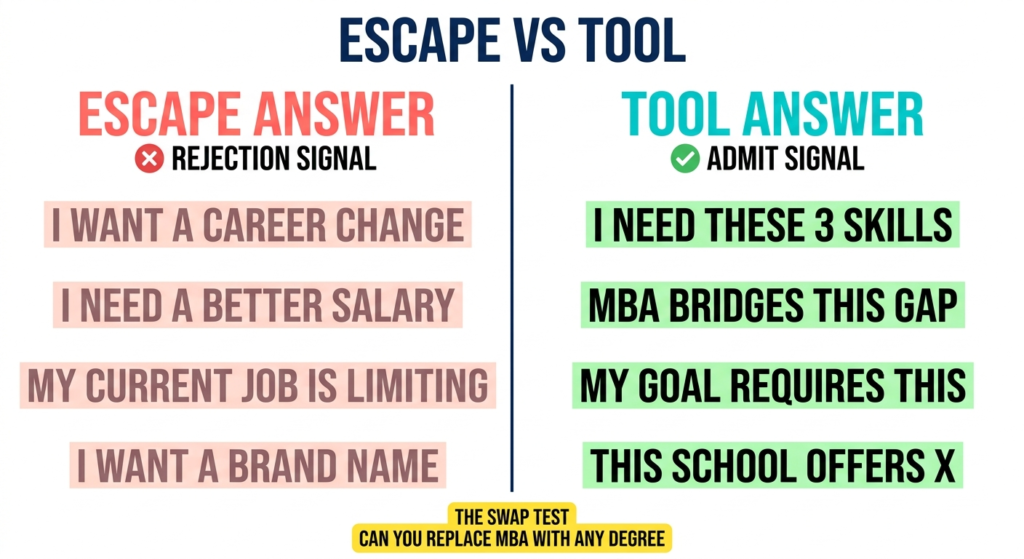
The why mba question exists to separate candidates who treat the MBA as an escape from candidates who treat it as a tool. Escape answers focus on what you’re running away from: a boring job, a stagnant role, a lack of international exposure, a ceiling on your salary. Tool answers focus on what you cannot build, execute, or access without this specific degree at this specific school at this specific point in your career. To understand how this question connects to the larger picture of how admissions committees evaluate everything else in your file, go through our complete breakdown of MBA admissions strategy for top global programs.
Your job in the interview is to sound like the tool-user. Every single time.
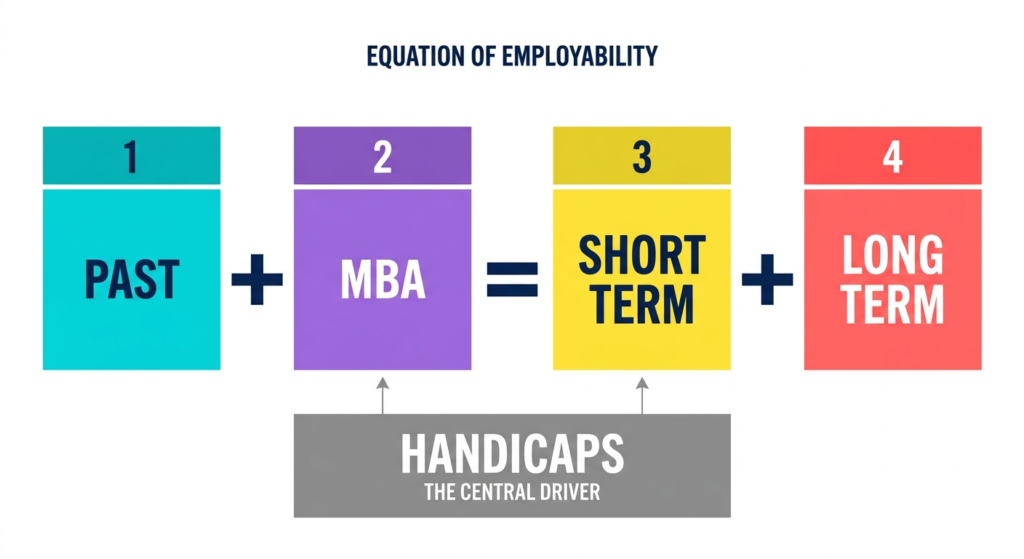
At PythaGURUS we call this the Equation of Employability, and every single applicant we coach at M7 and T15 schools runs their “why MBA” answer through this equation before they open their mouth in an interview. The equation is simple but brutal in its discipline: Past plus MBA equals Short Term (4 to 7 years) plus Long Term (7 to 15 years). Every component has to balance. Your past experience has to genuinely feed into what you’re asking the MBA to deliver, and what the MBA delivers has to genuinely enable a specific short term role, which in turn has to genuinely set up a specific long term trajectory. If any part of the equation is hollow, the whole answer collapses. This is how we have coached IT engineers from TCS, Wipro, and Infosys into admits at Kellogg, Booth, and Wharton, people who came in thinking “why MBA” was a feelings question and walked out understanding it was an employability equation.
Inside that equation sits the real engine of a winning answer, what we call Handicaps. I use the word “handicaps” deliberately, and I drill it into every single applicant in the PythaGURUS basecamp. A handicap is not a weakness in your personality. A handicap is a specific, identifiable gap between what you have today and what the next stage of your career demands, a gap that cannot be closed on the job, through certifications, or by switching companies. The standard test I give every applicant is this: if I gave you the job you say you want, tomorrow morning, right now, what are the 4 specific things you would not be able to do? Those 4 things are your handicaps. Those 4 handicaps are your real “why MBA.” Everything else is decoration. If you cannot produce 4 handicaps that are specific enough to be handed to a specific school’s career development center, you are not ready to sit in that interview chair.
How to Answer Why MBA: The Specificity Test
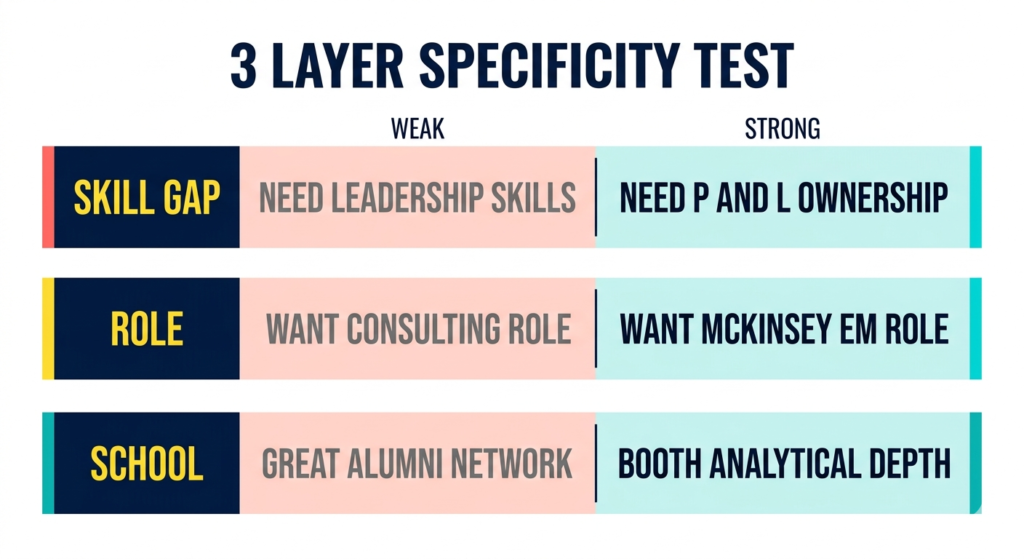
Knowing how to answer why mba comes down to one thing: specificity. Not passion. Not polish. Specificity. If your answer could be delivered word-for-word by another applicant with a different background, a different industry, different goals, it is not good enough. Swap-testing the answer is the fastest way to catch the weakness.
Here is how swap-testing works. Take your draft answer. Now imagine you are a product manager at Flipkart instead of a software engineer at TCS. Does the answer still make sense? If yes, your answer is generic. If the answer would sound false coming from a different person, you are on the right track.
The specificity test has three layers.
Skill gap specificity. Name the exact skills you cannot build in your current role. Not “business fundamentals.” Say “corporate finance at the level required to negotiate a carve-out transaction” or “operations strategy at the level required to run a multi-plant manufacturing vertical.” The more precise the gap, the more credible the need.
Role specificity. Name the role you want post-MBA. Not “consulting.” Say “associate at Bain’s private equity group” or “strategy lead at a mid-cap SaaS company going through its IPO prep.” If the role is vague, the need for an MBA is vague.
School specificity. Name the elements of this specific program that close the gap. Not “great network” or “strong curriculum.” Say “Kellogg’s marketing core combined with the healthcare management pathway because I’m moving from IT services into healthcare-tech product management.”
When all three layers land in 90 seconds, the interviewer stops evaluating and starts imagining you in the role. That’s the moment the interview tilts in your favour.
Knowing how to answer why mba is ultimately a test of whether you’ve thought harder about your career than the average applicant. Most haven’t. This is your chance to show you have.
Here is what 19 years of doing this has taught me about the specificity test. I can tell within 30 seconds of hearing an applicant’s “why MBA” answer whether they are going to get admitted with scholarship or get rejected without an interview. The distinction is almost always the same. The applicants who pass the test have done what I call the 5-Company Rule. If you can find 5 companies that have genuinely recruited international candidates from your target campus into the exact role you are describing, and those companies have sponsored work visas for MBAs in the last 2 years, your short term goal is real. If you cannot find those 5 companies, your goal is a figment of your imagination, however sincere it feels to you. I have sat in training calls with product managers from Bangalore, investment banking analysts from Mumbai, and engineering managers from Pune who thought they had strong “why MBA” answers, and the moment I asked them to name 5 hiring companies, they went silent. That silence is the gap between a rejection and an admit. Over 2,700 admits from our process, this pattern has held every single time.
Why MBA Now: Answering the Timing Trap
The why mba now sub-question is where most Indian applicants collapse. They answer the “why MBA” half reasonably well, and then when the interviewer follows up with “why now and not two years ago, or two years from now,” they freeze. Or worse, they say something like “I feel I’ve gained enough experience” or “the timing feels right.” Those are not answers. Those are filler.
The why mba now answer has to be causal, not descriptive. You are not describing your career. You are explaining why the next 12 months are the last realistic window to make this move without paying a massive penalty.
The strong timing answers I have seen always carry one of three causal structures.
The inflection point. Something measurable in your career has recently changed, and the next step in your plan requires skills you don’t have. Example: “I was promoted to lead product for our banking vertical eight months ago. The role exposed me to enterprise strategy decisions I had never touched before. To move from functional lead to business head over the next five years, I need structured exposure to corporate finance, M&A, and general management, which I don’t get by staying.”
The industry window. Your target industry is entering a phase where MBA-trained hires have a hiring advantage, and waiting two years closes that window. India’s climate-tech sector, for instance, is hiring aggressively right now because of the 2030 targets. Waiting closes that door.
The personal runway. You can realistically manage the financial, family, and career risk of an MBA for the next 18 months, but beyond that, constraints tighten. This works well as a supporting reason, rarely as the primary one.
Avoid the fourth structure, the emotional one. “I felt ready.” “Something inside told me it was time.” These sound poetic on paper. In an interview, they land flat.
MBA Profile Evaluation: What Top Schools Actually Assess and What You Can Change
“Jatin, can you tell me if my profile is good enough for a top school?” I hear this every week. And my answer always catches applicants off guard. An MBA profile evaluation that treats you as a collection of data points will mislead you every time. I got into 4 top-10 programs with a 58% undergrad score. Run that through a checklist and I’d have been told to forget about M7 schools.
Over two decades, the pattern is clear: applicants who succeed aren’t the ones with the “best” profiles on paper. They’re the ones who positioned what they had, filled their gaps through deliberate action, and told a story that made admissions committees lean forward. As I covered in our MBA admission process guide, admissions is a strategic positioning exercise. And that starts with how you evaluate your profile.
Why MBA at This Point in Your Career
The why mba at this point version of the question is the interviewer pressure-testing whether your trajectory actually needs an MBA right now, or whether you’re panicking. The why mba at this point framing shows up most often for candidates with 6+ years of experience, because the natural question at that level is “shouldn’t you be further along without needing a degree?”
For candidates with 7 to 10 years of experience, the answer has to pivot from “fresh skills” to “leverage.” You are not buying skills at this stage. You are buying scale, visibility, and access to roles that your current trajectory cannot reach no matter how hard you work.
Let me give you a concrete example. A former client of mine, an engineering manager at a Tier-1 Indian IT services firm with 9 years of experience, was terrified that his why MBA would sound like a mid-career crisis. We reworked his answer around one idea: he had hit the ceiling of what his company could teach him internally, his target shift was from delivery management in India to product general management at a US-based SaaS company, and that specific transition statistically does not happen for Indian IT professionals without a top MBA. Wharton admitted him. The answer wasn’t emotional. It was structural.
Here is a table I use with mid-career candidates to pressure-test their timing answer against their actual career stage.
Candidate Profile | Weak Timing Answer | Strong Timing Answer |
2 to 4 years, IT services | “I want to learn business fundamentals” | “I cannot move from execution into strategy in my firm for another 5 years. MBA compresses that timeline” |
5 to 7 years, consulting | “It’s the next logical step” | “Partner track at my firm requires an MBA; without it, the ceiling is Manager” |
7 to 10 years, industry | “I want a change” | “I’m moving from functional leadership to P&L ownership. I need general management training I cannot get internally” |
Entrepreneur, 4 to 6 years | “I want to scale my business” | “My next venture needs institutional capital; I need MBA-gated networks to access top-tier VCs and structured corporate finance” |
Non-profit / government, 5 to 8 years | “I want to transition to corporate” | “I’m moving from policy implementation to impact-focused corporate leadership; I need the commercial training only a business school provides” |
That table is the difference between an interviewer nodding politely and an interviewer writing “strong candidate” on the evaluation form.
Why Pursue MBA: The Gap You Must Prove
When you answer why pursue mba, the interviewer is looking for one thing: evidence that you have identified a gap between where you are and where you want to be that cannot be closed any other way. If the gap can be closed by a certification, a lateral job switch, a set of online courses, or another two years of work experience, the MBA is not the right answer. And the interviewer will see through you.
This is where I see the biggest failure pattern in Indian applicants, especially from IT and engineering backgrounds. They treat the MBA as the default “next step” without ever articulating what specifically they cannot do today that the MBA will enable them to do tomorrow.
When it comes to why pursue mba, three gap categories actually work.
The skill gap. Some skills cannot be picked up on the job, deep exposure to general management decisions, structured training in corporate finance, operations at scale, brand strategy for a multi-country rollout. If your current role cannot teach you these, the MBA is the most efficient path.
The network gap. Certain careers, private equity, venture capital, strategy consulting at the top firms, senior product roles in US tech, gatekeep through networks that Indian professionals cannot realistically access without a top-20 MBA. This is structural, not preference.
The credential gap. At certain levels, the MBA becomes a filter. Partner-track consulting. C-suite tracks in Fortune 500 firms. Leadership roles at global banks. Without the MBA, you are filtered out at the resume screen.
If your why MBA interview answer doesn’t explicitly call out which of these three gaps you’re trying to close, and exactly which role becomes accessible once you close it, you’re not ready for the interview yet. Full stop.
Let me tell you about two applicants who came to PythaGURUS with the exact problem this section is about. Salika and Alisha both came from the Indian IT industry. Both had the generic “why MBA” answer that every IT professional walks in with. “I want to learn strategy, I want to transition into consulting, I want more exposure.” That is the exact answer that gets Indian IT applicants rejected without an interview at top schools. When Salika first sat with me, she had no idea what specific role she was even targeting. Same for Alisha. For Salika, we reworked the entire answer around a specific private equity adjacent role where her past supply chain experience and her planned post MBA transition actually connected. For Alisha, we went through the Handicaps exercise in the PythaGURUS Goals Analysis, where I made her sit down and write out the 4 specific things she could not do today that her target post MBA role demanded. Suddenly her “why MBA” was not about exposure or networks. It was about 4 specific missing skills tied to 5 specific recruiting companies tied to one specific trajectory. Salika walked out with ₹3.2 crores in scholarships (Watch her story). Alisha walked out with ₹4.6 crores in scholarships (Watch her story). Both of them came from IT backgrounds that most consultants would have told them were “too common” to crack the league of schools they went to. They did not crack those schools because their profiles got stronger in 6 months. They cracked them because their “why MBA” answer finally passed the gap test. Everything else in their application followed that reframe.
Why Business School and Not Something Else
The why business school question is the one interviewers use to test whether you have genuinely considered alternatives. A good answer shows you looked at the other paths and made a deliberate choice. A bad answer sounds like you never considered anything else.
For every serious applicant, there are at least three alternatives to a business school degree: a specialised master’s (MFin, MS in Analytics, MiM), a professional certification (CFA, PMP, industry-specific credentials), or continued work experience with internal promotion. You need to have thought about each one, and be able to explain why none of them delivers what a two-year MBA delivers.
Take a candidate moving from software engineering into product management at a US-based firm. They could argue for a Masters in Analytics. They could argue for certifications. They could argue for switching jobs internally. None of those paths gives them access to the concentrated alumni network, the structured leadership training, the brand stamp, and the recruiting pipeline that only a top-20 MBA delivers for that specific transition.
That is the shape of a strong why business school answer. Not “MBA is the best option.” But “I considered X, Y, and Z, and here’s why each of them falls short of what I need.”
This is also where many Indian applicants hurt themselves by being too defensive. They think the interviewer is trying to catch them out. The interviewer is actually giving them a chance to show judgment. Show it.
GMAC’s 2024 Applicant Survey reported that roughly 60% of full-time MBA applicants cite deliberate career change or advancement as their primary motivation. That data point matters because it tells you the interviewer expects a trajectory-based answer, not a credentials-based one. Indian candidates who frame the MBA as “the next degree to collect” fall outside that 60%, and interviewers can tell.
Motivation for MBA Must Pass the Specificity Test, Not the Emotion Test
Your motivation for mba cannot rely on feeling. It has to rely on structure. Interviewers at top schools are trained to separate emotional motivation (which is easy to fake) from structural motivation (which requires evidence). Real motivation for mba is visible in the analysis that sits underneath the spoken words, not in the words themselves.
Structural motivation looks like this. You have a clear career plan spanning the next 10 to 15 years. The plan requires specific roles. Those roles require specific skills, credentials, and network access. The MBA is the only path that delivers all three simultaneously in a compressed two-year window.
Emotional motivation looks like this. You feel stuck. You feel bored. You feel like you have more to give. You want to prove something. These are real feelings. They are also useless in an interview. They do not differentiate you from any other ambitious 28-year-old in the applicant pool.
The whole idea is this. Your motivation must be the outcome of a rational analysis, not the cause of one. If you started by feeling you wanted an MBA and then reverse-engineered reasons, the interviewer will feel it. If you started by analysing your career gap and concluded that an MBA was the fix, the interviewer will feel that too, and it will sound completely different.
Your why MBA interview answer is the moment all of this underlying analysis gets compressed into 90 seconds of spoken English. If the analysis underneath is shallow, no amount of rehearsal will save it. If the analysis is deep, the answer almost writes itself. For the full set of other questions you need to prepare alongside this one, go through our detailed breakdown of MBA interview questions that admissions committees use across top programs.
FAQ: Why MBA Interview Answer
Q1: How long should my why MBA interview answer be?
Between 75 and 120 seconds when spoken at a natural pace. Shorter than that and you haven’t built a case; longer than that and the interviewer starts disengaging. Time yourself in prep. If you cross 2 minutes, you’re padding, cut the weakest third.
Q2: Should the answer change for different schools?
Yes, significantly. The core skill gap and role goal stay constant, but the school-specific justification must change for each program. Kellogg’s version emphasises team-based learning and marketing strength; Booth’s emphasises analytical rigour and flexible curriculum; INSEAD’s emphasises international exposure and one-year efficiency. Reusing the same school pitch across all programs is one of the fastest ways to signal you haven’t done the research.
Q3: Can I mention salary as a reason?
Only indirectly, and only at schools where ROI framing is culturally accepted (most US programs tolerate it; European programs often don’t). The safer approach is to name the role you want post-MBA and let the interviewer infer the compensation upside. Saying “I want a 3x salary jump” sounds transactional; saying “I want to move into a Director-level strategy role at a US-based SaaS company” carries the same financial implication without sounding mercenary.
Q4: What reasons should I never give?
Four reasons trigger immediate red flags: (1) “I’m unhappy in my current job,” (2) “My friends are doing MBAs,” (3) “I want more salary,” stated directly, and (4) “I want a brand name on my resume.” Each signals the MBA is an escape, not a tool. If any of your real reasons map to these, reframe them into forward-looking structural reasons before the interview.
Q5: How do I answer if I already have a stable, high-paying tech job?
Acknowledge the surplus openly, then reframe the MBA as a leverage move rather than an escape. Structure the answer like this: “My current role pays well and is stable. But it caps me at a specific trajectory, senior engineer to engineering manager to director. My long-term goal is general management at a US-based product company, and that specific path statistically requires either a founding-team exit or a top MBA. Since I’m not founding a company right now, the MBA is the efficient path.” This reframes the high-paying job as context, not contradiction.
Get Your Why MBA Interview Answer Evaluated Before It Costs You an Admit
Your why MBA interview answer is the single most important minute of your entire application. Not because it is the hardest question, it isn’t. But because it is the question where the interviewer decides whether to spend the remaining 25 minutes imagining you as an admitted student, or as a polite rejection. You only get to make that impression once.
Behind every PythaGURUS admit sits 19 years of pattern recognition from someone who cracked a top-10 MBA with a 58% undergrad and a full fellowship. That’s the lens Jatin Bhandari brings to every interview prep call, every goals analysis, and every “why MBA” answer he pressure-tests. We’ve helped Indian applicants secure over ₹200 crores in cumulative scholarships, and a large portion of that came from candidates who walked into interviews with answers that sounded nothing like the pool they were competing against.
If your why MBA interview answer isn’t yet at the specificity bar that top schools expect, start with a Comprehensive Profile Evaluation from PythaGURUS. We’ll tell you exactly where your answer stands, what’s missing, and how to rebuild it. You’ll walk out knowing the difference between the version of your answer that gets you waitlisted and the version that gets you admitted.
Let’s get you an admit. Let’s get there.