
MBA Profile Evaluation: What Top Schools Actually Assess and What You Can Change
“Jatin, can you tell me if my profile is good enough for a top school?” I hear this every week. And my answer always catches applicants off guard. An MBA profile evaluation that treats you as a collection of data points will mislead you every time. I got into 4 top-10 programs with a 58% undergrad score. Run that through a checklist and I’d have been told to forget about M7 schools.
Over two decades, the pattern is clear: applicants who succeed aren’t the ones with the “best” profiles on paper. They’re the ones who positioned what they had, filled their gaps through deliberate action, and told a story that made admissions committees lean forward. As I covered in our MBA admission process guide, admissions is a strategic positioning exercise. And that starts with how you evaluate your profile.
How to Build Profile for MBA: What Actually Matters
If you’re asking how to build profile for MBA admission at a top school, the first thing you need to understand is what admissions committees actually evaluate. Most applicants think about how to build profile for MBA programs the wrong way. They focus on collecting impressive-sounding credentials. A higher GMAT. A promotion. A volunteer certificate. That’s checkbox thinking, and schools see through it instantly.
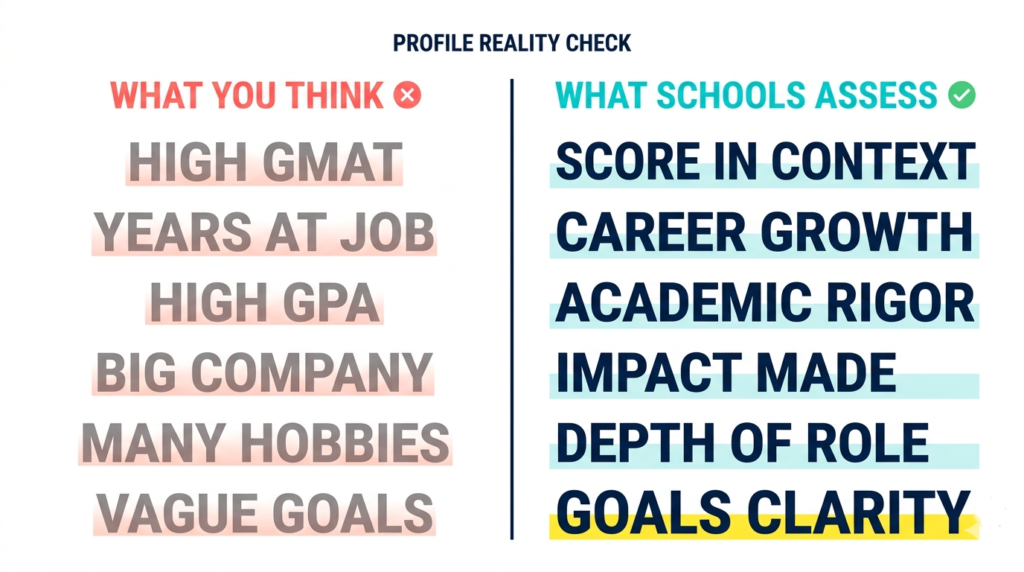
Here’s what actually matters in a profile evaluation. And I want you to pay close attention to the gap between what applicants believe matters and what admissions committees actually assess:
Profile Element | What Applicants Think | What Schools Actually Assess |
GMAT/GRE Score | Higher = better chances | Threshold check against school’s class average. Beyond that, minimal impact vs. other factors. |
Work Experience | Years matter most | Progression, impact, leadership. 4 years with rapid growth beats 7 years of lateral moves. |
Undergraduate GPA | Low GPA = automatic rejection | Context matters. Low GPA + strong GMAT + career growth = addressable. Low GPA + low GMAT = problem. |
Company Brand | McKinsey/Goldman = guaranteed admit | Brand helps for interview invite, not for conversion. What you did matters more than where. |
Extracurriculars | More activities = stronger profile | Depth and impact in 1-2 activities beats a list of 10 surface-level involvements. |
Goals Clarity | Optional / can figure out later | THE most important element. Schools admit futures, not pasts. |
Look at the Goals Clarity row. That’s not a nice-to-have. In my experience, it’s the single biggest differentiator between applicants who get admitted with scholarships and those who collect rejections despite strong stats. I’ve worked with applicants from no-name companies with average test scores who got into T10 programs because their goals were razor-sharp. And I’ve seen a lot of smart applicants who couldn’t crack T25 schools because their essays read like LinkedIn summaries. The data points get you past the initial filter. Everything after that is about depth.
The whole idea is this: schools are not evaluating your past. They’re predicting your future. Your profile is not a fixed set of facts. You are your profile. Which means you can change a lot just by changing your understanding of your goals, by networking deeply, by reframing your story. A Wipro engineer with sharp goals clarity has a better profile than an IIT-McKinsey applicant who can’t explain why they need an MBA beyond “career growth.” I’ve seen this play out hundreds of times.
MBA Profile Building: The 5 Dimensions Schools Evaluate
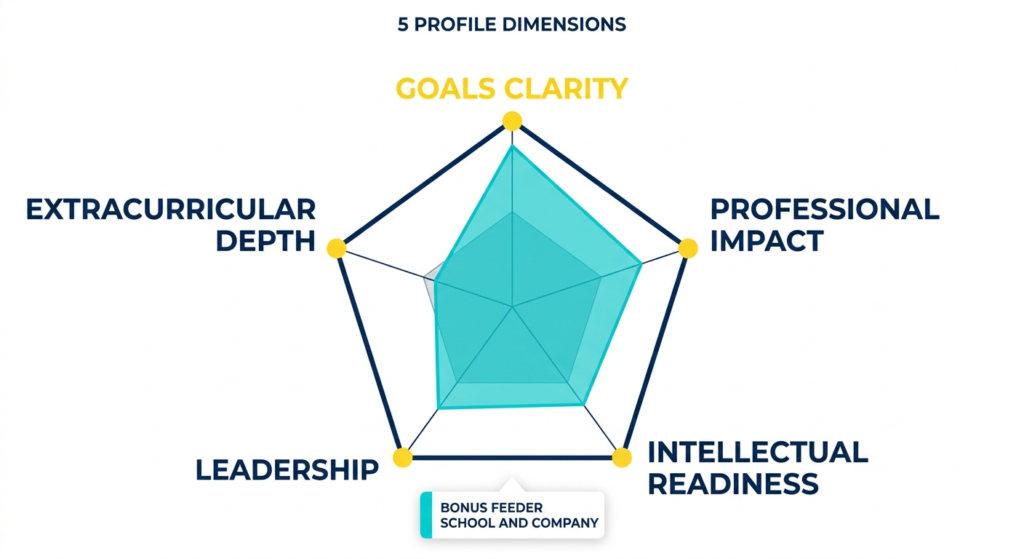
MBA profile building is not about checking boxes. It’s about depth across 5 specific dimensions that every top school evaluates, whether they say so explicitly or not. Effective MBA profile building means understanding which of these dimensions are strong in your case and which need work.
- Professional impact and progression. Not your job title, but what you accomplished. A Cognizant developer who built an internal tool that reduced client onboarding time by 40% has a stronger profile than a McKinsey analyst who participated in standard engagements. Impact is measured in outcomes, not logos.
- Intellectual readiness. GMAT/GRE score and academic performance signal whether you can handle MBA rigour. But have you also taken initiative to learn outside your job? Online courses, certifications, research projects. These show intellectual curiosity that committees value.
- Leadership beyond authority. The applicants who stand out led without a title. Organizing cross-team initiatives, mentoring juniors, starting community projects. These stories show you lead from conviction, not hierarchy.
- Community and extracurricular depth. I’ll cover this below, but the key principle is depth over breadth. One sustained commitment beats a dozen one-time activities.
- Goals clarity and self-awareness. The dimension most applicants ignore and the one that matters most. If you can articulate specific goals, explain your career handicaps, and connect it all to a specific school’s resources, you’re ahead of 80% of the pool. Goals drive everything: school selection, essays, interviews, scholarships.
I also want to add something here: your undergraduate institution matters. If you’re from an IIT, it genuinely sets you apart. Harvard, Stanford, and Wharton have feeder undergrads, institutions that consistently send students to their programs. IIT Delhi, IIT Bombay, IIT Madras are on that list. If you’re from a non-feeder college, every other dimension needs to be significantly stronger.
The same logic applies to your employer. Feeder companies like Goldman Sachs, McKinsey, Bain, Sequoia, Morgan Stanley, Google, and Amazon give you a built-in credibility signal. If you’re not at one of these, you need to demonstrate equivalent calibre through impact and progression.
Here’s how we do it at PythaGURUS. Our Comprehensive Profile Analysis starts with a detailed questionnaire covering strengths, weaknesses, target schools, goals, career progression, and why you think you need an MBA. Applicants spend hours on it. Then I prepare a thorough written analysis covering where your profile is strong, where the gaps are, which schools are realistic, and what actions you need to take. After you’ve reviewed it, we do a one-on-one meeting where I address everything directly.
What makes this different from free online profile evaluations? Those give you a generic “your chances are moderate” response based on GMAT and company name. We look at the full picture: career trajectory, goals depth, narrative potential, school fit at a cluster level, and the specific positioning strategy for your profile. I’ve done this for over 1,500 applicants, and I can usually tell within 10 minutes of reading someone’s questionnaire where the real opportunities are.
Profile Building for MBA Admission: What You Can Actually Change
Here’s the contrarian insight about profile building for MBA admission: most of what matters in your profile is still within your control, even 6-12 months before your application deadline. Profile building for MBA admission is not about your past. It’s about what you do between now and when you submit.
Your goals can change completely. This is the single biggest lever. I’ve seen applicants go from generic “I want a leadership role” goals to razor-sharp “I want to join the operational consulting practice at a PE firm focused on manufacturing buyouts” goals, and that transformation alone moved them from T25 to T10 candidates with scholarships. Goals change through targeted networking calls with professionals in your target career, deep self-reflection on what’s missing in your current trajectory, and honest analysis of your career handicaps. Not through copying templates from Reddit.
Your narrative can be reframed. A 6-year stint at TCS isn’t just “IT services.” It’s “leading cross-functional delivery teams across 3 continents, managing vendor relationships worth ₹50 crores, and reducing project delivery timelines by 25%.” Same facts, different narrative. At PythaGURUS, when we work on the resume step, applicants are often shocked at how different their career sounds once we’ve reframed it. The facts don’t change. The story does.
Your extracurriculars can be built. If you don’t have meaningful community involvement, start now. Not token volunteering. Genuine engagement. Teach underprivileged kids. Start an industry meetup group. Take a leadership role in an existing organization. Six months of real commitment creates stories that are authentic and defensible in an interview.
Your test score can improve. If your GMAT Focus score is significantly below the average of your target schools, especially from an over-represented Indian applicant pool, retaking is usually the highest-ROI activity. A 50-point improvement is achievable in 2-3 months. Don’t let ego stop you from retaking.
Your recommendations can be strategic. Most applicants pick recommenders based on seniority. That’s wrong. Pick recommenders who know your work deeply and can speak with specificity about your impact, leadership, and growth areas. A direct manager who can give detailed examples of your contributions is far more valuable than a VP who barely knows your name but has an impressive title. And coach your recommenders. Give them specific stories and themes to highlight.
For the full details on what each school requires, read our guide on MBA eligibility and requirements.
Extracurricular Activities for MBA: Depth Over Breadth
Let me be direct about extracurricular activities for MBA admission: most applicants approach this wrong. They try to pad their profile with a long list of activities: volunteered here, participated there, attended this. Schools don’t care about a list. When evaluating extracurricular activities for MBA applicants, they care about sustained commitment and measurable impact in one or two areas. If you can’t talk about an extracurricular for 5 minutes with genuine passion and specific details about your role and impact, it’s not helping your application. It might actually be hurting it by making you look shallow.
I’ve seen a Bangalore-based engineer who spent 3 years teaching math to underprivileged children every weekend get into Kellogg with a scholarship. And I’ve seen a Mumbai consultant with 12 extracurricular bullet points get rejected from every T15 school. The difference? The engineer could talk for 20 minutes about how his teaching methodology evolved, how student outcomes improved, and what he learned about leadership from managing volunteer teachers. The consultant couldn’t go deeper than “I participated in” for any of his activities. That depth gap is what admissions committees detect in seconds.
What actually works:
Pick one or two areas that genuinely matter to you. Not what looks good on an application. What you actually care about. Then go deep. If it’s education, don’t just tutor. Build a curriculum, recruit and train other tutors, measure learning outcomes, and scale the program. If it’s sports, don’t just play. Captain a team, organize tournaments, coach younger players. If it’s social impact, don’t just donate. Create a sustainable initiative with measurable results.
And start now. If your application deadline is 8-10 months away, you still have time to build something genuine. Schools ask about extracurriculars in interviews, and follow-up questions will expose any activity that’s resume decoration rather than real commitment.
One more thing. Don’t pick extracurriculars based on what you think admissions committees want to see. Pick what genuinely matters to you. Schools can tell the difference between someone who volunteers because they care and someone who does it because they read online that “community service helps your MBA application.” Authenticity shows up in interviews. You either have depth in an activity or you don’t, and 5 minutes of follow-up questions will make it obvious. The applicants who get scholarships are the ones whose extracurriculars reveal character, not the ones whose resume has the longest activities list.
Work Experience for MBA Admission: What Schools Want to See
Work experience for MBA admission is not about years. It’s about trajectory. I’ve worked with applicants who had 3 years of experience and got into M7 schools, and applicants with 8 years who couldn’t crack T25. The difference in work experience for MBA admission comes down to three things: progression, impact, and the story you tell about both.
Progression. Did you grow? Did your responsibilities expand? Were you promoted, or did you take on bigger projects, manage larger teams, or move into more strategic roles? A linear career with no growth signals that you might plateau. Schools want people who are accelerating, not coasting. Even if you weren’t formally promoted, show that your scope expanded. Moving from individual contributor to team lead, from domestic projects to international ones, from execution to strategy. That’s progression even without a title change.
Impact. Can you quantify what you achieved? Not “I worked on the digital transformation project” but “I led the migration of 200,000 users to a new platform, reducing customer churn by 18% and saving ₹12 crores in annual support costs.” Numbers matter. Specificity matters. If you can’t quantify your impact, you haven’t thought hard enough about what you actually accomplished. Go back through every role and find the numbers. They exist. You just haven’t looked for them yet.
The story. Your work experience needs a throughline that connects to your MBA goals. If you’re a supply chain manager targeting PE, every career decision needs to look like it was building toward that goal, even if you only realized the goal recently. The narrative creates coherence, and coherence creates conviction.
For applicants coming from Indian IT companies (TCS, Infosys, Wipro, HCL, Cognizant), the challenge is differentiation. Thousands of applicants from these companies apply every year. Your work experience needs to show what you did differently, not just what the company assigned you to do. Volunteer for cross-functional projects. Take international assignments. Build something outside your standard delivery responsibilities. That’s how you stand out from the over-represented pool.
And if you’re from a non-traditional background (manufacturing, healthcare, government, startups), don’t underestimate your advantage. Applicants from these sectors often have more interesting stories than those from brand-name firms. A factory floor process that reduced waste by 30% or a district-level health initiative reaching 50,000 people makes admissions committees sit up. The key is framing your impact with the same specificity that consulting and finance applicants use naturally.
How to Improve MBA Profile: Strategic Actions You Can Take Now
If you’re wondering how to improve MBA profile strength before your application cycle, here are the highest-impact actions you can take right now. Each of these directly addresses how to improve MBA profile weaknesses that admissions committees care about.
Action 1: Get your goals sharp. This is the single most transformative thing you can do. Most profile weaknesses stop mattering when your goals are deep, specific, and connected to your background. Do 15-20 targeted networking calls with professionals in your target career path. Go through the career research process I’ve described throughout our MBA admission process guide. Your goals should be so clear that you could explain them for 5 minutes without notes.
Action 2: Check your GMAT against school averages. Be honest about your applicant pool. Look up the average GMAT Focus score of every school on your target list. If your score is significantly below that average and you’re from a competitive pool like Indian IT or engineering, retake the test. When thousands of applicants have similar profiles, your GMAT needs to be at or above the school’s average to avoid being filtered out early. The ROI of 2-3 months of test prep is enormous.
Action 3: Build one meaningful extracurricular. Not three shallow ones. One deep one. Start a community initiative, take a leadership role in an existing organization, or commit to a cause that matters to you. Give it 6 months of genuine effort. That creates a story with depth and authenticity.
Action 4: Document your professional impact. Go back through your career and quantify everything. Revenue generated, costs saved, people managed, processes improved, clients served. You’ll need these numbers for your resume, essays, and interviews. Start tracking them now rather than scrambling during application season.
Action 5: Get an honest external assessment. You can’t objectively evaluate your own profile. You’re either too confident or too insecure about your chances. A professional MBA profile evaluation from someone who has seen thousands of profiles and knows the patterns will tell you exactly where you stand and what to prioritize. The best time to get this assessment is 12-18 months before your deadline, so you have time to act on the feedback. Getting it 2 months before the deadline leaves you with information but no time to use it.
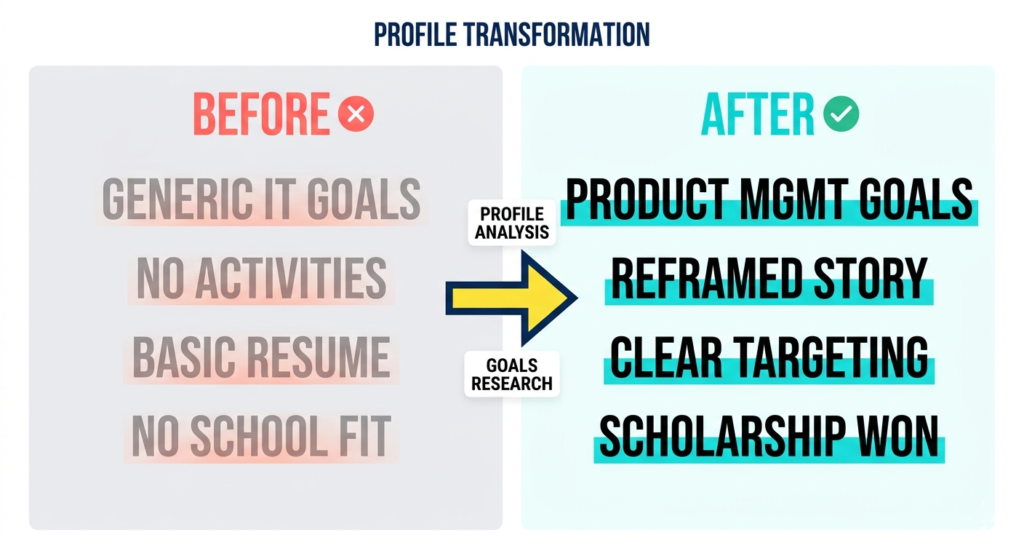
Bindu’s story is a perfect example. She came to us as a software engineer with 8+ years of experience, which is typically high for 2-year MBA programs. Most consultants would have pushed her toward an EMBA. But our Comprehensive Profile Analysis showed something different. Her initial goals were about IT consulting. Through our goals analysis and networking process, we redirected her toward product management at companies like Microsoft or Google. That shift from generic IT consulting to specific product management transformed her entire application.
And she did all of this while pregnant. Interviews in her eighth month, mock sessions in her ninth, running every morning, working full-time. The results? Tepper ₹72 lakh. Ross ₹24 lakh. McCombs ₹64 lakh. USC Marshall ₹64 lakh. That’s ₹2.24 crores in total scholarships across 4 admits. It started with a profile analysis that saw potential where a checklist would have seen “too many years of experience.
Watch Bindu’s video testimonial on securing ₹2.24 crores in scholarships across 4 top schools.
MBA Admission Chances Calculator: Why Online Tools Don't Work
Let me be blunt about every MBA admission chances calculator you’ve seen online. They don’t work. No MBA admission chances calculator can predict your outcome because admissions is not a formula. It’s a subjective, holistic evaluation by human beings who are building a class, not running an algorithm. I’ve had applicants come to me saying “the calculator gave me a 70% chance at Kellogg” and then get rejected, and others saying “it said 15% at Columbia” who got in with scholarships.
These calculators typically ask for your GMAT score, GPA, years of work experience, and maybe your undergraduate school. Then they spit out a percentage. That’s like predicting whether someone will win a job interview based on their resume alone. The resume gets you in the door. The interview. In MBA admissions, that means your essays, recommendations, goals clarity, and actual interview performance. That determines the outcome.
The real factors that determine outcomes (essay quality, goals depth, recommendation strength, interview performance, class composition needs) are things no calculator can measure. An Indian male IT engineer with a strong GMAT might get waitlisted not because his profile is weak, but because the school already has enough applicants with that exact background in that round. No algorithm captures that.
And the biggest variable these tools miss is positioning. Two applicants with identical stats can have completely different outcomes based on how they tell their story. One frames their TCS career as “IT delivery.” The other frames it as “leading cross-continental teams through complex digital transformations.” Same facts. Completely different perception. A calculator treats both profiles identically. An experienced evaluator knows one will get interviews and the other won’t.
If you want a real assessment of your chances, skip the online calculators and talk to someone who has guided hundreds of applicants to your target schools. A genuine MBA profile evaluation from an experienced consultant will give you more accurate insight in 30 minutes than any algorithm can provide. Not because the consultant has a better formula, but because they’ve seen enough profiles to know what works and what doesn’t at specific schools. They know which schools value which traits, which applicant pools are over-represented, and what positioning strategies actually convert. For a detailed understanding of how schools select applicants and what criteria drive decisions at different program tiers, read our guide on MBA college selection.
Frequently Asked Questions About MBA Profile Evaluation
When should I get an MBA profile evaluation?
Ideally 12-18 months before your target application deadline. This gives you enough time to act on the findings: retake GMAT if needed, build extracurriculars, sharpen your goals through networking, and strengthen any weak areas. Getting evaluated 2 months before the deadline leaves almost no room to improve.
Can a weak undergraduate GPA be overcome?
Yes, but it requires a strong compensating strategy. A high GMAT Focus score (710+) signals current academic capability. Strong work performance shows professional growth. Quantitative coursework through platforms like Coursera or university extension programs demonstrates recent academic readiness. I got into 4 top-10 programs with a 58% undergrad. It’s absolutely possible with the right positioning.
Do Indian IT professionals have a disadvantage in MBA admissions?
Not a disadvantage, but a differentiation challenge. Indian IT is the most over-represented applicant pool globally. Your profile needs to show what makes you different from the thousands of other Indian IT professionals applying. That comes from unique project work, international exposure, meaningful extracurriculars, and most importantly, deeply specific career goals that go beyond “I want to move into consulting or product management.”
How important is the GMAT score in profile evaluation?
It’s a threshold, not a differentiator. If your score is significantly below the class average of your target schools, your application is at serious risk of being filtered before a human reads it. Once you’re at or above the average, additional points add minimal value. At that point, other profile elements (goals, experience, essays) determine your outcome. Don’t spend 6 months chasing a perfect score when that time could be better spent on networking and goals research.
Are You Exploring Top-Tier Business Schools?
At PythaGURUS, we’ve helped over 1,500 applicants secure admits at the world’s top business schools. From MBA interview questions to essays to school selection, our founder Jatin Bhandari (Darden MBA) has spent two decades preparing applicants for every stage.