MBA Interview Questions: What Top Schools Actually Ask and How to Answer
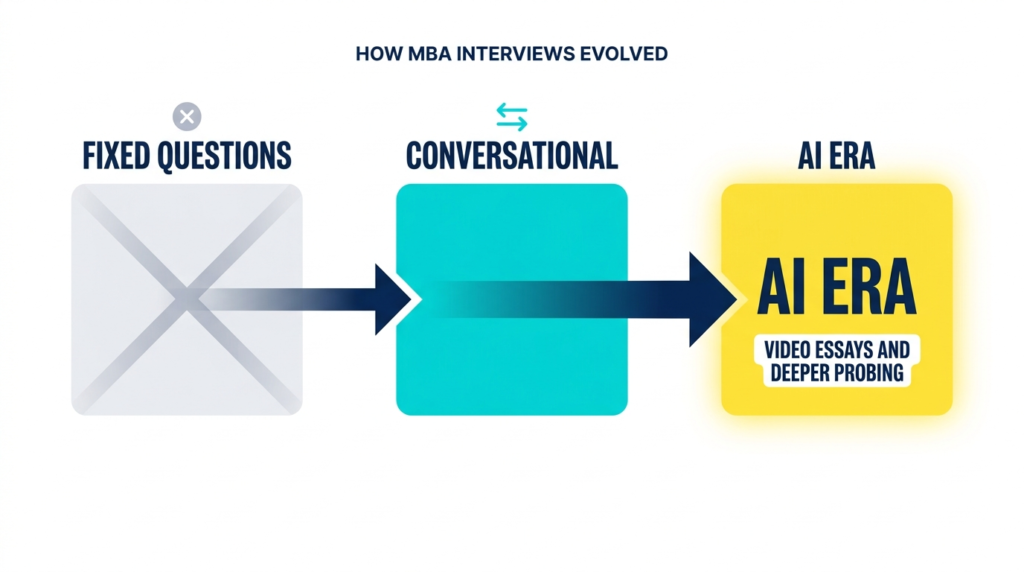
I’ve watched MBA interviews evolve dramatically over the last decade. Ten years ago, most schools ran a fixed set of questions – “Tell me about yourself,” “Why MBA,” “Greatest weakness” – and applicants prepared rehearsed answers that sounded polished but told the admissions committee nothing real. Schools caught on. They realised that with a predictable question set, too many applicants were doing stage performances instead of having genuine conversations. So the format shifted. Interviews became deeply conversational – interviewers started asking sharp follow-up questions, going back and forth, probing inconsistencies, pushing applicants to think on their feet rather than recite from memory.
And now, in the world of AI, interviews have become even more critical. Schools know that applicants have powerful writing assistants at their disposal. They know your essays might have been polished (or written) by ChatGPT. That’s exactly why MBA interview questions carry more weight today than ever before – the interview is the one part of your application that can’t be faked. Some schools have introduced video essays and video interview questions as additional screening tools. The interview is no longer just a filter. It’s become the most authentic signal schools have. Let’s look at how to approach it the right way.
I’ve seen applicants with 740 GMAT scores bomb their Wharton team-based discussion because they talked too much and listened too little. And I’ve seen applicants with 710 scores walk out of INSEAD’s two-interview format with admits and scholarships because their answers had a depth that no rehearsed script can fake. The interview is where the entire application comes alive or falls apart. Your GMAT, your essays, your recommendations – they get you the invite. But the invite is just permission to compete. Converting it is a completely different game.
The MBA interview questions you’ll face aren’t random. They follow patterns. Schools ask the same categories of questions year after year – they just phrase them differently. And once you understand those categories and know how to build answers with genuine depth, the interview stops being terrifying and starts being the strongest part of your application. As I covered in our MBA admission process guide, the interview is the final gate. This article gives you everything you need to walk through it.
MBA Interview Preparation: Where Most Applicants Go Wrong
Let me start with the biggest mistake I see in MBA interview preparation. Most applicants prepare by memorizing answers to a list of 50 questions they found online. That’s not MBA interview preparation. That’s exam cramming, and admissions committees can smell it from the first answer.
The problem with memorized answers is they collapse under follow-up questions. An interviewer at Kellogg asks, “Tell me about a time you led a team.” You deliver your rehearsed STAR-format response. It sounds polished. Then the interviewer asks, “What would the team member who disagreed with you say about that experience?” And you freeze. Because you memorized the success story but never thought about it from someone else’s perspective.
Real interview preparation is not about having the right answer to every question. It’s about having such a deep understanding of your own story, your goals, your strengths, and your weaknesses that you can handle any question from any angle. When I prepare applicants at PythaGURUS, we don’t start with a question list. We start with self-knowledge. If you’ve done the hard work of identifying your 8 career handicaps, researching your goals through 20-30 networking calls, and building a story that’s genuinely yours, you can answer any question because you’re not performing – you’re just talking about your own life with clarity and conviction.
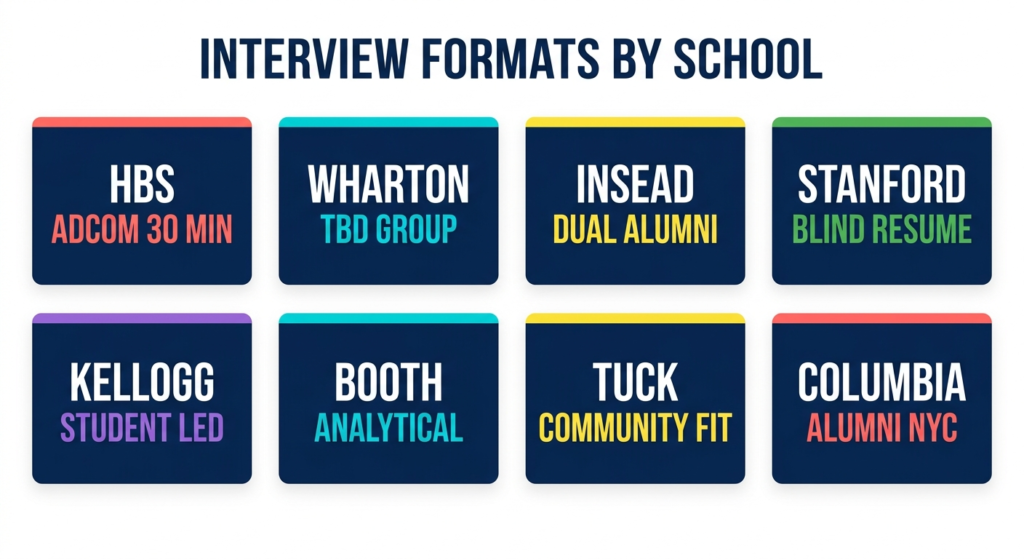
I also want to add something here. The format of MBA interviews varies dramatically by school, and your preparation strategy should match:
School | Format | Interviewer | Key Characteristic |
HBS | 30 min, post-application review | Admissions board member | They’ve read your full application; expect deep follow-ups |
Stanford GSB | Blind interview | Alumni or student | Interviewer has only your resume; everything else you must convey |
Wharton | Team-based discussion (TBD) | Adcom observes group | Evaluated on collaboration, not dominance; listening matters as much as speaking |
Kellogg | Blind interview | Alumni or current student | Conversational; teamwork and culture fit heavily weighted |
Booth | Conversation-style | Alumni or student | Analytical depth valued; be prepared to discuss your reasoning |
INSEAD | Two separate interviews | Two different alumni | Global perspective critical; expect questions about cross-cultural experiences |
Tuck | Alumni or adcom | Varies | Community fit is everything; show genuine interest in small-town Hanover |
Columbia | By invitation only | Alumni | NYC-focused career questions common; know why Columbia specifically |
If you’re preparing for Wharton the same way you’re preparing for INSEAD, you’re preparing wrong. The format shapes everything.
Common MBA Interview Questions: The 6 Categories
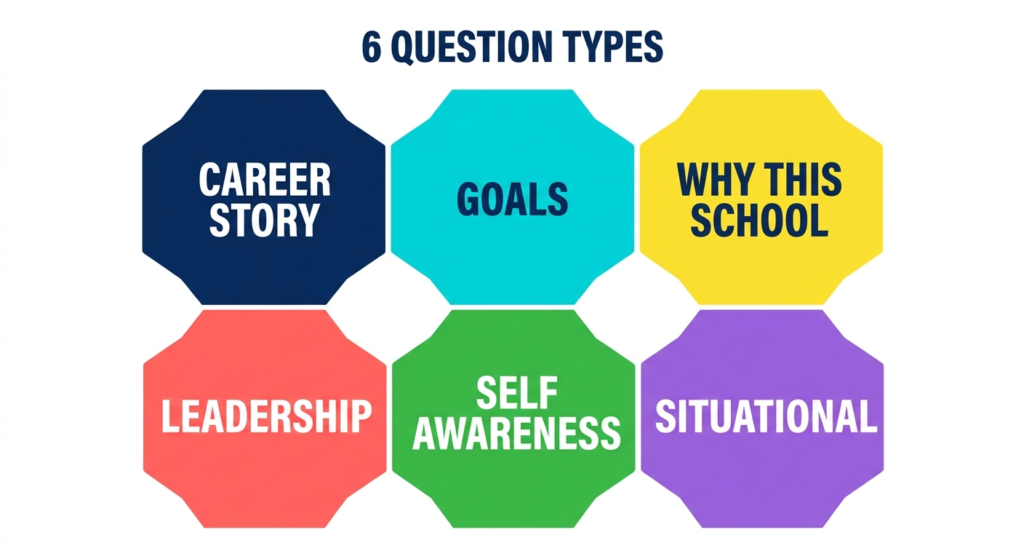
After reviewing interview reports from thousands of applicants, I can tell you that common MBA interview questions fall into 6 clear categories. Every school draws from these categories. The phrasing changes, the depth varies, but the categories are constant. Understanding these common MBA interview questions categories is more valuable than memorizing 100 individual questions.
Category 1: Career Story and Resume Walk-Through
“Walk me through your resume” or “Tell me about yourself.” This is the most common opening question and the one most applicants waste. They give a chronological recitation of their resume – which the interviewer has already read. The right approach is to tell a story with a throughline: what drove your career decisions, what patterns emerge, and where you’re headed. At PythaGURUS, we train applicants on a technique I call “throwing baits” – embedding interesting hooks in your resume walkthrough that invite the interviewer to ask follow-up questions about your strongest stories. If your walkthrough is boring, the interviewer picks the questions. If your walkthrough is strategic, you’re steering the conversation toward your best material.
Category 2: Goals and Why MBA
“What are your short-term and long-term goals?” “Why do you need an MBA?” “Why now?” These questions are make-or-break. I’ll cover these in depth in the next section.
Category 3: Why This School
“Why Kellogg?” “Why INSEAD?” “What specifically attracts you to Booth?” Generic answers kill you here. “I love your collaborative culture and strong alumni network” tells the interviewer you spent 10 minutes on their website. “I want to take Professor X’s course on emerging market valuations because my career handicap is understanding how technology companies are valued in cross-border PE deals” tells them you’ve done your research and know exactly what you need.
Category 4: Behavioral and Leadership
“Tell me about a time you led a team.” “Describe a failure and what you learned.” “Give me an example of managing a difficult team member.” These questions follow the STAR format (Situation, Task, Action, Result) but the best answers go beyond STAR and include genuine reflection. What would you do differently today? What did the experience teach you about your leadership style?
Category 5: Self-Awareness and Weaknesses
“What is your greatest weakness?” The worst answer is a fake weakness disguised as a strength (“I’m a perfectionist”). The right approach is to share a genuine development area, show awareness of its impact, describe specific steps you’ve taken to improve, and be honest that it’s still a work in progress. Admissions committees don’t expect you to be flawless. They expect you to be self-aware.
Category 6: Oddball and Situational
“What would you do if you don’t get admitted?” “What other schools have you applied to?” “How would you sell your country to us?” “Describe an ethical dilemma you faced.” These questions test how you think on your feet. There’s no right answer – there’s a right approach: be honest, show your thought process, and don’t try to say what you think they want to hear.
Here’s what makes our interview preparation different from every other consultant out there. Most consultants do 2-3 mock interviews and call it done. At PythaGURUS, we’ve built a complete interview training system with 21+ dedicated modules that applicants go through before they ever sit for a mock interview. It’s split into three tracks.
The first track is the Employability Intensive – this covers everything from how to walk through your resume strategically (I teach a technique called “throwing baits” where you embed hooks that steer the interviewer toward your strongest stories), to how to frame your short-term and long-term goals with conviction, to how to answer “Why MBA” and “Why this school” in a way that’s integrated and natural rather than rehearsed. Every module comes with my own sample answers so applicants can see what depth looks like before building their own.
The second track is Comprehensive Behavioral Interview Mastery – leadership questions, failure questions, contribution questions, challenging situations, accomplishments. Each question type has its own module with do’s, don’ts, multiple example approaches, and webinar-style walkthroughs. I don’t just teach STAR format. I teach how to go beyond STAR with genuine reflection that shows self-awareness.
The third track is Oddball Questions – managing a difficult team member, what makes you unique, how to ask questions at the end, what if you don’t get admitted, what other schools have you applied to, how to sell your country, ethical dilemmas. These are the questions that catch people off guard, and we prepare applicants for every single one. By the time someone finishes all three tracks and does their mock interviews with me, they’re not nervous anymore. They’re ready.
Why MBA Interview Questions: The Answer That Makes or Breaks You
Why MBA interview questions are the single most important category because they test the depth of your conviction. Schools ask why MBA interview questions in different forms – “Why do you want an MBA?”, “Why now?”, “Why can’t you achieve your goals without an MBA?” – but they’re all probing the same thing: does this person genuinely understand what they need and why our program is the right place to get it?
Here’s the contrarian truth about the why MBA interview answer: the strongest why MBA interview answer is not about the MBA at all. It’s about the gaps. When you can clearly articulate 4-5 specific things you cannot learn or access in your current career – and then connect each one to a specific resource at the school – your answer becomes bulletproof. “I need an MBA because I want to grow” is a D-grade answer. “I need this MBA because I don’t understand valuation frameworks for manufacturing buyouts, I’ve never worked with LP-GP dynamics, and I need the PE club’s deal competition and Professor X’s course to bridge those specific gaps” is an A-grade answer.
The difference between these two answers is not talent or intelligence. It’s preparation. The applicant who gave the A-grade answer spent weeks doing networking calls with PE professionals, went through deep goals analysis, and identified specific career handicaps before the interview. The applicant who gave the D-grade answer Googled “why MBA sample answer” the night before.
I also want to add something here. Your “why this school” answer must be different for every school you interview at. If your answer for “Why Kellogg?” sounds like it could work for “Why Booth?” with a name swap, it’s not specific enough. Each school has a distinct culture, distinct strengths, and distinct resources. Your answer needs to reflect that you’ve done the work to understand the difference.
And don’t ignore the “why now” component. This catches Indian applicants off guard constantly. If you have 3 years of experience, the interviewer wants to know why you’re not waiting until 5. If you have 7 years, they want to know why you didn’t come sooner – or whether an EMBA would serve you better. The right answer connects timing to specific inflection points in your career: “I’ve hit a ceiling in my current trajectory. My last two projects showed me that I can execute operational improvements but I can’t drive strategic decisions about which improvements to prioritize. That gap is only going to widen if I wait, and the cost of the MBA increases with every year of senior-level salary I forego.” That’s a timing argument grounded in career reality, not a vague “I feel ready.”
At PythaGURUS, we train applicants to build an integrated response that connects Why MBA, Why This School, and their short-term/long-term goals into one coherent answer that flows in about 2-3 minutes. The structure I teach works like this: start with the career inflection point – the moment you realized your current trajectory has hit a ceiling. Then move to the specific gaps (your handicaps) that you can’t fill without an MBA. Then connect those gaps to specific resources at the school – not brochure language, but professor names, specific courses, clubs, treks, and alumni pathways you discovered through your networking calls. And close by showing where this all leads – your post-MBA role, the impact you want to create, and why this school specifically is the bridge between where you are and where you’re headed.
We have dedicated modules for this – Why MBA, Why This School, and a separate integration module that shows applicants how to weave all three into a single response that doesn’t sound like three separate answers stitched together. I also share my own sample responses so they can hear what a natural, integrated answer sounds like versus a mechanical one. The applicants who go through this process don’t freeze when the interviewer asks “Why MBA” because they’ve internalized the answer so deeply that it comes out as genuine conviction, not memorized content.
Personal Interview Questions for MBA: Behavioral and Beyond
Personal interview questions for MBA programs go deeper than your professional achievements. These personal interview questions for MBA admission probe who you are as a person – your values, your self-awareness, your ability to reflect on failure and growth.
The failure question. Every school asks some version of this. “Tell me about a significant failure.” “What’s your biggest professional mistake?” “Describe a time when things didn’t go as planned.” The trap here is choosing a “safe” failure that isn’t really a failure. Schools see through that instantly. Pick a genuine failure where you made a real mistake – not a situation where external circumstances went wrong. Then show what you learned, what you changed, and how it shaped your approach going forward. The key is showing growth, not perfection.
The weakness question. This trips up Indian applicants more than any other question. The cultural instinct is to present a strength disguised as a weakness – “I work too hard” or “I’m too detail-oriented.” This doesn’t work at top schools. They’ve heard it a thousand times. Share a real developmental area. Show you understand its impact on your work. Describe the specific steps you’re taking to address it. And be honest that you’re still working on it. Self-awareness beats self-promotion every time.
The leadership question. “Tell me about a time you led a team through a difficult situation.” Most Indian applicants default to a story about managing a project at work. That’s fine, but the best answers show leadership beyond authority – influencing people who don’t report to you, rallying a team around a vision when you had no formal power, or making a difficult call that cost you something personally. Admissions committees want to see that you lead because of who you are, not because of your job title.
The contribution question. “What will you contribute to the class?” This is not about listing your achievements. It’s about showing how your specific background, perspectives, and experiences will add something unique to classroom discussions. An Indian supply chain engineer brings a perspective that a Wall Street banker doesn’t, and vice versa. Know what makes your viewpoint different and articulate it clearly.
The ethical dilemma question. “Describe a time you faced an ethical challenge at work.” This comes up more often than most applicants expect, especially at INSEAD and schools with a strong emphasis on responsible leadership. Don’t invent a dramatic scenario. Most genuine ethical dilemmas are small but real – a vendor offering personal favours for contract renewals, a colleague inflating numbers in a client presentation, discovering a billing error that benefits your company. What matters is that you show a moral compass and the courage to act on it, even when it was uncomfortable.
The accomplishment question. “What are you most proud of and why?” This seems easy but it’s a trap for overachievers who list their most impressive-sounding achievement. Pick the accomplishment that reveals something about your character, not just your capability. The promotion you earned is less interesting than the time you coached a struggling team member who went on to outperform everyone else. Schools want to see what you value, not just what you’ve done.
MBA Interview Tips That Separate Admits from Waitlists
After working with applicants who’ve interviewed at every top school, here are the MBA interview tips that consistently make the difference. These MBA interview tips are not generic advice. They’re patterns from real outcomes.
Tip 1: Treat the interview as a conversation, not a performance. The best interviews feel like a genuine exchange between two professionals. The worst ones feel like a candidate delivering a presentation. Ask clarifying questions. React naturally to what the interviewer says. If they make a joke, laugh. If they share an insight about the school, engage with it. Schools want to admit people they want to spend two years with in a classroom.
Tip 2: Prepare stories, not scripts. Have 6-8 well-thought-out stories from your career that cover leadership, teamwork, failure, ethical dilemma, and impact. Know these stories so well that you can tell any of them in 2 minutes or expand to 5 minutes based on the question. But never memorize word-for-word scripts. Memorized answers sound robotic, and they collapse under follow-up questions.
Tip 3: Know your application cold. For schools where the interviewer has read your application (HBS, Darden, Yale SOM), every claim in your essays and resume is fair game. If you mentioned leading a team of 15, be ready to talk about specific challenges with specific team members. If you wrote about a career goal in your SOP, be ready to defend it with specifics you learned from networking calls.
Tip 4: Have 3-4 specific questions ready for the end. When the interviewer asks “Do you have any questions for me?” – this is not a formality. It’s another evaluation point. Ask questions that demonstrate genuine research and specific curiosity about the program. “How has the PE club’s deal competition evolved in the last 2 years?” is a hundred times better than “What’s the culture like?”
Tip 5: For Wharton’s TBD, practice collaboration, not dominance. The team-based discussion is the most misunderstood interview format. Applicants who try to dominate the conversation get dinged. The ones who listen actively, build on others’ ideas, bring quieter team members into the discussion, and summarize progress constructively are the ones who convert. Practice this with a group. You cannot prepare for TBD alone.
Tip 6: Do mock interviews with someone who will challenge you. Not your friend who will tell you everything sounds great. Someone who will throw unexpected follow-up questions, push back on your answers, and point out where you’re being vague or rehearsed. At PythaGURUS, our mock interview process is the most intensive part of the preparation because the interview is where preparation meets reality.
Frequently Asked Questions About MBA Interviews
Start your MBA interview prep by re-reading your entire application – essays, resume, and recommendations. Then identify the 6-8 stories from your career that best illustrate leadership, teamwork, failure, and impact. MBA interview prep should also include 2-3 mock interviews with someone who will push back on your answers and force you to go deeper. Don’t start with question lists. Start with self-knowledge.
How long do MBA interviews typically last?
Most MBA interviews last 20-40 minutes. HBS interviews are roughly 30 minutes. INSEAD runs two separate 30-minute interviews. Wharton’s TBD is about 35 minutes. Kellogg alumni interviews can run 30-45 minutes depending on the conversation. Don’t try to fill every second with talking. Pausing to think is far better than rushing into a half-formed answer.
What should I wear to an MBA interview?
Business professional for in-person interviews (suit and tie for men, professional attire for women). For virtual interviews (which are now common), dress the same from at least the waist up – interviewers notice. Make sure your background is clean, your lighting is good, and your internet connection is stable. Technical issues during a virtual interview create an avoidable negative impression.
Can I recover from a bad answer during the interview?
Yes. One bad answer rarely sinks an entire interview. If you realize mid-answer that you’re going in the wrong direction, it’s actually better to stop and say “Let me approach this differently” than to keep going down a weak path. Interviewers appreciate self-correction – it shows the same self-awareness they’re looking for in the behavioral questions.
Are You Exploring Top-Tier Business Schools?
At PythaGURUS, we’ve helped over 2,700 applicants secure admits at the world’s top business schools. From MBA interview questions to essays to school selection, our founder Jatin Bhandari (Darden MBA) has spent two decades preparing applicants for every stage.