MBA Admission Process: The Complete Guide You Actually Need
I’ve guided over 1,500 applicants through the MBA admission process across 19+ years – IIT and non-IIT graduates, tech and non-tech professionals, from consulting, finance, healthcare, manufacturing, startups, and every function you can think of. They’ve applied to top global b-schools across the US, Europe, Canada, India, and APAC. And the single biggest pattern I’ve seen? The applicants who fail aren’t the ones with weak profiles. They’re the ones who treat admissions like a form-filling exercise instead of a strategic positioning exercise.
Here’s the thing. The MBA admission process at a top global program – whether it’s an M7 school like Wharton or a T15 program like Darden – is nothing like what most Indian applicants expect. It’s not about ticking boxes. It’s about building a case for why you, specifically, belong in that incoming class. And that case needs to be built months before you ever click “Submit.”
This guide covers everything: eligibility, entrance exams, documents, the application timeline, essay and interview strategy, and the specific mistakes that cost Indian applicants admits every single year. I’m not going to give you the same recycled advice you can find on 50 other websites. I’m going to tell you what actually works – based on data from thousands of real applications.
How to Apply for MBA: The Step-by-Step Roadmap

If you’re figuring out how to apply for MBA programs abroad, the first thing you need to understand is that this is not a linear, fill-and-submit process. How to apply for MBA programs at any competitive school involves five parallel workstreams running simultaneously – and most applicants only focus on one or two of them.
Let me lay out the real roadmap:
Phase 1: Self-Assessment and Profile Building (12–18 months before deadline). This is where 80% of the game is won or lost. Before you touch a single application form, you need to audit your profile against what top programs actually value. What’s your quantitative credibility? What’s your leadership narrative? What gaps exist – and can you close them in time? If you’re a software developer at Wipro with five years of experience and no extracurriculars, you cannot fix that in September when Round 1 deadlines are in October.
Phase 2: Test Preparation (6–12 months before). GMAT or GRE – pick the right test for your profile. But here’s what most people miss: the test is a threshold, not a differentiator. A 740 GMAT won’t get you into HBS. But a 680 GMAT can disqualify you from consideration before anyone reads your essays. .
Phase 3: School Selection (6–9 months before). This is the most under-invested phase. Most applicants pick schools based on rankings alone. That’s a mistake. School selection is portfolio construction – you need a mix of reach, target, and safety schools calibrated to your specific profile. A 720-GMAT Indian IT applicant and a 720-GMAT Indian PE professional need completely different school lists.
Phase 4: Application Execution (3–6 months before). Essays, recommendations, resume, short-answer questions – this is where your strategy meets the page. Each school has a different personality: HBS values intellectual vitality, Stanford GSB rewards deep self-awareness, Wharton looks for collaborative leadership. Your MBA application essays need to reflect these differences, not repeat the same story across every school.
Phase 5: Interview and Post-Submission (1–3 months after). Most top programs invite only 40–60% of applicants for interviews. Getting the invite is the first gate. Converting it into an admit is the second. Each school runs a different format – Wharton uses team-based discussion, INSEAD runs two separate interviews with alumni, Kellogg’s interview is student-led.
This is not a weekend project. The applicants I’ve seen get into M7 and T15 schools consistently are the ones who started early, invested in every phase, and treated the whole process as a strategic campaign.
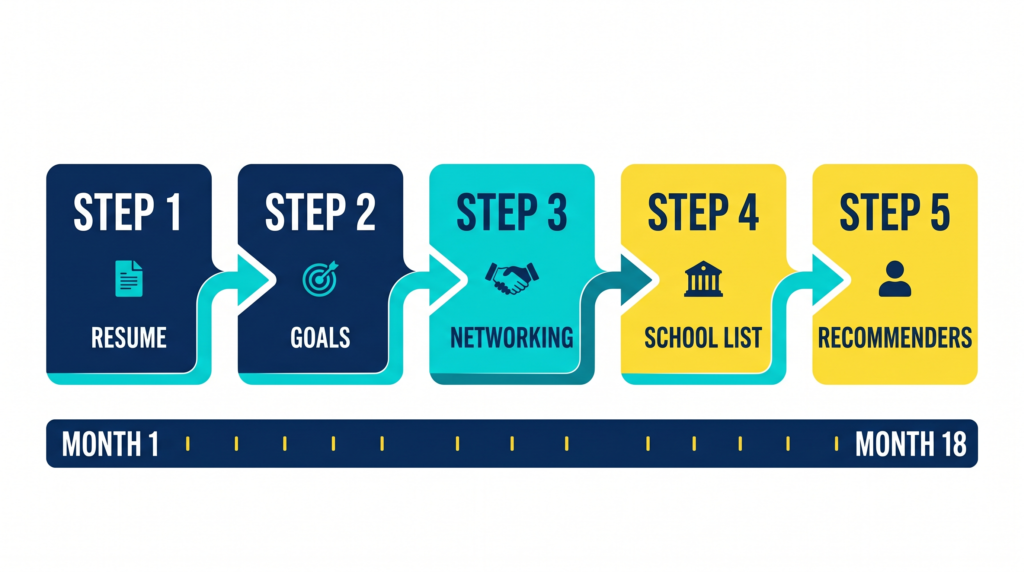
At PythaGURUS, we run every applicant through a structured 5-step process that I’ve refined over nearly two decades. Step 1 is Resume, where we rebuild your resume from a strategic lens, not a job-search lens. Step 2 is Goals Analysis – and this is where the real work begins. We identify what I call your 8 Handicaps – the specific career gaps standing between where you are today and where you want to be. These handicaps become the backbone of your entire application. Why do you need an MBA? Because of these 8 specific things you can’t solve without one.
Step 3 is Networking. Most Indian applicants skip this entirely or treat it as a formality. We don’t. We train every applicant, including introverts who’ve never had a single international conversation, to conduct 20 to 30 targeted networking calls with alumni across three continents. I even run mock networking calls to show them exactly how a great call sounds. Step 4 is School Shortlisting using our cluster-based model, and Step 5 is Recommender Shortlisting. Only after all five steps are complete do we touch a single essay draft. Every step feeds the next. Skip one, and the whole application weakens.
For Round 1 (September-October deadlines), I want applicants started on Steps 1 and 2 by January. Networking should be running by March. School shortlisting locked by May. Essays begin June-July. For Round 2, shift everything forward by about 4 months. And here’s something most consultants won’t tell you: I recommend applying in both Round 1 and Round 2. Split your schools across rounds. Even applicants who started with me just 4 months before Round 1 do both rounds. It’s not about picking one – it’s about maximizing your options.
MBA Eligibility Criteria: What Schools Actually Look For
Let me be direct about MBA eligibility criteria because this is where Indian applicants waste the most energy. MBA eligibility criteria for top global programs are simultaneously simpler and more complex than most people realise.
The simple part: MBA eligibility at the basic level requires a bachelor’s degree from a recognised university, a valid GMAT or GRE score, and professional work experience (typically 2–8 years, with the sweet spot at 4–6 years). That’s it. There’s no minimum percentage cutoff at most US and European schools. No specific undergraduate major required. No age limit.
The complex part: Meeting basic MBA eligibility gets you through the door. It doesn’t get you a seat. The real eligibility criteria – the ones that determine who gets admitted – are completely different from the ones listed on school websites. They include the strength of your career progression, the quality of your leadership examples, the clarity of your post-MBA goals, the depth of your community involvement, and your ability to contribute to classroom diversity.
For Indian applicants specifically, eligibility dynamics shift because of the “over-represented pool” factor. Indian male IT professionals are the largest single demographic in most MBA application pools. This means your profile isn’t compared against all applicants – it’s compared against everyone who looks like you. A Cognizant project manager with 5 years of experience is competing against hundreds of other Indian IT applicants with nearly identical backgrounds.
This doesn’t mean you can’t get in. It means your bar is higher. You need to demonstrate differentiation that goes beyond your day job.
MBA Eligibility: Basic vs. Real Criteria
Criteria | What Schools List | What Actually Matters |
Education | Bachelor’s degree | Academic rigour, quantitative readiness, institution brand |
Test Score | GMAT/GRE accepted | Threshold for your demographic (Indian IT: 720+ for M7) |
Work Experience | Typically 2+ years | Career progression, scope of impact, leadership |
English Proficiency | TOEFL/IELTS for non-native | Communication quality in essays and interviews |
Extracurriculars | Not always listed | Depth of community contribution, sustained commitment |
I’ll share something personal here. I had a 58% in my undergrad. Fifty-eight percent. And I cracked 4 top-10 MBA programs with ₹4.5 crores in scholarships, including a 100% fellowship at Darden. On paper, I shouldn’t have been eligible for any of these schools. But I was, because I knew how to build a case that made my profile compelling despite the low GPA. That experience shaped how I work with applicants today. We’ve had applicants at PythaGURUS with sub-60% GPAs, career gaps of 2+ years, and non-traditional backgrounds get into T15 schools with significant scholarships. The key is never hiding the weakness – it’s building such a strong compensating story across the other six dimensions that the weakness becomes a footnote, not a headline.
MBA Entrance Exams: GMAT, GRE, CAT, and What Scores Really Mean
The MBA entrance exam question is the first fork in the road for most applicants. Which MBA entrance exam should you take? What score do you need? And does it really matter as much as everyone says?
Let me give you the honest answer: your entrance exam score is a filter, not a story. No admissions committee has ever admitted someone because of a 760 GMAT. But they have rejected people because of a 640.
GMAT vs. GRE: The Real Difference
For global MBA programs (M7, T15, T25), the GMAT is still the default. About 75–80% of admitted applicants at top US business schools submit GMAT scores. The GRE is fully accepted everywhere now, but there’s a perception gap – some adcoms have told me privately that they view GRE scores with slightly less context because they see fewer of them.
My advice: if you’re strong in quantitative reasoning and data sufficiency, take the GMAT. If you’re stronger in vocabulary and verbal reasoning, the GRE might give you a higher percentile. But don’t overthink this. Pick one, commit, and hit the score threshold for your target schools.
Score Thresholds by School Tier
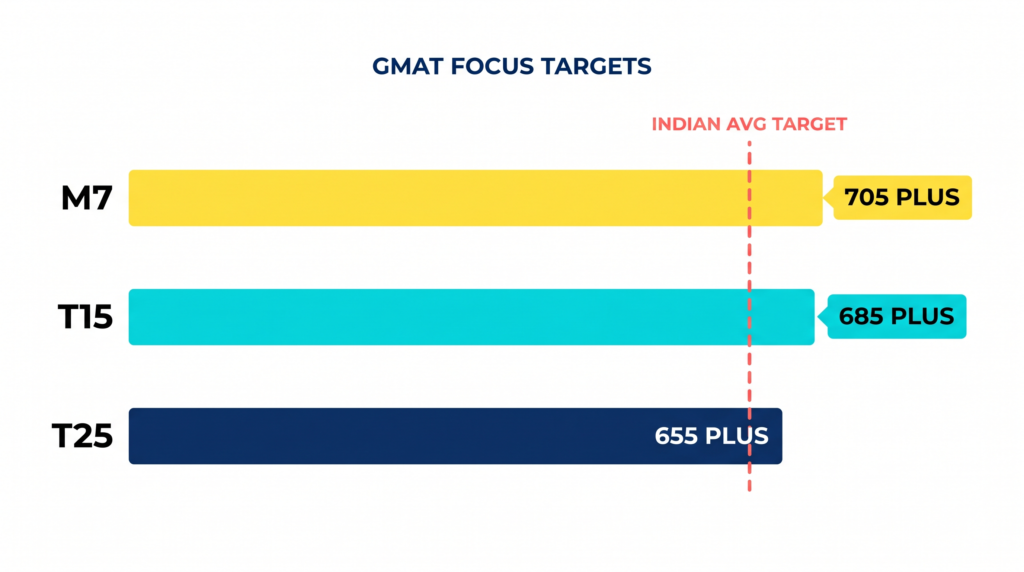
School Tier | Legacy GMAT (Class Avg) | GMAT Focus (Class Avg) | GMAT Focus (Indian Target) | GRE (Avg) |
M7 (HBS, Stanford, Kellogg) | 733 | 685 | 695 | 328 |
T15 (Darden, Tuck, Yale) | 725 | 671 | 681 | 322 |
T25 (Kelley, Tepper, McCombs) | 700 | 645 | 655 | 315 |
A critical point: the “Indian Target” column is roughly 10 points above the class average because you’re competing within the over-represented Indian pool. A 671 GMAT Focus might match the class average at Darden, but it’s below average for admitted Indian applicants at that same school. The GMAT Focus Edition (scale 205 to 805) is now the only version available since the legacy GMAT was discontinued in February 2024. Schools are reporting both scores during the transition, but going forward, Focus scores are what matter.
What About Indian MBA Entrance Exams?
If you’re targeting Indian programs – the IIMs, ISB, XLRI, SPJIMR – the entrance exam world is completely different. CAT is the primary gateway for IIMs. XAT covers XLRI and several other schools. NMAT covers NMIMS. These are domestic exams with domestic scoring norms. They don’t translate to global programs.
I’ve had applicants ask me, “Can I use my CAT score for US MBA programs?” The answer is no. Global programs require GMAT or GRE. Period. If you’re considering both Indian and global MBA programs, you’ll need to prepare for at least two different exams.
Here’s how I advise applicants on this decision after two decades of watching how test scores interact with profiles. First, take a diagnostic for both tests. Don’t guess. Your diagnostic performance tells you which format plays to your strengths. Second, look at your target schools and your cluster. If you’re an Indian male IT professional fighting for M7 schools, your GMAT Focus score needs to be around 10 to 15 points above the class average – that’s roughly 695 to 715 on the Focus Edition. If your diagnostics suggest you can’t get there on the GMAT but your GRE verbal is strong, switch. Third, and this is critical – do not spend more than 4 to 5 months on test prep. I’ve seen applicants burn 8 to 10 months chasing a perfect score while their profile-building window closes. The test is a threshold. Once you’re past it, every additional hour on GMAT prep has diminishing returns compared to an hour spent on networking or essay strategy.
MBA Admission Requirements Beyond Your Test Score
Here’s where most guides on MBA admission requirements fail you. They list the requirements – transcripts, test scores, essays, recommendations – and move on. That tells you nothing about what actually gets people admitted. MBA admission requirements are not a checklist. They’re a canvas.
In 19 years of this work, I’ve identified seven dimensions that every top MBA application is evaluated on. Schools may weight them differently, but all seven matter:
- Academic Capability. Demonstrated through your undergraduate GPA, GMAT/GRE score, and any additional quantitative coursework. If your undergrad percentage is below 65%, you’ll need a strong test score and possibly supplemental coursework to compensate.
- Professional Impact. Not your title. Not your company name. Your impact. Did you lead a team? Did you drive revenue? Did you improve a process? Admissions committees at schools like Booth and Stern are looking for evidence that you made things happen, not that you occupied a chair.
- Leadership Evidence. Both professional and community. Wharton and Kellogg weigh this especially heavily. And leadership doesn’t mean “manager.” It means influence, initiative, and the ability to move people toward a goal.
- Post-MBA Goal Clarity. Why do you need this MBA? Why now? Why this school? If your answer is vague – “I want to transition to a leadership role” – you’re done. Your goals need to be specific, credible, and connected to your past experience.
- Community Contribution. Extracurricular activities, volunteer work, mentorship. This is the most under-developed area for Indian IT professionals, and it’s often the reason strong profiles get rejected.
- Self-Awareness and Maturity. Stanford GSB’s famous “What matters most to you?” essay is the extreme version, but every school is probing for this. Can you reflect honestly on your strengths, weaknesses, and motivations?
- Cultural Fit and Diversity Contribution. Each school has a culture. INSEAD values global citizens. Tuck values tight-knit community builders. Haas values social impact. Your application needs to signal that you belong in that specific community. Our MBA profile evaluation service is designed to assess exactly where you stand across all seven dimensions.
These seven MBA admission requirements are interconnected. A gap in one can be offset by strength in another, but only if you’re strategic about it.
Let me tell you about Raghav. When Raghav came to us, he’d already been told by top consultants that his chances of cracking a top-tier business school were slim. He was at Grail Research, and his initial goal was product sales and marketing for a global pharmaceutical company. Noble ambition, but too generic – business schools would’ve yawned at it.
We looked at his profile differently. His research background gave him exactly the transferable skills that consulting firms look for – problem-solving, analytical depth, industry understanding. We reshaped his entire narrative around a consulting career post-MBA, and suddenly his story clicked. His research experience wasn’t a limitation; it was his differentiator.
The road wasn’t smooth. Raghav had a rough Tuck interview where he’d previously met the interviewer at an MBA event in Delhi and they hadn’t gotten along. Then his Kellogg alumni interview at a Cafe Coffee Day lasted all of 10 minutes because the interviewer was rushing to work. He came back to me saying, “Jatin, this is so unfortunate. I don’t know if I’ll make it after this.” But setbacks are part of the process. We rebuilt his confidence and pushed forward.
The results? Kenan-Flagler offered him a 100% scholarship. Ross gave him a 40% scholarship. That’s ₹1.6 crores in total scholarships for someone the industry had written off. Today, Raghav is at McKinsey – one of the most prestigious consulting firms in the world. His story proves exactly what I keep saying: a gap in one dimension can be overcome if you’re strategic about compensating across the others.
Documents Required for MBA Admission: The Complete Checklist
Let’s talk about the documents required for MBA admission at global programs. The documents required for MBA admission vary slightly by school, but the core set is consistent. Here’s exactly what you need to prepare:
Official Transcripts. From every undergraduate and postgraduate institution you attended. Indian universities can be slow with this – start requesting transcripts at least 2-3 months before your earliest deadline. Some schools accept scanned copies initially and require official documents only after admission. Many US schools also require a WES (World Education Services) evaluation to convert your Indian percentage or CGPA into the US 4.0 scale – this process alone takes 4-6 weeks, so plan ahead.
GMAT or GRE Score Report. Sent directly from GMAC or ETS to your target schools. You can send scores to up to five schools for free at the time of the test. Additional reports cost $28–35 each.
TOEFL or IELTS Score (if required). Many schools waive this for applicants who completed their undergraduate degree in English. Check each school’s policy – some will waive it if your workplace language is English; others won’t.
Resume/CV. One page. Non-negotiable at most schools. This isn’t your job-search resume. It’s a strategic document designed to give the admissions committee a quick snapshot of your professional progression, key achievements, and community involvement.
Essays. Every school has its own essay prompts. Some require one; some require three. HBS has one open-ended essay. Stanford GSB has two deeply introspective ones. Wharton asks about your contribution to the community. Your statement of purpose for MBA and application essays need to be tailored to each school’s personality and values.
Letters of Recommendation. Typically two. Most schools strongly prefer professional recommenders (your direct supervisors) over academic ones. The best recommendation letters don’t just praise you – they provide specific, vivid examples of your leadership and impact.
Application Form and Short-Answer Questions. Most schools use their own online application portal. Short-answer questions often include: “Why this school?” “Describe your career goals.” “What will you contribute to the class?” Don’t treat these as throwaway fields. Every word is read.
Financial Documentation (for scholarship applications). Some schools, especially European ones like INSEAD and LBS, require proof of financial ability. Scholarship applications often require additional documentation about your financial situation.
The MBA Application Process: From First Decision to Final Admit
The MBA application process is where strategy meets execution. And the MBA application process at top schools is designed to be holistic – which is admissions-speak for “we look at everything, and everything needs to work together.”
Here’s what the process actually looks like from the inside:
Round Selection: The Most Underrated Decision
Most competitive programs run three rounds. Round 1 (September–October deadlines) gets the largest share of admits. Round 2 (January deadlines) is the most competitive. Round 3 is effectively waitlist territory for most top schools.
My recommendation for Indian applicants: apply Round 1 wherever possible. The over-represented pool fills up fast. By Round 2, many schools have already admitted a significant number of Indian applicants and have less room for your demographic. I’ve seen identical profiles get admitted in R1 and rejected in R2 at the same school. Round strategy matters. Our guide on application timeline and deadlines breaks down every major school’s deadlines and optimal timing.
School Portfolio Construction
Apply to 7 to 9 schools if you’re targeting around 2 countries. Not 3 and not 15. Seven to nine is the sweet spot where you can invest enough quality time in each application while maintaining a strategic mix of reach, target, and safety schools.
I also want to add something here. Your school portfolio should include diversity of school types, not just diversity of rankings. One M7, two or three T15, two T25, and one or two European programs is a strong portfolio for most Indian applicants. Every school in your list should be one you’d genuinely attend.
Essay Strategy: Not One Story, But One Theme
The biggest mistake in essay writing? Telling a different story at every school. Your narrative should be consistent – the same career arc, the same core motivations – but adapted to each school’s specific questions and values. I’ve reviewed thousands of essays that try to reinvent the applicant for each school. Admissions committees see through it immediately.
Your essays should answer three questions clearly: Where have you been? Where are you going? Why do you need this specific school to get there? For essay-specific strategies for every top school, read our complete MBA application essay guide.
Recommendations: Choose Strategically
Your recommenders should be people who have directly supervised your work and can provide specific examples of your leadership, impact, and growth areas. In Indian corporate culture, there’s a tendency to go for the most senior person possible. Don’t. A VP who barely knows you will write a generic letter. A direct manager who has seen you in action will write a letter that changes the game.
Interviews: The Final Gate
If you’re invited to interview, you’re in the top 40–60% of applicants. The interview is your chance to bring your application to life. Be specific, be authentic, and know why you want that particular school. Generic answers kill interview performance.
Here’s something I’ve built over 19 years that no other consultant has: a cluster-based school selection model. I don’t rely on linear rankings because rankings change every year without anything intrinsically changing inside a program. Instead, I’ve grouped schools into three clusters – A, B, and C – with each cluster split into an upper and lower segment. Schools within the same cluster are similar in prominence, career outcomes, salary potential, and brand reputation. I’ve tracked the performance and rankings of these schools over the last 18+ years to assign these clusters.
When I build a school portfolio, I look at your GMAT score, work experience, goals, undergrad GPA, the country you want to study in, and your demographic. Based on all of these, I map you to the right cluster combination. For example, an Indian male applicant targeting US schools will find the lower-A cluster very competitive, while an Indian female applicant might find more openings there. Someone looking at Europe alongside the US gets a completely different cluster mix.
I recommend 7 to 9 programs across Round 1 and Round 2 if you’re looking at around 2 countries. Out of these, applicants do 4 to 5 with me – the ones with the toughest essay combinations – and the rest on their own using the frameworks we’ve already built together. The logic is simple: I want people to have a lot of options in terms of admits and scholarships toward the end. And more schools reduces the anxiety of any single rejection. Don’t fall in love with any school emotionally during the process. Think of it very objectively. Finish the process thoroughly, and compare your options only after you have them on the table.
Current Trends Shaping MBA Admission Today
Whether you’re looking at MBA admission for this cycle or next, certain trends are reshaping how top schools evaluate applicants. These aren’t temporary shifts – they’re structural changes that every Indian applicant needs to understand.
Application volumes are consistently high. Top programs like HBS and Stanford GSB receive 7,000 to 10,000 applications per cycle, and the post-COVID rebound has stabilised at these elevated levels. For Indian applicants, this matters because the Indian pool consistently represents the largest international demographic at most top US schools. More volume means tighter competition within your demographic pool. I’ve seen this play out year after year – the Indian male IT applicant pool at M7 schools is so dense that profiles with 720+ GMAT scores and strong work experience still face rejection rates above 85%.
The GMAT Focus Edition is the new reality. The legacy GMAT was discontinued in February 2024. Schools are now reporting Focus Edition averages: HBS median is 685, Kellogg averages 687, Darden and Tuck both average 671. If you haven’t adjusted your score targets to the Focus Edition scale (205 to 805), do it now. And GRE submissions are rising fast – at HBS, 44% of the most recent class submitted GRE scores, up significantly from previous years.
Essay prompts are getting more personal. HBS simplified its essay. Stanford GSB kept its deeply introspective format. Columbia introduced a short-video component. The direction across schools is toward genuine self-awareness and away from formulaic career-goals narratives. This favours applicants who invest in real reflection, not template-driven writing.
Diversity signals matter more than ever. Schools are increasingly explicit about building classes with diverse professional backgrounds, nationalities, and perspectives. For Indian applicants, this is a double-edged sword. You’re in the most competitive international pool, but if you can demonstrate a genuinely unique angle – an uncommon industry, a non-traditional career path, deep community impact – you stand out more than ever. The applicants I work with who break from the Indian IT mould consistently outperform those who don’t.
Scholarship competition is intensifying. More schools are offering merit-based scholarships to attract top international talent. But scholarship applications are essentially a second application process. At PythaGURUS, we’ve helped applicants secure over ₹200 crores in cumulative MBA scholarships – and the common thread is that scholarship winners invested time in their applications far earlier than the average applicant.
What never changes: the fundamentals. Schools value clear career goals, demonstrated leadership, community impact, and the ability to contribute to the class. No amount of trend-chasing replaces a strong, well-positioned application.
MBA Admission Tips That Actually Move the Needle
After 19 years of doing this, here are the MBA admission tips that I know make the difference. These MBA admission tips are not the generic advice you’ll find on forums. They’re patterns I’ve seen across thousands of real applications.
Tip 1: Start 12–18 months early. The best applications are not written in 6 weeks. They’re built over 12–18 months. Profile building, networking, test preparation, school visits – all of this takes time. If your target deadline is September, you should have started by the previous January at the latest.
Tip 2: Your MBA story is not your resume. Your resume lists what you did. Your MBA application explains why it matters and where it’s taking you. I’ve seen applicants with ordinary resumes get into M7 schools because their narrative was compelling, specific, and authentic. And I’ve seen IIT-IIM applicants with perfect stats get rejected because their application read like a LinkedIn profile.
Tip 3: Do not let your recommenders wing it. Brief your recommenders thoroughly. Tell them which stories to highlight. Give them the specific examples you want them to reference. A great recommendation letter does not happen by accident. It happens because you prepared your recommender with the same rigour you prepared your essays.
Tip 4: Address weaknesses head-on. Low GPA? Career gap? Short work experience? Do not ignore it and hope nobody notices. Every admissions committee member will notice. Use the optional essay or the right essay section to address it directly, explain it honestly, and show what you’ve done to compensate.
Tip 5: Invest in school-specific research. Attend info sessions. Talk to alumni. Visit campus if possible. “Why this school?” is the most important question in your application, and the only way to answer it well is to actually know the school. Generic answers like “I love your collaborative culture” get applications rejected. Specific answers like “I want to work with Professor X’s fintech lab and recruit into Y industry through your Z trek” get applications admitted.
Tip 6: Apply in Round 1. I cannot stress this enough for Indian applicants. Round 1 gives you the best odds. The seat availability is highest, and the over-represented pool has not filled up yet. If you’re not ready for Round 1, it’s often better to wait a full year and apply Round 1 the next cycle than to rush a Round 2 application.
Tip 7: Do not confuse activity with impact. I’ve seen applicants list 15 extracurricular activities, none of them meaningful. Three sustained, impactful activities are worth more than fifteen surface-level ones. Admissions committees want depth, not breadth.
And here’s the contrarian tip nobody else will give you: the application is not where you tell your best story. It’s where you tell the right story for the right audience. The best version of you for HBS is different from the best version of you for INSEAD. Positioning is everything.
The principle that drives everything at PythaGURUS is something I call the Handicap Framework. Most applicants approach their essays by telling business schools why the school is great. That’s writing a brochure for the MBA program. We do the opposite. We identify 8 specific handicaps – career gaps, skill deficiencies, knowledge voids – that stand between where you are today and where you want to be. These 8 handicaps become the entire foundation of your application.
Why does this work? Because when you walk into a networking call and ask, “I’m trying to move from supply chain at a mid-size Indian manufacturer to operational consulting at a PE firm, and I don’t understand how valuation models work in the context of portfolio companies – can you tell me how your MBA helped you bridge that specific gap?” – that question is so specific, so thoughtful, that the other person actually wants to help you. Your essays become impossible to reject because they’re grounded in real self-awareness, not borrowed brochure language. Your interview answers are sharp because you’ve spent months understanding your own gaps.
The whole idea is this. You are not telling the school why they are the best school in the world. You are telling them why that school sits perfectly between where you are now and where you’re headed – and the 8 handicaps are the proof. That level of positioning is what separates a generic application from one that gets admits with scholarships. I’ve trained this approach over two decades, and applicants who go deep on their handicaps consistently outperform applicants with stronger profiles but weaker self-awareness.
Frequently Asked Questions About the MBA Admission Process
What is the ideal work experience for MBA admission?
Most top MBA programs admit students with 3–6 years of post-undergraduate work experience. The median at M7 schools is around 5 years. However, the quality of your experience matters far more than the duration. Two years of high-impact consulting work can outweigh six years of repetitive project management. Schools want evidence of progression, leadership, and increasing responsibility.
Can I get into a top MBA program with a low GPA?
Yes, but you need to compensate strategically. A strong GMAT/GRE score (730+ for M7 schools) helps offset a low GPA. Taking quantitative coursework through platforms like Coursera or university extension programs demonstrates academic capability. I’ve guided applicants with 55–60% undergraduate scores into T15 programs by building a strong compensating narrative.
How many MBA programs should I apply to?
Seven to nine is the optimal range if you’re targeting around 2 countries. Fewer than five limits your odds; more than ten dilutes the quality of each application. Structure your list as a portfolio: 2–3 reach schools, 3–4 target schools, and 1–2 safety schools. Every school on your list should be one you’d genuinely attend if admitted.
Is MBA admission harder for Indian applicants?
Statistically, yes – Indian applicants face lower acceptance rates at most top global programs because they represent the largest international applicant pool. This does not mean it’s impossible. It means you need sharper positioning, stronger differentiation, and a more strategic school selection process than applicants from less-represented countries.
When should I start preparing for MBA admission?
If you’re targeting Round 1 deadlines (September-October), start your GMAT/GRE preparation and profile building by January-March of the same year at the latest. Ideally, serious test preparation begins 6–9 months before your target deadline, and profile building starts 12–18 months before.
Ready to Start Your MBA Admission Process?
The MBA admission process rewards preparation, strategy, and self-awareness. It does not reward procrastination, generic applications, or copy-paste advice from internet forums.
At PythaGURUS, our 1,500+ applicants have secured 2,700+ admits at the world’s top business schools – Harvard, Stanford, Wharton, INSEAD, Kellogg, Booth, and every other M7 and T15 program. Our founder, Jatin Bhandari (Darden MBA), has spent 19+ years doing this. He’s seen every profile type, every challenge, and every path to admission.
If you’re serious about a top MBA, the first step is a Comprehensive Profile Evaluation from PythaGURUS. We’ll assess your profile across all seven dimensions, identify your strengths and gaps, build a preliminary school portfolio, and give you a clear roadmap to your strongest possible application.