MBA Eligibility: What You Actually Need to Get Into a Top Program
MBA eligibility looks simple on paper but gets complicated fast. Do you need a 4-year degree or will a 3-year Indian BCom work? What’s the real minimum GMAT score for your target schools? Does your 62% undergraduate percentage put you out of the running? These are not irrational worries – they’re real questions with answers that change depending on the school, the country, and your specific demographic. And getting them wrong can cost you an entire application cycle.
The problem is that most eligibility guides online give you a generic checklist and move on. They don’t tell you that Columbia and Haas prefer 4-year degrees while Harvard and Wharton don’t care. They don’t tell you that a 680 GMAT might be competitive for a T25 school but below the threshold for an Indian male applicant at a T15 program. As I covered in our complete MBA admission process guide, admissions is a strategic positioning exercise – and eligibility is where that strategy starts. This article gives you the real, school-specific answers.
MBA Eligibility Criteria for Top Global Programs
Let me break down the actual MBA eligibility criteria for top programs, because most websites give you a generic list and call it a day. MBA eligibility criteria vary significantly depending on whether you’re targeting US schools, European programs, Indian B-schools, or schools in Canada and APAC.
For US MBA programs (M7, T15, T25): You need a bachelor’s degree from a recognized institution, a valid GMAT Focus or GRE score, professional work experience (sweet spot is 3-6 years), English proficiency (TOEFL/IELTS if your undergrad wasn’t in English), and strong essays and recommendations. There’s no minimum GPA requirement listed by most schools. No minimum GMAT cutoff published. But don’t let that fool you – the unofficial thresholds are real, and I’ll cover those below.
For European MBA programs (INSEAD, LBS, HEC, IESE): Similar academic requirements, but work experience expectations run higher – INSEAD’s average is around 6 years. INSEAD also requires two alumni interviews conducted in different locations, often different countries. LBS and HEC look for strong international exposure. European schools tend to be more flexible on GPA but very particular about career diversity and maturity.
For Indian MBA programs (IIMs, ISB, XLRI): The eligibility criteria shift completely. IIMs require a CAT score and typically want a bachelor’s degree with 50%+ marks (45% for reserved categories). ISB requires a valid GMAT/GRE and a minimum of 2 years work experience but tends to prefer 4-5+ years. XLRI uses XAT. The scoring norms, the selection process, the academic cutoffs – everything is different from global programs.
This is the part most people miss. Meeting the basic MBA eligibility criteria gets your application read. It doesn’t get you admitted. The real criteria – the ones that separate admits from rejects – are about what you’ve done with your career, how clearly you articulate your goals, and whether you bring something the class needs.
Here’s what I can tell you from pattern recognition across nearly two decades. The eligibility bar is not the same for everyone – it shifts dramatically based on your demographic. An Indian male IT professional from TCS or Infosys with a 680 GMAT Focus is fighting in the most competitive pool on the planet. That same score for an Indian woman from a non-tech background – say healthcare administration or media – puts her in a significantly less crowded pool. I’ve seen applicants with 58% undergrad scores (including myself) crack top-10 programs, and applicants with 80%+ and 720 GMAT scores get rejected everywhere because they couldn’t articulate why they needed an MBA. The eligibility bar is not about your numbers. It’s about your numbers relative to your pool, combined with the strength of your story. During our Comprehensive Profile Analysis, I map every applicant against their specific demographic pool – not against the general class average – because that’s what admissions committees actually do.
Minimum Percentage for MBA: What Indian Applicants Need to Know
The minimum percentage for MBA admission is one of the most misunderstood topics in this space. Indian applicants in particular stress about their undergraduate marks because our education system conditions us to believe that percentage defines capability. So let me set the record straight on what minimum percentage for MBA programs actually looks like.
For US and European MBA programs: There is no published minimum percentage requirement. None. Harvard doesn’t have a GPA cutoff. Stanford doesn’t reject you automatically for a 60% undergraduate score. I got into 4 top-10 programs with a 58% undergrad – and a 100% fellowship at Darden. What matters is the overall narrative: if your GPA is low, your GMAT score, work experience, and career progression need to compensate. And you need to address it proactively in your application, not hope nobody notices.
For Indian MBA programs: The rules are explicit. Most IIMs require a minimum of 50% in graduation (45% for SC/ST/PwD). ISB doesn’t publish a hard cutoff but their admitted students typically have 65%+ or a 7+ CGPA. XLRI, SPJIMR, and MDI have similar thresholds, often with relaxation for reserved categories.
But here’s something most guides won’t tell you: even within schools that publish minimum percentage cutoffs, the practical threshold is much higher than the published one. IIM Ahmedabad’s published minimum is 50%, but the candidates who actually convert calls typically have 70%+ or equivalent CGPAs. The published number keeps you from being automatically filtered out. The practical number is what makes you competitive in the interview room. Don’t confuse the two. If you’re an applicant with 55-60% marks targeting IIM A or B, your CAT percentile needs to be extraordinary – think 99.5%+ – to compensate. For ISB, a 65% undergrad with a strong GMAT Focus score of 680+ and 5+ years of solid work experience is competitive. Below 60% at ISB, your chances drop significantly unless your career story is genuinely exceptional.
Here’s what I tell every applicant who comes to me worried about marks: if your undergraduate percentage is below 60%, you need a GMAT score that’s well above the class average of your target schools. A 685+ GMAT Focus score tells the admissions committee that your academic ability is not defined by a percentage you earned at 21. And if your marks are below 55%, consider additional quantitative coursework through Coursera or university extension programs to demonstrate recent academic readiness.
The reality? I’ve seen applicants with 55% get into T15 schools, and applicants with 85% get rejected from T25 schools. Percentage is a data point, not a verdict.
Eligibility for MBA After Graduation: 15 vs 16 Years of Education
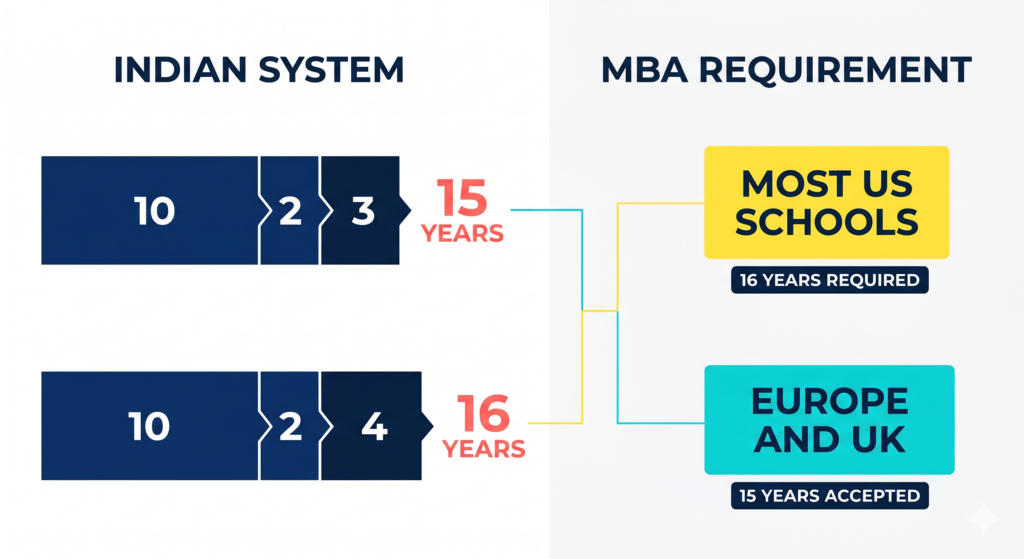
This is the section that most MBA guides completely ignore, and it trips up more Indian applicants than almost any other eligibility for MBA after graduation question. If you completed a 3-year bachelor’s degree in India (10+2+3 = 15 years of formal education), your eligibility for MBA after graduation at certain global programs is affected. Some schools require 16 years of formal education (10+2+4) and a 3-year Indian degree doesn’t meet that threshold.
Why does this matter? Because India’s most common undergraduate degrees – B.Com, BA, BSc from most universities – are 3-year programs. Only B.Tech/BE (4 years), integrated programs, and some newer universities offer 4-year degrees. If you have a 3-year degree, you need to know which schools accept 15 years and which require 16.
School-by-School Breakdown: Who Accepts 15 Years, Who Doesn’t
Let me be clear: this is not a universal “all US schools accept 3-year degrees” situation. Some top US programs explicitly prefer or require 16 years of education. Here’s the school-by-school picture based on publicly available admissions policies:
School | 3-Year Degree (15 Yrs) Accepted? | Notes |
Harvard Business School | Yes | Accepts 3-year Indian degrees |
Stanford GSB | Yes | Accepts 3-year Indian degrees |
Wharton | Yes | Accepts 3-year Indian degrees |
Kellogg | Yes | Accepts 3-year Indian degrees |
Booth | Yes | Accepts 3-year Indian degrees |
MIT Sloan | Yes | Accepts 3-year Indian degrees |
Columbia Business School | Prefers 4-year degree | 3-year applicants may face disadvantage; additional qualifications help |
UC Berkeley Haas | Prefers 4-year degree | Explicitly states 4-year bachelor’s preferred |
Yale SOM | Conditional | Requires 4-year degree or equivalent; 3-year applicants typically need additional master’s |
CMU Tepper | Prefers 4-year degree | Verify directly with admissions |
Darden | Yes | Accepts 3-year Indian degrees |
Tuck | Yes | Accepts 3-year Indian degrees |
Ross | Yes | Accepts 3-year Indian degrees |
Fuqua | Yes | Accepts 3-year Indian degrees |
INSEAD | Yes | Accepts 3-year Indian degrees |
LBS | Yes | Accepts 3-year Indian degrees |
HEC Paris | Yes | Accepts 3-year Indian degrees |
Oxford Said | Yes | Accepts 3-year Indian degrees |
Cambridge Judge | Yes | Accepts 3-year Indian degrees |
IESE | Yes | Accepts 3-year Indian degrees |
ISB | Yes | Accepts 3-year Indian degrees |
Rotman (Canada) | Often requires 16 years | May need PG diploma or master’s to bridge |
Ivey (Canada) | Often requires 16 years | Check directly; some flexibility in recent years |
NUS (Singapore) | Typically requires 16 years | 3-year degree may need supplemental qualifications |
NTU (Singapore) | Typically requires 16 years | 3-year degree may need supplemental qualifications |
Melbourne (Australia) | Typically requires 16 years | WES or equivalency evaluation may help |
The bottom line: Don’t assume. If you have a 3-year Indian degree, check each school’s specific policy before investing months in an application. Schools like Haas, Columbia, Yale SOM, and Tepper are known to prefer 4-year degrees even within the US. Most Canadian, Singaporean, and Australian schools lean toward requiring 16 years. And policies change – always verify directly with the admissions office and get written confirmation.
If you have a 3-year degree and are targeting a school that requires 16 years, you have options. A postgraduate diploma, a master’s degree, or even a professional certification (CA, CFA Level 2+) can sometimes satisfy the requirement. But don’t bank on it without checking first.
That said, we’ve had tremendous success even with applicants who had only 15 years of education. Take Priyanshi – she had a 3-year degree and worked at a firm that wasn’t exactly a household name. Despite that, she secured admits to 2 top-20 business schools with ₹1.35 crores in total scholarships. Her story is proof that 15 years of education is not a barrier if the rest of your application is positioned right. Watch a video testimonial on cracking top-20 schools with a 3-year degree.
And she’s not the only one. Look at Fahad – he also had 15 years of education (12+3) and cracked London Business School and Darden School of Business. Two of the most competitive programs in the world, and he did it without a 4-year degree. Watch Fahd’s video on getting into LBS and Darden with 15 years of education.
MBA Admission Requirements That Go Beyond Your Transcript
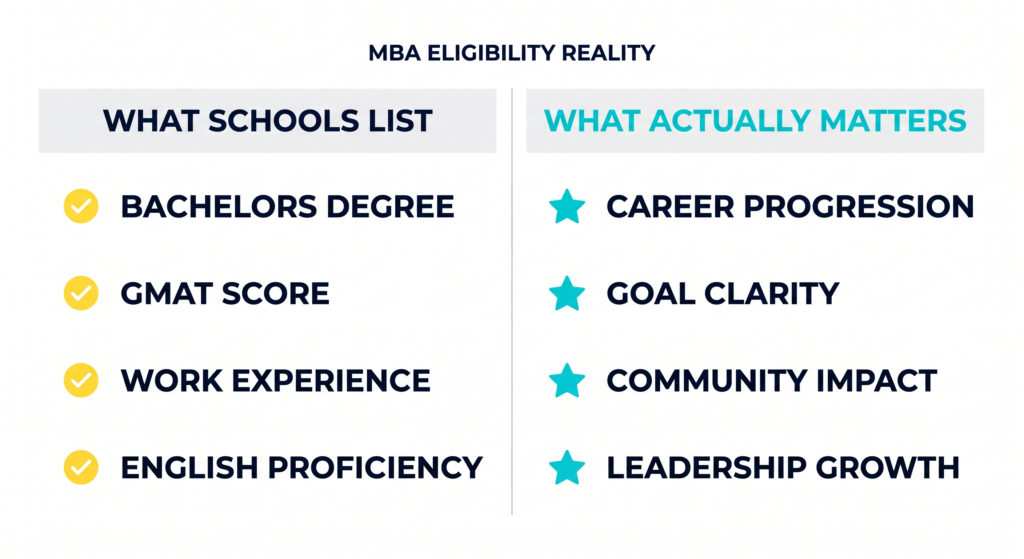
Here’s where most eligibility guides stop, and where the real game begins. MBA admission requirements at competitive programs go far beyond academic credentials. MBA admission requirements include a set of soft and strategic factors that determine who actually gets in versus who just meets the minimum bar.
I’ve identified seven dimensions across 19 years of consulting – I covered them briefly in the MBA admission process guide, but let me go deeper here on the three that Indian applicants most consistently underestimate:
Career progression, not just tenure. Five years at TCS doing the same role with a title change is not progression. Three years at a startup where you went from individual contributor to managing a team of 8 and launching a product line – that’s progression. Schools want to see that your responsibilities expanded, not just that your calendar advanced.
Community contribution and extracurriculars. This is the biggest gap for Indian IT professionals. Your work is strong. Your GMAT is good. But when the admissions committee asks, “What has this person done outside of work?” and the answer is “nothing sustained” – that’s a rejection waiting to happen. You need at least one meaningful extracurricular commitment with demonstrated impact. Not a weekend volunteering event. Something sustained over 12+ months where you actually led or built something.
Post-MBA goal clarity. “I want to move into a leadership role” is not a goal. “I want to transition from IT services delivery at Infosys to product management at a B2B SaaS company, focusing on enterprise automation” – that’s a goal. The sharper your goals, the easier every other part of the application becomes – your school selection, your essays, your networking, your interview answers. Everything flows from goals.
When someone comes to us for a Comprehensive Profile Analysis, we don’t just look at GMAT and GPA. We run them through a detailed questionnaire covering strengths, weaknesses, short-term and long-term goals, extracurricular depth, leadership examples, and career trajectory. Based on their responses, I give them a thorough written analysis before we even get on a call. The most common gaps I see in Indian applicant profiles? Two things come up again and again.
First, extracurriculars. Most Indian IT professionals have zero sustained community involvement. They’ve done a weekend blood donation drive or a one-time NGO visit and they think that counts. It doesn’t. Schools want to see 12+ months of sustained commitment where you actually led or built something. Second, goal clarity. When I ask “what do you want to do after your MBA?”, the answer I get 80% of the time is some version of “I want to move into a leadership role.” That’s not a goal. That’s a vague aspiration. We fix this in Step 2 of our process – the Goals Analysis – where we identify 8 specific career handicaps that define exactly why you need an MBA. Once those handicaps are clear, everything else in your application becomes sharper.
Timeline to fix these gaps? If you’re starting from scratch on extracurriculars, give yourself 12 months minimum. You can’t manufacture a year of community leadership in 3 months. For goal clarity, we can usually get there in 4-6 weeks of intensive work through our process. But the earlier you start, the stronger your application will be.
MBA Eligibility After 12th: How Early Should You Start Planning?
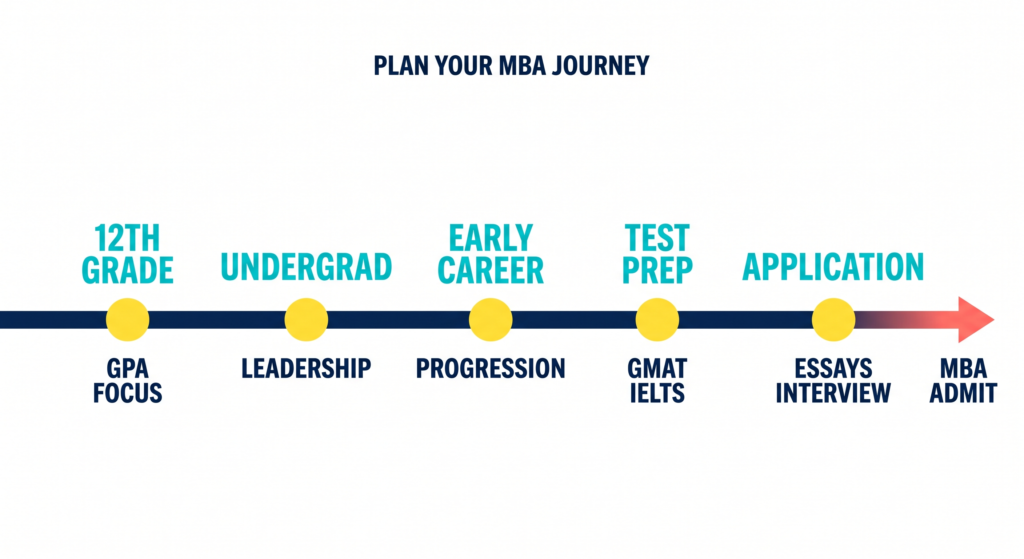
I get asked about MBA eligibility after 12th more often than you’d expect, usually from parents or from students in their first year of engineering or commerce college. Can you start planning for an MBA after 12th? The short answer: MBA eligibility after 12th is about building the right foundation, not about applying early.
No top MBA program admits students straight out of 12th or even straight out of undergrad (with rare exceptions like HBS 2+2 or Stanford’s deferred enrollment programs, which accept college seniors for admission 2-4 years later). The standard expectation is 2-8 years of post-undergraduate work experience, with the sweet spot at 4-6 years.
But if you’re in 12th or early college and thinking about an MBA, here’s what actually matters at this stage:
- Choose your undergrad wisely. A 4-year B.Tech from an IIT or a strong private university gives you more flexibility than a 3-year BCom from a tier-3 college – not because of the degree itself, but because of the career opportunities it opens. The 15 vs 16 year education issue I covered above also favours 4-year programs.
- Focus on GPA. Your undergraduate percentage will follow you to every MBA application. It’s much easier to maintain a strong GPA now than to compensate for a low one later with GMAT scores and extra coursework.
- Build early leadership experiences. College clubs, social initiatives, sports captaincy, organizing events – these become the foundation of your extracurricular profile 5-8 years from now when you actually apply.
- Don’t optimize too early for MBA. The biggest mistake I see is students who engineer every decision around a future MBA application. Live your career. Take risks. Build real skills. The MBA application will be stronger because of genuine experiences, not manufactured ones.
5. Think about your industry choice carefully. The industry you enter after undergrad shapes your MBA candidacy more than you realise. If you end up in a large Indian IT services company doing the same project management work as 50,000 other engineers, you’ll be competing in the most crowded applicant pool when you apply. But if you enter a niche manufacturing role, a healthcare startup, a media company, or even a government position – you bring diversity that admissions committees actively seek. I’m not saying avoid IT. I’m saying if you do go into IT, make sure you’re doing work that’s genuinely differentiated – product development, client-facing strategy, or cross-functional leadership – not cookie-cutter delivery management
Eligibility Criteria for MBA: How It Differs by Program Type
The eligibility criteria for MBA abroadaren’t one-size-fits-all. What qualifies you for a full-time 2-year MBA is different from what’s needed for a 1-year MBA, an executive MBA, or an online MBA. Understanding these differences in eligibility criteria for MBA programs helps you target the right format for your profile.
Full-time 2-year MBA (US model): Bachelor’s degree, GMAT/GRE, 2-8 years work experience, English proficiency. This is the standard format at all M7 and most T15/T25 US schools. Best for applicants aged 25-30 with clear career switch or acceleration goals.
Full-time 1-year MBA (European and Indian model): Same academic requirements, but higher work experience expectations – typically 5+ years. INSEAD, LBS, ISB, and IIM one-year programs fall here. These programs move fast and expect you to hit the ground running.
Executive MBA (EMBA): Usually requires 10+ years of work experience with significant management responsibility. GMAT/GRE is often optional or waived. Schools like Wharton EMBA, Kellogg-HKUST, and ISB PGPMAX target senior professionals who can’t take 2 years off work. The eligibility bar here is less about test scores and more about the seniority and scope of your role. If you’re a VP or director-level professional managing P&L responsibility, teams, or cross-functional projects, you’re in the right zone. If you’re 12 years into your career but still in an individual contributor role, most EMBA programs will push back.
Deferred enrollment programs: HBS 2+2, Stanford’s deferred enrollment, Booth Scholars, Yale Silver Scholars accept applications from current college students or recent graduates. You apply now, work for 2-5 years, and then matriculate. Eligibility is unique: you need to demonstrate leadership potential before you have a full career behind you. For Indian students at IITs or top universities, these are worth exploring seriously – the acceptance rates can be more favourable than the regular application pool because fewer people know about them.
Online and hybrid MBA programs: Programs like Kelley Direct (Indiana), Warwick WMG, and several AACSB-accredited online MBAs have more relaxed eligibility criteria – some accept applicants with 2+ years of experience and no GMAT. But be careful here. The ROI calculation is completely different from a full-time program, and employer perception of online MBAs varies dramatically by industry and geography. If you’re considering this route, make sure the program’s placement data supports your specific career goals.
Frequently Asked Questions About MBA Eligibility
What documents are required for MBA admission?
The core documents required for MBA admission at global programs include: official transcripts, GMAT/GRE score report, TOEFL/IELTS scores (if applicable), a one-page resume, 2 recommendation letters, essays, and the completed application form. Some schools require additional financial documentation for scholarship applications. European schools like INSEAD may require passport copies and proof of financial ability. The full list of documents required for MBA admission varies by school, so start collecting transcripts 2-3 months before your earliest deadline – Indian universities are notoriously slow.
What is the MBA admission process step by step?
The MBA admission process step by step involves: (1) self-assessment and profile building, (2) GMAT/GRE preparation, (3) school research and shortlisting, (4) networking with alumni, (5) essay writing and recommendation management, (6) application submission, (7) interview preparation, and (8) decision and scholarship negotiation. The entire process typically takes 12-18 months if done right. I covered this in depth in our MBA admission process guide.
Can I get an MBA with a 3-year bachelor’s degree from India?
Yes, for most top global programs. All US and UK MBA programs accept 3-year Indian degrees. Some schools in Canada, Singapore, and Australia may require 16 years of education, which means you’d need additional qualifications to compensate. See the detailed 15 vs 16 year breakdown in this article.
Is there an age limit for MBA eligibility?
There’s no formal age limit at any top MBA program. That said, the average age for full-time MBA students is 27-28, and most students are between 25-32. If you’re 35+ with 12+ years of experience, an Executive MBA format is usually a better fit than a full-time program. Schools won’t reject you for age, but your ROI case needs to be strong.
Do I need work experience for MBA eligibility?
For most top MBA programs, yes. The typical requirement is 2-8 years of post-undergraduate professional work experience. The sweet spot is 4-6 years. Some deferred enrollment programs (HBS 2+2, Stanford deferred) allow college seniors to apply, but even those require 2-5 years of work before you actually start the MBA.
Not Sure If You're Eligible? Let's Find Out
MBA eligibility is not about meeting a minimum bar. It’s about understanding where your profile stands, what gaps exist, and which schools are the right fit for your specific combination of strengths and weaknesses.
At PythaGURUS, our 1,500+ applicants have secured 2,700+ admits at the world’s top business schools. Our founder, Jatin Bhandari (Darden MBA), has spent 19+ years evaluating profiles across every industry, every function, and every education background you can imagine.
If you’re wondering whether your profile is strong enough – or which schools are realistic for you – the first step is a Comprehensive Profile Evaluation from PythaGURUS. We’ll assess your MBA eligibility across all seven dimensions, identify your strengths and gaps, build a preliminary school portfolio, and give you an honest, no-nonsense roadmap.
Book your Comprehensive Profile Evaluation today. Stop guessing about your eligibility. Get a clear answer.