Statement of Purpose for MBA: How to Write One That Actually Gets You In
Every week, I review SOPs that read like LinkedIn summaries. “I have 5 years of experience in IT and I want to pursue an MBA to enhance my leadership skills and transition to a strategic role.” That’s not a statement of purpose for MBA admission. That’s a sentence that tells the admissions committee nothing about who you are, where you’re headed, or why their school matters to your future. And it’s the reason most applicants get rejected.
A strong statement of purpose for MBA programs is not about impressing a school. It’s about making the school believe that you are a customer who knows exactly what you’re buying and why. I’ve reviewed thousands of SOPs across two decades. The ones that win admits and scholarships all share one thing: depth. Not length – depth. The applicant understands their own gaps, knows precisely how the MBA fills those gaps, and can articulate all of it with specificity that no generic template can produce. As I covered in our MBA admission process guide, admissions is a positioning exercise. Your SOP is where that positioning lives or dies.
How to Write SOP for MBA: The Framework That Works
Before I tell you how to write SOP for MBA programs, let me tell you what not to do. Do not Google “SOP template” and fill in the blanks. Do not copy a framework from Reddit or Quora. And definitely do not start writing before you’ve done the hard thinking about your goals. Here’s how to write SOP for MBA applications that actually convert:
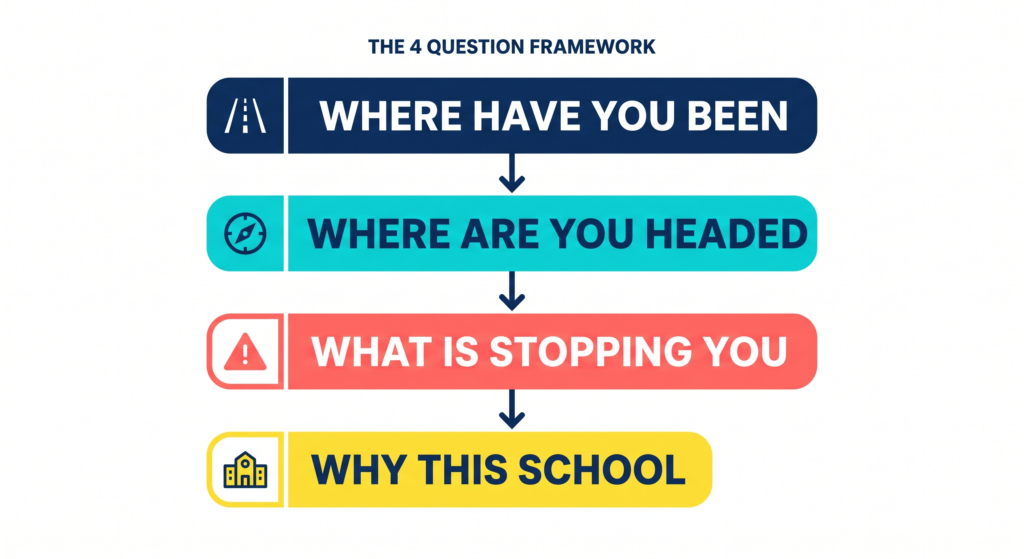
Every effective SOP answers four questions in sequence. Miss one, and the whole thing falls apart:
- Where have you been? This is your career story – not a resume dump. The admissions committee wants to see progression, key decisions, transferable skills, and moments where you demonstrated impact. A supply chain manager at Tata Motors who reduced manufacturing costs by 35% through a first-of-its-kind technology implementation has a story. A software developer who “worked on multiple projects” does not.
- Where are you headed? Your short-term and long-term goals. And this is where 90% of Indian applicants go wrong. They write goals that are vague, generic, or disconnected from their past. “I want to move into a strategic leadership role” means nothing. “I want to join the operational consulting team at a PE firm focused on manufacturing buyouts, using my supply chain and plant operations experience to lead due-diligence during acquisitions” – that means something.
- What’s stopping you? This is what I call the Handicap Framework. You need to identify the specific gaps – skills, knowledge, networks, credentials – that stand between your current position and your goals. Most applicants skip this entirely. But this is the section that makes admissions committees lean forward. When you can clearly articulate what’s missing and why you can’t get it from your current job, the “why MBA” question answers itself.
- Why this school? Not “your school is ranked #7 and has a great alumni network.” But “Professor X’s fintech lab, the Y career trek, and the Z club are specifically relevant because of my handicap in understanding how technology valuations work in cross-border PE deals.” The more specific you are, the harder it is for the admissions committee to say no.
At PythaGURUS, we train applicants to identify 8 specific handicaps before they write a single word of their SOP. These handicaps become the backbone of the entire application – your SOP, your school selection, your networking questions, and your interview answers all flow from this analysis. I was the first MBA admissions consultant in India to build dedicated training modules – Management Consulting Mastery, Investment Banking Mastery, Product Management Mastery, Supply Chain Mastery – specifically to help applicants develop the depth of understanding they need before they can write a credible SOP. Because here’s the thing: if you don’t genuinely understand the career you’re writing about, no amount of editing will save your essay.
MBA SOP Format: Structure, Length, and What Schools Expect
The MBA SOP format varies by school, but the underlying principles are consistent. Understanding the MBA SOP format saves you from the most common structural mistakes I see every application season.
Word count: Most schools give you 500-1000 words for the main essay (career goals / statement of purpose). Some schools like HBS give you one open-ended essay with no word limit but expect around 900 words. Stanford GSB asks two essays – one on “what matters most” and one on “why Stanford.” Columbia gives a short-answer format. Don’t assume one format fits all.
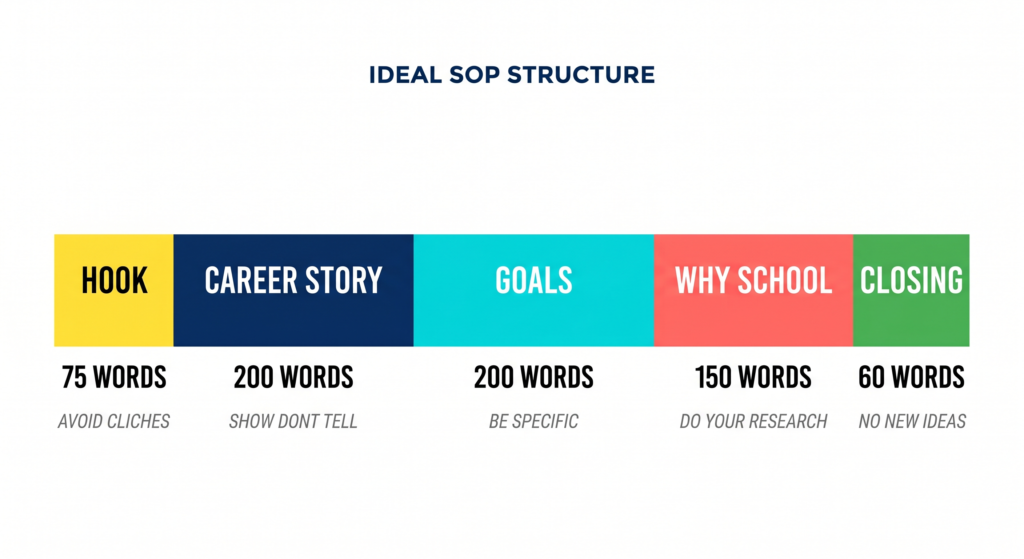
Structure: There’s no universal template, but the strongest SOPs I’ve seen follow a narrative arc rather than a bullet-point structure:
Section | Purpose | Approx. Length | Common Mistake |
Opening hook | Grab attention with a specific moment or insight | 50-100 words | Starting with “Since childhood, I wanted to…” |
Career story | Show progression, decisions, impact | 150-250 words | Resume dump with no narrative thread |
Goals + Handicaps | Specific ST/LT goals and why MBA is needed | 150-250 words | Vague goals like “leadership role” |
Why this school | Specific resources, people, programs | 100-200 words | Copying school brochure language |
Closing | Forward momentum, contribution to class | 50-75 words | Repeating what was already said |
Tone: Conversational but professional. First person always. Active voice. No academic jargon. The best SOPs read like a smart person explaining their life plan to a mentor over coffee – not like a research paper. And never, ever use AI to write your SOP from scratch. Admissions committees have read thousands of essays – they can spot AI-generated content from the first paragraph.
School-specific format differences matter. HBS gives you one essay with broad freedom – use it to tell your most compelling story, not to list achievements. Stanford GSB’s Essay A asks “what matters most to you and why” – this is deeply personal, not a career goals essay. Wharton asks about your contribution to the community. Kellogg wants specific examples of leadership and teamwork. INSEAD asks a motivation essay plus a leadership essay plus an optional essay. Each school’s MBA SOP format is different because each school is looking for something different. Writing one generic SOP and submitting it across 8 schools is the fastest path to 8 rejections.
SOP for MBA Abroad: What International Schools Care About
Writing an SOP for MBA abroad is fundamentally different from writing one for Indian programs. The depth expectation, the format, and the evaluation criteria are all different. If you’re targeting schools in the US, Europe, or Canada, your SOP for MBA abroad needs to address some things that Indian applicants consistently miss.
Employability matters more than you think. The biggest shift in mindset I push with every applicant targeting international programs is this: stop trying to impress the school. Start behaving like a customer. You’re evaluating whether this MBA program is the right investment for your career. When you write from that perspective – clearly showing how the school’s specific resources will help you become employable in your target role – the dynamic changes completely. Schools don’t want applicants who are desperate for a brand name. They want applicants who will get hired, boost the employment statistics, and become successful alumni.
I also want to add something here. Most Indian applicants write their “why this school” section by copying points from the school’s website. “Kellogg’s collaborative culture” or “Booth’s analytical rigour” – these are sentences the school wrote about itself. They add zero value to your SOP. What adds value is connecting a specific school resource to a specific gap in your profile. “I don’t currently understand how to model technology valuations for cross-border PE deals. Professor X’s course on emerging market valuations and the Y Private Equity Club’s annual deal competition would directly address this gap.” That’s specific. That’s credible. That’s the kind of SOP that wins scholarships.
Cultural context matters. If you grew up in India, worked in India, and have limited international exposure – own it. Don’t pretend to be a global citizen if you’re not one yet. Instead, use it as a motivation: “I’ve built my career entirely in the Indian manufacturing sector. I need international exposure to understand how global supply chains operate differently, and INSEAD’s multicultural cohort with students from 80+ nationalities is the most efficient way to build that understanding.” Honesty about where you are is more compelling than manufactured cosmopolitanism.
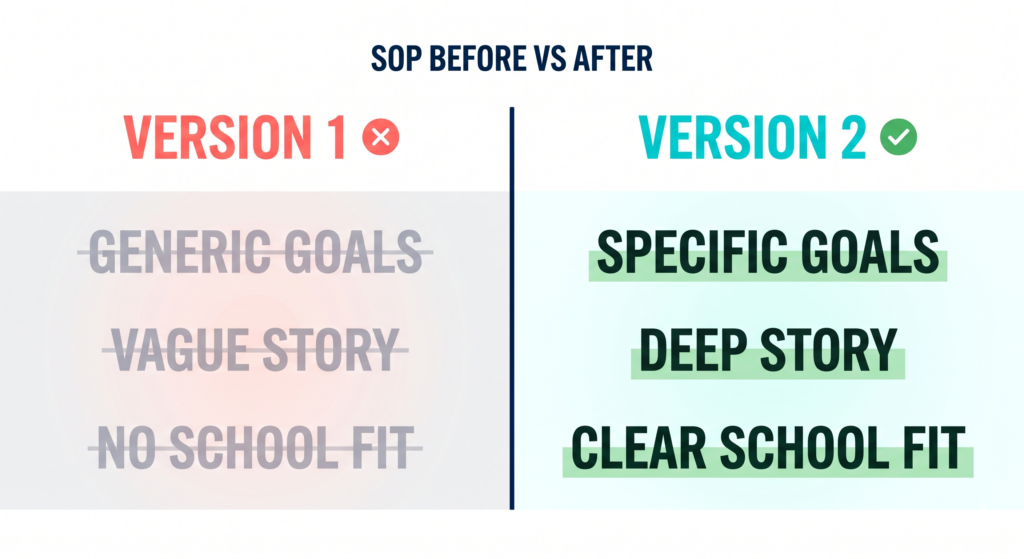
Let me show you what I mean with a real example from how I train applicants. Here’s what I call the Version 1 vs Version 2 framework. Version 1 is what most applicants write on their first attempt. Version 2 is where we take them after the goals analysis.
Version 1 sounds like this: “I have worked across various functions in the manufacturing business starting from engineering to operations and marketing. Now I want to make a move into finance and join a private equity player that deals in the manufacturing industry. My overall view of the manufacturing business and understanding of various functions have made me a strong manager.” That’s generic. It tells the admissions committee nothing about why this person specifically needs an MBA, or why they can’t just apply to PE firms directly.
Version 2 for the same applicant sounds completely different. It starts with a well-connected story: the specific transferable skills (leading teams, implementing first-of-its-kind technology, reducing costs by 35%), then names precise goals (joining the operational consulting team at a PE firm focused on manufacturing buyouts), then articulates the handicaps – “I don’t understand how valuation models work in cross-border deals. I’ve never worked with LP-GP structures. I don’t know how to assess management teams during due-diligence.” And then it connects each handicap to a specific school resource that addresses it.
The gap between Version 1 and Version 2 is not writing talent. It’s depth of thinking. And that depth comes from our goals analysis process, the Mastery Modules (Management Consulting Mastery, Investment Banking Mastery, Product Management Mastery), and 20-30 targeted networking calls. By the time an applicant has gone through all of this, they don’t need a template. Their SOP writes itself because they genuinely understand what they want and why.
Best SOP for MBA: What Separates Winners from Rejects
What makes the best SOP for MBA applications? After reviewing thousands of essays, I can tell you the best SOP for MBA admission is not the one with the fanciest vocabulary or the most impressive-sounding goals. It’s the one with the deepest self-awareness.
Let me explain what I mean with a pattern I see constantly. Two applicants come to me with nearly identical profiles – both from Indian IT companies, both with 5 years of experience, both with 700+ GMAT Focus scores, both wanting to move into product management. Applicant A writes: “My experience in software development has given me technical skills. Now I want an MBA to develop business and leadership skills for a product management career.” Applicant B writes: “After leading the migration of 200,000 users from a legacy CRM to a cloud-based platform at Wipro, I realized the hardest part wasn’t the technology – it was understanding why customers resisted the change. I don’t have the frameworks to think about product adoption, user psychology, or go-to-market strategy. These are the specific gaps I need to fill.”
Applicant B gets admitted. Every time. Because Applicant B has done the work of understanding what’s actually missing. And that clarity doesn’t come from writing talent. It comes from deep reflection, targeted networking, and genuine career research.
The whole idea is this: the best SOPs are not written. They are discovered. You don’t sit down and craft a story from scratch. You do the 20-30 networking calls, you identify your 8 handicaps, you understand exactly how a specific school fills those handicaps, and then the SOP practically writes itself.
I also want to add something here. The applicants who secure the largest scholarships are not the ones with the most polished writing. They’re the ones who behave like customers, not supplicants. When your SOP reads like you’re evaluating whether the school is the right investment for your career – rather than begging for a seat – the power dynamic shifts. Schools become insecure about losing you. And when schools are insecure about losing a candidate, they offer money. Every single high-scholarship admit I’ve worked with had an SOP that radiated this energy: “I know exactly what I need, I know exactly how your school provides it, and I’m assessing whether you’re the best place for me to spend two years.” That confidence comes from genuine preparation, not from attitude.
Manasa is a perfect example of this. When she first came to us, she had a strong background in data science and consulting, but her goals lacked the clarity admissions committees need. She’d worked across marketing, products, and risk management and wanted to move into product management – but she couldn’t connect her scattered experience into a coherent narrative. Her SOP read like a list of things she’d done, not a story about where she was headed.
We worked on every aspect of her application – resume, recommendations, essays, short-term and long-term goals, interview preparation. The breakthrough came when we sharpened her goals down to something specific and credible: “My immediate post-MBA goal is to land a Product Management role in a leading tech company such as Google or Facebook, blending my data science experience with product thinking to develop products that impact lives globally.” That single sentence of clarity changed everything. Her data science background wasn’t a random career detour anymore – it was her competitive advantage for product management.
The results? UC Berkeley Haas – admitted. Cornell Johnson – ₹70 lakh scholarship. UNC Kenan-Flagler – full tuition scholarship. UCLA Anderson – ₹82 lakh scholarship. Dartmouth Tuck – admitted. That’s ₹2.2 crores in total scholarships. And it all started with fixing her goals. Not her writing. Not her GMAT. Her goals. Watch Manasa’s video testimonial on securing ₹2.2 crores in scholarships across 5 top schools.
SOP for MBA Admission: Mistakes That Get You Rejected
Even strong profiles get rejected because of avoidable SOP for MBA admission mistakes. Here are the patterns I see destroy applications every single year – and what to do instead for your SOP for MBA admission.
Mistake 1: Writing goals you don’t believe in. If you can’t explain your short-term goals with conviction in a 2-minute conversation without looking at notes, your SOP will read as manufactured. Admissions committees can feel when someone has borrowed goals from a sample SOP versus when someone has genuinely researched and networked their way into understanding a career path.
Mistake 2: Making the SOP about your past, not your future. Your career achievements matter, but only as evidence of where you’re headed. I’ve seen SOPs that spend 600 out of 800 words on past experience and squeeze goals into 2 sentences. Flip that ratio. Your past is context. Your future is the story.
Mistake 3: Using the same SOP for every school. The career story and goals can stay consistent across applications. But the “why this school” section must be rewritten from scratch for every single school. Kellogg’s team-based culture is not Booth’s analytical rigour is not INSEAD’s global immersion. If you submit a generic “why this school” section, expect rejection.
Mistake 4: Ignoring the “why now” question. Even if a school doesn’t explicitly ask “why now,” your SOP must answer it. Why is this the right time in your career for an MBA? If you have 3 years of experience, why not wait until 5? If you have 8 years, why not do an EMBA? The timing needs to make sense.
Mistake 5: Skipping networking before writing. This is the biggest one. If you haven’t spoken to alumni, current students, and industry professionals before writing your SOP, your “why this school” section will be generic. And generic gets rejected. At PythaGURUS, we don’t let applicants touch their SOP until they’ve completed at least 15-20 targeted networking calls. The insights from those calls become the raw material for an SOP that no template can produce.
Mistake 6: Writing about what you’ll learn, not what you’ll become. “I want to learn finance and strategy at Booth” is about the school. “After learning valuation frameworks and deal structuring at Booth, I’ll join the PE team at Bain Capital to lead operational due-diligence for manufacturing acquisitions in South Asia” is about your transformation. Schools don’t admit students to teach them things. They admit students who will use what they learn to create impact. Your SOP needs to show the impact, not just the input.
Frequently Asked Questions About MBA SOP Writing
Can you share an SOP for MBA sample or template?
I deliberately don’t share SOP for MBA sample templates because they cause more harm than good. When you read a sample SOP, you unconsciously mimic its structure, phrasing, and even its goals – and admissions committees have seen every template on the internet. Instead of seeking samples, invest your time in networking calls and self-reflection. A genuine SOP built from your real experiences will always outperform one modelled on someone else’s story.
Are statement of purpose MBA examples available online reliable?
Most statement of purpose MBA examples you find online are either fabricated, outdated, or from applicants targeting schools well below the M7/T15 tier. The few genuine ones that exist online were written for a specific applicant’s profile and cannot be adapted to yours without destroying what made them work. Your SOP needs to be built from your unique career trajectory, your specific goals, and your individual handicaps.
How long should an MBA SOP be?
It depends on the school’s instructions. Most career goals essays are 500-1000 words. HBS gives you roughly 900 words with no strict limit. Stanford GSB’s Essay B on “why Stanford” is 650 words. Never exceed the stated limit, and don’t pad short essays with filler. If the school says 500 words, write 480 sharp words rather than 500 mediocre ones.
Should I mention weaknesses in my SOP?
Yes – but frame them as handicaps, not weaknesses. There’s a critical difference. A weakness sounds like an apology: “I don’t have finance experience.” A handicap sounds like strategic awareness: “My career has been entirely operations-focused, which means I lack the financial modelling skills needed for PE deal evaluation. This is precisely what I need from the MBA.” The second version turns a gap into a reason for the MBA.
Your SOP Won't Write Itself. But Your Story Is Already There.
A statement of purpose for MBA admission is not a writing exercise. It’s a thinking exercise. The writing is the easy part. The hard part is doing the self-reflection, the networking, the goals research, and the school-specific analysis that gives you something real to write about.
At PythaGURUS, our 1,500+ applicants have secured 2,700+ admits at the world’s top business schools. Our founder, Jatin Bhandari (Darden MBA), has personally reviewed thousands of SOPs and knows exactly what admissions committees at Harvard, Stanford, Wharton, INSEAD, Kellogg, and every other top program look for.
If you’re staring at a blank page and don’t know where to start, the first step isn’t writing. It’s a Comprehensive Profile Evaluation from PythaGURUS. We’ll assess your profile, identify your career handicaps, and give you a clear roadmap for building an SOP that no template can replicate.
Book your Comprehensive Profile Evaluation today. Let’s turn your story into admits.