
MBA Abroad Eligibility: What Indian Students Actually Need
I’ve had applicants come to me convinced they weren’t eligible for an MBA abroad because their GPA was 58% or they didn’t have a GMAT score yet. The single biggest misconception I see is that mba abroad eligibility is a hard gate with fixed cutoffs. It’s not. Every school evaluates holistically, and the “eligibility” bar is far more flexible than generic websites make it sound.
Let me walk you through the real mba abroad eligibility requirements – what actually matters, what’s negotiable, and where Indian applicants consistently misread the signals. After guiding 1,500+ Indian professionals through this process over 19 years, I know exactly which concerns are valid and which are wasted anxiety. For the complete strategic picture, start with our comprehensive guide to studying MBA abroad.
Eligibility for MBA Abroad: The Four Pillars That Matter
The eligibility for mba abroad comes down to four core components. Every business school in the world evaluates some version of these four, though they weigh them differently. Understanding how eligibility for mba abroad really works helps you focus your preparation on what moves the needle.
- Academic qualification: A bachelor’s degree from a recognised university. That’s the baseline. Most schools don’t specify a minimum GPA – they look at the quality of your institution and your academic trajectory. A 65% from IIT carries more weight than an 85% from an unknown college. Indian applicants from IITs, NITs, BITS, SRCC, St. Xavier’s, and similar institutions have a built-in credibility advantage.
- Standardised test score: GMAT, GRE, or (increasingly) Executive Assessment. This is the most misunderstood component – I’ll break it down in detail in the GMAT section below.
- Work experience: Most top MBA programmes want 2-7 years of full-time professional experience. Zero experience? You’re looking at MiM programmes or deferred enrolment, not traditional MBAs. 10+ years? You might be better suited for executive MBA or senior executive programmes like LBS Sloan or INSEAD EMBA.
- English proficiency: IELTS 7.0+ or TOEFL 100+ for non-native English speakers. Many schools waive this if your undergraduate degree was taught in English – which covers most Indian applicants from English-medium universities.
Here’s what I want you to understand: none of these four pillars is a pass/fail gate. They’re evaluated together. A 615 GMAT Focus score with 8 years of exceptional work experience at McKinsey is a stronger application than a 705 GMAT Focus with 3 years of unremarkable work at a mid-tier firm. Schools are building a class, not checking boxes.
Requirements for MBA Abroad: What Top Schools Actually Expect
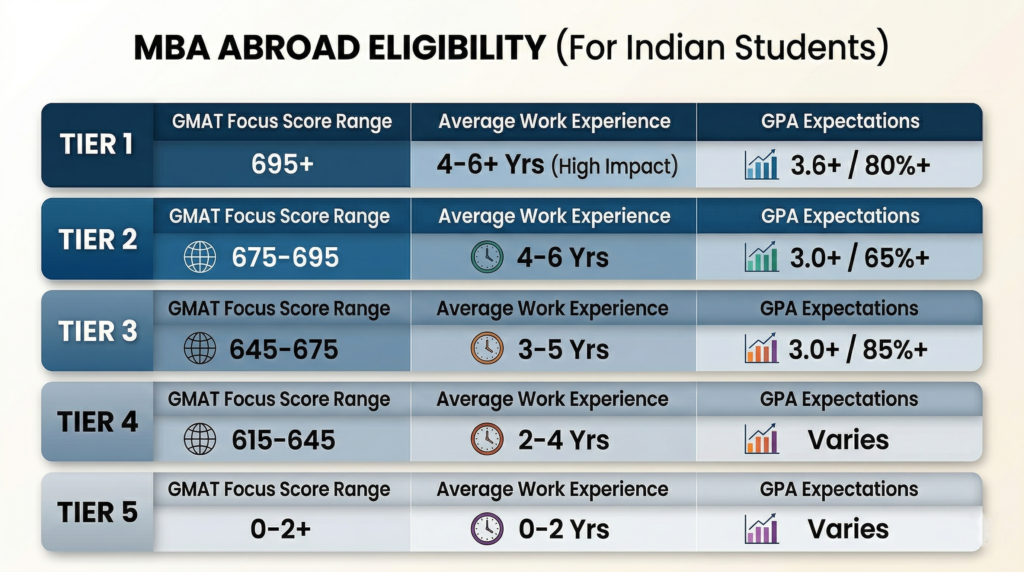
The requirements for mba abroad vary by school tier. Here’s a realistic picture of requirements for mba abroad at different levels, based on what I’ve seen work for Indian applicants across 1,500+ cases.
School Tier | GMAT Focus | Work Exp | GPA/Academics | What Really Differentiates |
M7 (HBS, Stanford, Wharton) | 685+ | 4-7 years | Top institution preferred | Unique narrative, leadership impact, clear goals |
T15 (Kellogg, Booth, Tuck) | 675+ | 3-6 years | 60%+ from good college | Career progression, essay quality, school fit |
T25 (Darden, Fuqua, Ross) | 665+ | 3-5 years | 60%+ acceptable | Clear goals, strong recs, demonstrated growth |
European Top (INSEAD, LBS, HEC) | 675+ | 3-8 years | Varies widely | International exposure, language skills, global mindset |
T25-50 (Emory, Kenan-Flagler) | 645+ | 2-5 years | 55%+ acceptable | Scholarship-driven, community contribution |
The most important column in that table is the last one. Once you meet the baseline requirements for mba abroad, the differentiators are all about narrative, positioning, and fit – not about having a higher GMAT or better GPA. This is the part most applicants get wrong. They spend months chasing a GMAT Focus score increase from 675 to 695 when they should be investing that time in building a compelling career story.
Documents Required for MBA Abroad: The Complete Checklist
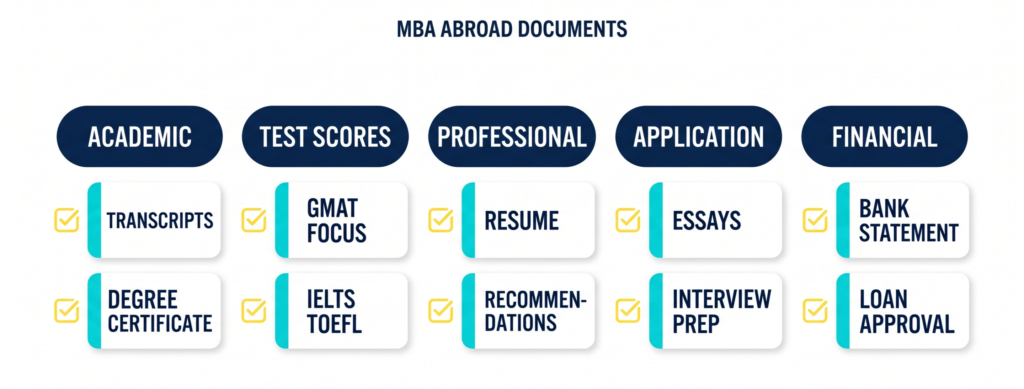
Every Indian applicant asks about documents required for mba abroad at some point. Here’s the complete list of documents required for mba abroad that you’ll need for almost every application.
Academic documents: Bachelor’s degree certificate and transcripts (mark sheets for all years/semesters). Some schools want these sent directly from your university in a sealed envelope. If your transcripts are in a language other than English, you’ll need certified translations. WES or ECE evaluation may be required by some US and Canadian schools.
Test scores: GMAT/GRE official score report (sent directly from the testing agency to each school). IELTS/TOEFL score report if required. These have expiration dates – GMAT scores are valid for 5 years, IELTS for 2 years.
Professional documents: Updated CV/resume (MBA format – not the Indian biodata style). Two letters of recommendation (typically one from a current supervisor and one from a previous or senior colleague). Employment verification letters may be requested after admission.
Application materials: Essays (2-4 per school, each with specific prompts). Application form with personal details, academic history, and work experience. Application fee (typically $100-250 per school). Interview – either by invitation or as part of the standard process.
Financial documents (post-admission): Proof of funds or loan sanction letter for visa processing. Bank statements showing sufficient funds. Scholarship letters if applicable. These aren’t needed at application time – only after you’ve been admitted and are applying for a student visa.
MBA Abroad Admission Requirements: The Unwritten Rules
The mba abroad admission requirements you’ll find on school websites are just the starting point. The real mba abroad admission requirements – the ones that determine whether you get admitted or rejected – are largely unwritten. After 19 years of doing this, here’s what actually matters.
Career progression, not just years: Schools don’t just count your years of experience – they evaluate the trajectory. A Deloitte consultant who went from analyst to senior consultant to manager in 5 years tells a stronger story than someone who spent 5 years in the same role at the same company. Indian IT professionals at TCS, Infosys, or Wipro often struggle here because the corporate structure doesn’t always show clear progression on paper. We spend significant time helping these clients reframe their experience to show genuine growth and impact.
Leadership evidence, not leadership titles: You don’t need to be a VP to demonstrate leadership. Admissions committees want evidence that you’ve influenced outcomes, taken initiative, and made decisions that mattered. An Indian engineer who led a 5-person team that delivered a ₹10 crore project on time has a leadership story. They just need to tell it properly.
The most common rejection reason I see for Indian applicants – especially IT professionals – isn’t a low GMAT or low GPA. It’s a shallow narrative. India is a competitive country. We’ve been trained since school to think everything is about scores and marks. So when Indian applicants approach MBA admissions, they bring the same mindset: “I scored 715 on GMAT Focus, I have a 75% GPA, I work at Amazon – why didn’t I get in?” Because schools don’t need another high-scoring Indian IT professional with a generic career goals essay. They need someone whose story has depth, character, and a genuine connection between past experience and future ambition. I’ve seen applicants with 735 Focus scores come to us after rejections from T15 schools, confused about what went wrong. When we looked at their essays, the answer was obvious – beautifully written language, zero depth of thought. Schools can spot a well-crafted essay that says nothing meaningful. The admission requirement nobody lists on their website is this: you need a story that makes the admissions committee remember you after reading 500 other applications that day.
What Is Required for MBA Abroad: Experience Requirements by Programme Type
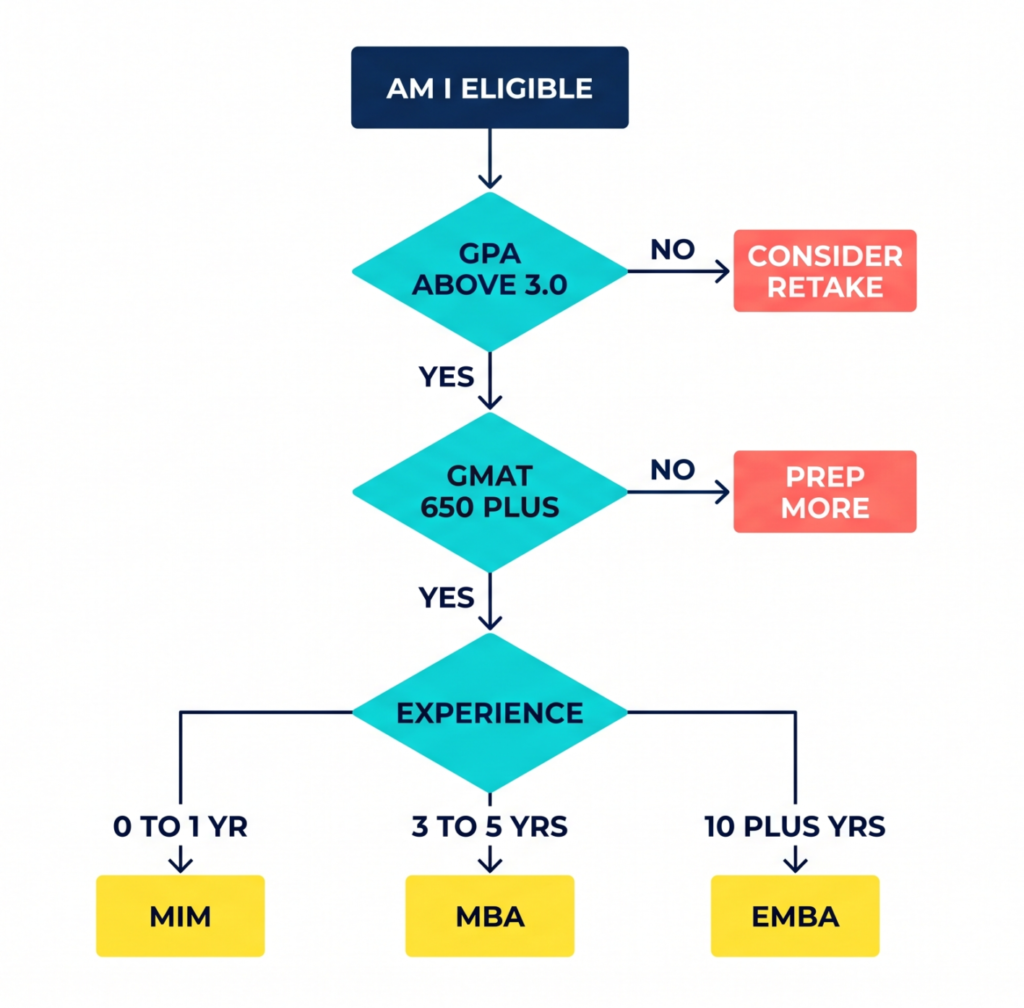
Understanding what is required for mba abroad depends heavily on which type of programme you’re targeting. The experience requirements shift dramatically. Here’s what is required for mba abroad across the major programme formats.
Traditional 2-year MBA (US): 3-7 years of work experience is the sweet spot. Under 3 years and you’re competing against applicants with more professional substance. Over 7 years and you might be better served by an EMBA. Indian applicants with 4-5 years at companies like Amazon, McKinsey, Goldman Sachs, or Tata Group are in prime position.
1-year MBA (Europe): 3-10 years, depending on the school. INSEAD averages 6 years. IE accepts candidates with as little as 2. For Indians with 5+ years who want speed, the European one-year format is ideal.
Zero experience: If you’re a fresh graduate or have under 2 years of experience, a traditional MBA is not the right programme. You need a Masters in Management (MiM) programme instead. Schools like HEC Paris, ESCP, and IE offer excellent MiM programmes designed specifically for early-career applicants. For a deeper look at this, see our guide on MBA abroad without work experience
10+ years: Executive MBA (EMBA) or senior executive programmes. LBS Sloan, INSEAD EMBA, Wharton EMBA, and Kellogg EMBA are designed for senior professionals who can’t take 1-2 years away from their careers. These programmes run on weekends or in modular formats.
GMAT Requirement for MBA Abroad: The Real Score Thresholds
The gmat requirement for mba abroad is the single most researched and most misunderstood aspect of MBA eligibility. Here’s what the gmat requirement for mba abroad actually looks like for Indian applicants.
For Indians specifically, the competitive GMAT thresholds are higher than the school averages suggest. Why? Because Indians are in the over-represented applicant pool. When a school reports a GMAT Focus Edition average of 685 (equivalent to roughly 730 on the old Legacy GMAT), that average includes applicants from under-represented countries who may have been admitted with lower scores. Indian applicants competing against thousands of other Indian applicants need to be at or above the average to be competitive.
M7 schools: 685+ on GMAT Focus Edition for Indian male applicants (equivalent to about 740 on Legacy GMAT). Indian female applicants can be competitive at 675-685 Focus. The reported Focus averages at M7 schools range from 675 to 690 – Stanford reports 689, HBS 685, Columbia 690. Higher is always better – the higher your score, the more flexibility you have in every other part of your application.
T15 schools: 675+ on GMAT Focus Edition (equivalent to about 720 on Legacy GMAT) for a strong Indian application. Again, higher is better. A 685 Focus at Kellogg or Booth gives you a genuinely competitive position.
T25 schools: 665+ on GMAT Focus Edition (equivalent to about 710 on Legacy GMAT) is the competitive range. Schools like Darden, Fuqua, and Ross expect strong scores – 675+ Focus puts you in a comfortable zone. This is where Indian applicants with solid work experience and a clear narrative can find excellent programmes with real scholarship potential.
The whole idea is this: your GMAT score gets you past the initial filter. After that filter, it stops mattering. No one gets admitted because of their GMAT score. They get admitted because their GMAT score was good enough AND their story was compelling. I’ve seen applicants with 645 Focus scores get into T15 schools because their narrative, work experience, and essay quality were outstanding. That’s the power of strategic positioning – it makes a good score work harder than a great score with a generic application.
Eligibility Criteria for MBA Abroad: Common Indian Applicant Concerns
Let me address the specific eligibility criteria for mba abroad concerns that Indian applicants raise most often. These are the questions I get asked every single week. Understanding the real eligibility criteria for mba abroad helps you stop worrying about the wrong things.
“My GPA is low (55-60%). Am I eligible?” Yes. A low GPA from a strong institution is different from a low GPA from a weak institution. And a strong GMAT score can offset a low GPA significantly. I’ve guided applicants with 55% GPAs into T25 schools. The key: don’t pretend the GPA doesn’t exist. Address it in the optional essay, and let your GMAT and work experience demonstrate your intellectual capability.
“I don’t have a bachelor’s in business. Am I eligible?” Absolutely. Most MBA applicants are NOT business graduates. Engineers, doctors, lawyers, military officers, artists – MBA programmes want diversity of academic backgrounds. Being a BTech or BSc graduate is an advantage, not a disadvantage.
“I’ve been at the same company for 7+ years. Is that a problem?” Not inherently, but you need to show progression. If you’ve been promoted, taken on new responsibilities, or led increasingly complex projects, you’re fine. If you’ve been in the same role for 7 years with no visible growth, that’s a red flag you need to address.
“I’m over 30. Am I too old?” For a traditional full-time MBA, the average age is 27-29. Being 30-33 is fine at most schools. Over 33 for a full-time programme is possible but less common – consider EMBA or senior executive programmes instead. European schools (INSEAD, LBS) tend to have slightly older average ages than US schools.
MBA Abroad Without GMAT: Is It Actually Possible?
The question of mba abroad without gmat has exploded in popularity since COVID. Can you genuinely do an mba abroad without gmat? Yes – but with significant caveats that most articles won’t tell you.
Schools that accept without GMAT: IE Business School (Spain) offers its own proprietary assessment. Several UK schools (Warwick, Cranfield, some Imperial programmes) accept applicants based on academic credentials and experience alone. Some Canadian schools accept GMAT waivers for applicants with strong professional credentials.
Test-optional (you can skip it, but should you?): Post-COVID, many US schools made the GMAT optional. But “optional” doesn’t mean “irrelevant.” If you’re an Indian IT professional without a GMAT, you’re competing against other Indian IT professionals who DO have strong GMAT scores. Not submitting a score when most of your competition does puts you at a disadvantage.
My honest recommendation: Take the GMAT. It costs ₹22,000 and takes 2-3 months of preparation. A strong GMAT score opens more doors, strengthens scholarship applications, and removes doubt from admissions committees. The only scenario where I’d skip the GMAT is if you’re targeting a specific school that genuinely doesn’t require it AND you have overwhelming professional credentials that make the test unnecessary. For 95% of Indian applicants, taking the GMAT is the right call.
Frequently Asked Questions
Q: What is the minimum GPA for MBA abroad?
There’s no universal minimum. Most schools evaluate holistically. Indian applicants with 55-60% from strong institutions (IITs, NITs, top colleges) regularly get admitted to T15-T25 programmes. A strong GMAT score and work experience can offset a lower GPA.
Q: Is work experience mandatory for MBA abroad?
For a traditional MBA, yes – most schools require 2+ years minimum and prefer 3-5 years. For zero experience, look at Masters in Management (MiM) programmes instead. Some schools offer deferred enrolment for final-year students.
Q: Can I apply to MBA abroad with a 3-year degree?
Yes. Most US and European schools accept Indian 3-year bachelor’s degrees (BA, BCom, BSc). Some may require WES or ECE credential evaluation. A 3-year degree does not make you ineligible.
Q: How much does it cost to apply to MBA programmes abroad?
Application fees are $100-250 per school. GMAT costs ₹22,000. IELTS costs ₹16,000-17,000. Budget ₹1-2 lakhs for the application process (5-7 school applications). This is separate from tuition, which varies by programme.
Check Your MBA Abroad Eligibility
The mba abroad eligibility question isn’t really about whether you qualify. With a bachelor’s degree and some work experience, you almost certainly do. The real question is which schools match your specific profile – your GMAT score, your work experience, your academic background, and your career goals.
If you want an honest, profile-specific assessment of where you stand and which schools give you the best admission and scholarship probability, that’s what our Comprehensive Profile Analysis delivers. Straight talk from someone who has guided 1,500+ Indian applicants through exactly this process.