Deferred MBA Programs: HBS 2+2, Stanford GSB, and the Ones Indian Students Keep Ignoring
Every year I meet a handful of Indian seniors at IIT, BITS, Ashoka, or top US undergrad schools who ask me the same question. “Should I just take the Goldman offer or apply to HBS 2+2?” And almost every one of them is asking the wrong question. Because deferred MBA programs are not a shortcut to Harvard. They are not a backup plan. They are one of the most competitive admissions funnels in business school, harder than the regular round at the same schools, and the Indian applicants who get in are not just high GPA candidates. They are candidates whose story, clarity, and conviction is already at the level of a 5-year-experienced analyst. If you understand that, the rest of this guide will make sense. If you don’t, you are about to waste an application fee.
What Deferred Admission MBA Programs Are (And Who They’re Designed to Reject)
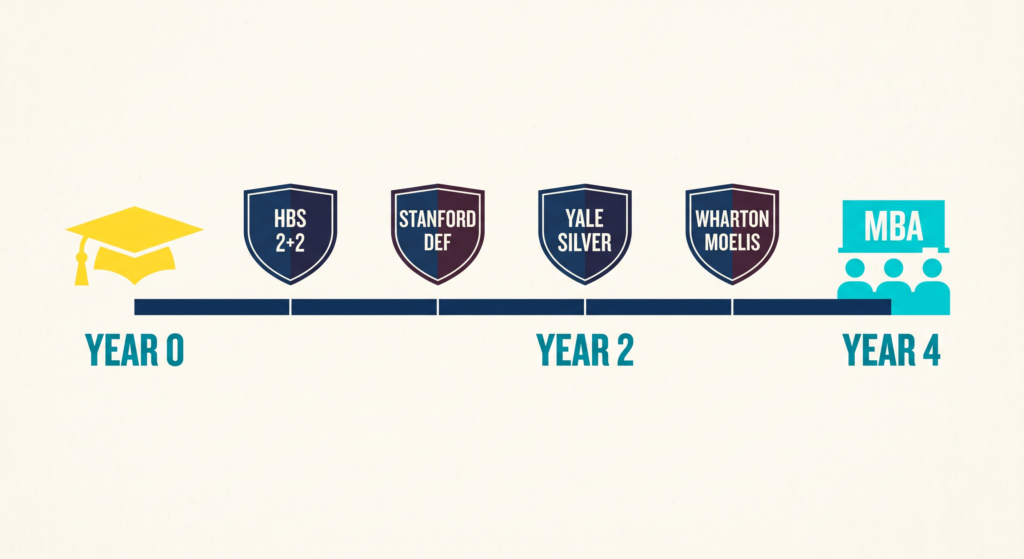
A deferred admission MBA is an early-commitment program where you apply during the final year of your undergraduate or immediate-next master’s degree, receive an admit, then work for 2 to 4 years before matriculating. HBS 2+2, Stanford GSB Deferred Enrollment, Yale Silver Scholars, Wharton Moelis, Chicago Booth Scholars, Kellogg Future Leaders, Columbia Deferred, Haas Accelerated Access. These are the flagship deferred MBA programs, and together they admit fewer than 1,000 students globally each year.
Here is what most articles on this topic get wrong. They frame a deferred admission MBA as a “lower-stakes” path because you don’t need work experience yet. That framing is dangerous. The reality is that these programs are designed to reject roughly 90 to 94% of applicants, often with higher selectivity than the regular MBA round, precisely because admissions committees are making a bet on potential, not proof. When HBS evaluates a 5-year Deloitte consultant, they have track record to verify. When HBS evaluates a 21-year-old, they have a GPA, a resume, and two essays. The bar for differentiation goes up, not down.
The people these programs are designed for are not the strongest academic candidates. They are candidates with unusual trajectories by age 21. Think founders at 19, published researchers, international-Olympiad medalists, students who turned a campus initiative into a 10,000-user platform, or students from non-obvious sectors (climate, defence tech, rural education) who already have a 5-year plan.
If you are an engineering senior at IIT Delhi with a 9.2 CGPA, a summer internship at Morgan Stanley, and a plan to work in investment banking before your MBA, you are not the target. You are the baseline. Fifteen thousand applicants like you apply globally. You need something sharper. For a broader look at the positioning playbook Indian IT and engineering applicants need to stand out, see our guide on MBA strategy for Indian IT professionals.
The Indian students I have seen crack these programs have one thing in common. Their undergraduate years already show pattern-level leadership and impact that most professionals take 3 to 4 years to demonstrate. That is the real eligibility criterion, and it is not written on any admissions page. In my experience across nearly two decades, the Indian candidates who actually make it into these programs fall into one of two camps. One, they come from what I call feeder-profile backgrounds. IIT or a top international undergrad like UPenn, Wharton School, Dartmouth, or other global universities, ideally paired with a high-quality internship at a Goldman Sachs, McKinsey, Bain, BCG, Google, or Microsoft. Two, they do not have the feeder profile on paper, but they have done something sharply specific. A venture with revenue, a research publication that matters, or a large-scale initiative. And they have built what I teach as the “Past + MBA = Short Term + Long Term” equation at 21 instead of at 28. The second category is harder to pull off, but it is where a lot of our best stories come from. The framework I use to evaluate deferred-readiness is simple. Can this person walk me through their 5 to 15 year career arc without hedging, without brochure language, and without stopping? If yes, they are ready. If not, they need 6 to 12 months of training before they submit a deferred application.
HBS 2+2: Inside the Harvard Deferred MBA Program
HBS 2+2, the Harvard deferred MBA program for college seniors, is the most coveted deferred MBA pipeline in the world, and the numbers explain why. In a recent cycle, 1,463 students applied to the HBS 2+2 program and only 131 were admitted. That is a single-digit acceptance rate in the 8 to 9% range, which is actually tighter than HBS’s regular MBA admit rate of roughly 11 to 12%. The Harvard deferred MBA route is not an easier path to HBS. It is the same bar, evaluated on thinner evidence.
The structure is strict. You must apply in the final year of your undergraduate or a master’s program that you entered directly from undergrad. You cannot have held any full-time job. Internships and co-ops are fine, but even six months of full-time work makes you ineligible. Students in law, medicine, or PhD programs are excluded. The 2026 cycle has one deadline, April 22, 2026, with decisions released June 25, 2026. Admitted applicants commit to 2 to 4 years of pre-MBA work in an HBS-approved role and cannot apply to other MBA programs during the deferral.
What throws most Indian applicants is the essay architecture. The HBS 2+2 application uses three specific essay prompts asking about who you are, what you have done, and how the deferral period will build the foundation for your post-MBA goals. The prompts sound simple. The execution kills most people. An application that reads like a well-written resume narrative gets rejected. An application that reads like a person who already knows why they exist professionally, at 21, gets interviewed.
The committee is explicit about what they evaluate. Demonstrated leadership during undergraduate years, intellectual vitality, and specialised depth in at least one area. In practice, this is where most Indian IIT or BITS applicants get filtered out. High CGPA and a Goldman internship are not leadership evidence. Leadership at this stage looks like something you started, something you persuaded other people to join, or something you built from zero. If your resume reads as a sequence of elite academic boxes ticked, the 2+2 committee will flag that as a profile trained to compete but not yet doing anything uniquely its own.
There are Indian admits to HBS 2+2 every year, but they are vanishingly rare. Most come from US or UK undergraduate programs. The ones who come from IITs and Ashokas are the top 1% of their campus, and almost always have something unusual on their record. An international hackathon, a venture already in revenue, a policy paper published somewhere that matters. For a fuller picture of how top US programs evaluate Indian candidates at any stage, read our guide to MBA abroad for Indian students.
Stanford GSB Deferred Enrollment: The Hardest Ticket in Business School
Stanford GSB Deferred is, without exaggeration, the single hardest admit at any business school in the world. Stanford’s overall MBA acceptance rate hovers around 6 to 7%, and GSB deferred enrollment sits at or below that. The school does not publish deferred-specific data, but the math of a 424-student class with global demand makes the bar extraordinarily high. There is no separate application for deferred enrollment at Stanford. You apply in the regular pool, select your preferred enrollment year, and the admissions committee decides your deferral length, typically 1 to 4 years.
That design choice matters. At Stanford, you are not being compared to a separate pool of 21-year-olds. You are being compared to the entire GSB applicant pool, including the 28-year-old McKinsey EM with a 760 GMAT and a startup on the side. The admissions committee is asking one question. Would this person, at 21, still be in the top fraction of our class even if they were joining straight from undergrad? The answer is almost always no. Which is why admits are so rare.
Stanford evaluates on three criteria. How you think, how you lead, how you see the world. For deferred applicants, the third criterion does the heaviest lifting. Because deep self-awareness at 21 is far rarer than leadership at 21. Stanford’s culture prizes candidates who have already spent serious time asking themselves why they care about what they care about, and the deferred essay is where that shows up or doesn’t.
The Indian angle is brutal here. Indian applicants to Stanford GSB face the tightest over-represented pool dynamics of any school, and the deferred round makes it worse because most applicants come from US undergrads with deeper extracurricular records than their Indian counterparts. An Ashoka or Plaksha senior will be compared against Yale, Stanford, MIT, and Princeton undergraduates, and the benchmarks for “impact” at those campuses are different.
That said, Stanford GSB Deferred has admitted Indian students who did not attend US undergrads. The ones I have seen make it share one pattern. Exceptionally clear conviction about one narrow thing they want to change in the world, expressed with the maturity of someone twice their age. Check our companion guide on Stanford GSB essay strategy and the What Matters Most prompt to understand how that shows up on the page.
GSB Deferred Enrollment Essays: What Separates Admits From Rejects
The GSB deferred enrollment essays are functionally identical to the regular Stanford MBA essays, and that identity is the trap most applicants fall into. The “What Matters Most to You, and Why?” prompt is the most-written essay in MBA admissions, and 90% of what gets submitted reads like a motivational speech instead of a person’s actual interior life.
At 21, most applicants have not spent enough time alone, thinking, to know what actually matters to them. They write what they think should matter, service, leadership, impact, and the admissions committee reads it as generic in the first paragraph. The few who break through have done something uncomfortable. They have sat with a specific memory, a specific person, a specific regret, and written about it with a level of concreteness that cannot be faked.
The second essay in the GSB deferred enrollment application, aspirations and how Stanford fits, is where Indian applicants most often lose the admit. The reason is simple. At 21, without work experience, goals tend to be borrowed from what parents, seniors, or career fair recruiters have put in front of them. Stanford reads “I want to do management consulting and then start a business” thousands of times per cycle. A deferred admit to GSB typically has a goal that is unusual in specificity. Not “consulting then entrepreneurship” but “spend three years in a commodities trading role at Glencore because I want to build a climate-risk-hedging product for the reinsurance market, which requires understanding the asset side first.”
That level of specificity cannot be written by an essay consultant. It has to come from the applicant having actually thought hard about their 10-year plan, tested it against people who live in that world, and refined it through real conversations. The networking that builds a goal like this typically takes a college senior 3 to 4 months of sustained effort. Most don’t do it.
This is where our Handicaps Framework changes the game for 21-year-old applicants. Most deferred applicants approach Stanford’s essays by trying to impress. They list accomplishments, they paint ambition. Wrong move. What actually gets an admit is the opposite motion. I train every applicant I work with to build a list of their own Handicaps before they write a single word. Meaning, what specifically can they not do right now, in terms of skills, exposure, and business judgment, that is stopping them from delivering the career they claim they want? If a candidate tells me they want to build a climate-risk-hedging product, I push them to show me the 6 to 8 real gaps in their current ability to do that. They don’t understand reinsurance pricing, they have never modeled counter-party risk, they have no exposure to commodities trading infrastructure, and so on. Once those Handicaps are honest and specific, Stanford’s “What Matters Most” essay writes itself, because your “why” is no longer abstract, it is sitting in the gap between who you are and who you are trying to become. The whole idea is that business schools don’t buy ambition. They buy self-awareness paired with ambition. Our applicants who crack top-tier programs have spent weeks on the Handicaps exercise before they ever start the essay. The ones who skip it write what I call “vague and irrelevant” goals, the bottom-left quadrant of my four-quadrant goals map, and those essays almost always get rejected, regardless of how polished the English is.
Yale Silver Scholars: The Deferred MBA That Starts Immediately
Yale Silver Scholars is structurally unlike any other deferred MBA program, and most Indian applicants don’t realize it. At HBS 2+2, Stanford GSB Deferred, Wharton Moelis, and Booth Scholars, you get an admit, work 2 to 4 years, then start your MBA. Yale Silver Scholars reverses the sequence. You are admitted, you start the MBA immediately after undergrad, complete one year of core MBA coursework, go out into a full-time internship year, then return for a final year of electives. It is a three-year program.
Yale runs this program because they believe MBA coursework without work experience is not wasted if it is quickly grounded in a full-year professional engagement. For the right candidate, it works. For the wrong candidate, it is the worst of both worlds. Insufficient pre-MBA experience to contribute in classroom discussion, and a one-year internship placement that doesn’t carry the weight of a full 2 to 4 year track record when you hit the job market.
Yale does not publish a Silver Scholars-specific acceptance rate, but the program runs through the same rounds as the regular MBA (September, January, April), and admits land at GMAT ranges of 700 to 760 with GPAs of 3.3 to 4.0 and strong extracurriculars. Yale admits international students including Indians, and unlike the other deferred programs, you can still apply if you have had up to a year of full-time work as long as you are within six months of graduation.
The Silver Scholars program makes sense for one specific kind of candidate. Someone who knows exactly what industry and function they want, who thrives in cohort-based environments, and who will use the internship year surgically to land a full-time role post-MBA. It does not make sense for candidates who are still figuring things out. If you have doubts, do not apply to Silver Scholars. Apply to HBS 2+2 or Stanford and take the 2 to 4 year work window instead.
Indian candidates who fit Silver Scholars tend to have one thing in common. An early and unusually clear thesis on what they want to build. For everyone else, the deferral time is worth more than the early MBA start.
Other 2+2 MBA Programs Worth Your Application
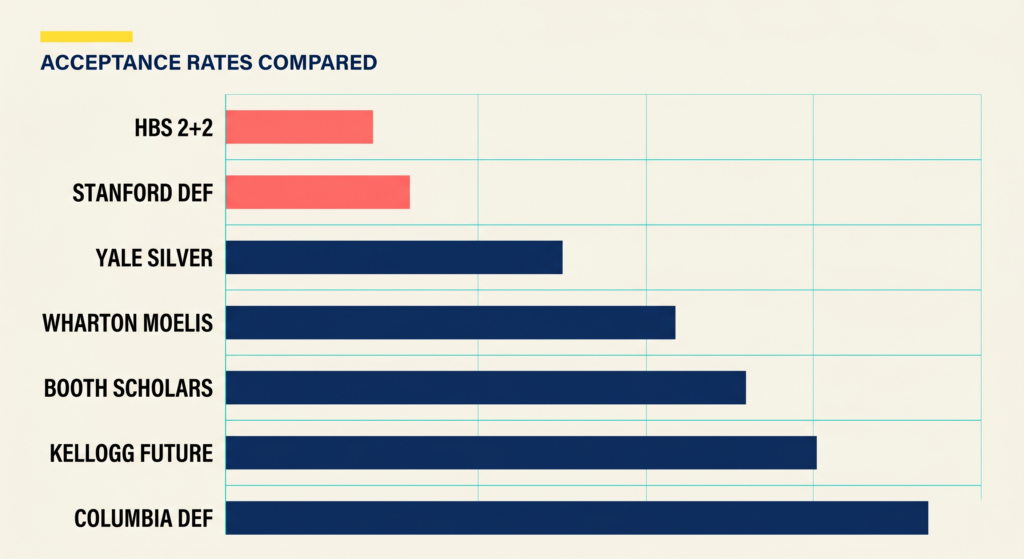
Beyond HBS and Stanford, there are several 2+2 MBA programs that admit 200 to 400 students collectively each year and are less discussed in Indian forums. You should know them cold before you decide where to apply. Wharton Moelis Advance Access, Chicago Booth Scholars, Kellogg Future Leaders, Columbia Deferred Enrollment, Berkeley Haas Accelerated Access, MIT Sloan Early Admission, and Darden Future Year Scholars are the main others. Most are more selective than their regular MBA pools, not less.
Here is the real comparison picture, with current data:
Program | Acceptance Rate | Deferral Period | 2026 Deadline | App Fee |
|---|---|---|---|---|
HBS 2+2 | ~8 to 9% | 2 to 4 years | April 22, 2026 | $100 |
Stanford GSB Deferred | ~6 to 7% (est.) | 1 to 4 years | Any of 3 rounds | $275 |
Yale Silver Scholars | Not disclosed (single digit est.) | Starts immediately + 1-yr internship | Any of 3 rounds | $250 |
Wharton Moelis | ~14 to 20% | 2 to 4 years | April 2026 | Varies |
Chicago Booth Scholars | Not disclosed | 2 to 5 years | April 2026 | $0 |
Kellogg Future Leaders | Not disclosed | 2 to 5 years | April 2026 | $0 |
Columbia Deferred | ~18 to 22% (overall MBA proxy) | 2 to 5 years | April 15, 2026 | $0 (eligible students) |
Wharton Moelis deserves special attention. It has a noticeably higher admit rate than HBS or Stanford deferred, it is strong for finance-bound applicants given the Wharton brand weight, and it was only opened to non-Penn undergrads in 2020, meaning the applicant pool is still finding its ceiling. For an Indian applicant with strong quant credentials and a finance focus, Wharton Moelis is often a better real-odds bet than HBS 2+2, even if it doesn’t carry the same cocktail-party name recognition.
Booth and Kellogg have fee waivers. $0 application cost and deferral periods up to five years, which gives you more career flexibility than Harvard’s 2 to 4 window. If you are not sure what you want to do post-undergrad, a five-year deferral runway from Booth Scholars is strategically more valuable than a tight Harvard 2+2 window.
One nuance Indian applicants miss. The 2+2 MBA programs at Booth, Kellogg, and Columbia do not charge application fees for eligible current students, and several allow you to submit GMAT or GRE scores on your deadline date rather than weeks before. This matters because most Indian undergrad applicants underestimate how much GMAT prep compounds while they are still in their final year. You have four to five free hours a day that disappear the moment you start a full-time job. Use those hours now, not later, and apply to two or three of the waiver-fee schools as a risk-free portfolio alongside your HBS or Stanford shot.
Indian applicants targeting consulting or tech should heavily consider Kellogg Future Leaders and Booth Scholars alongside HBS 2+2. The prestige gap between these schools in the Indian consulting market is much smaller than people assume, and the admit odds are meaningfully better. For context on how US MBA outcomes compare to domestic options, see our analysis of ISB vs US MBA for Indian candidates.
The Hidden Risk of MBA Deferred Enrollment: Why the Wrong Job Kills the Admit

Here is the insight that doesn’t appear in any competitor article on MBA deferred enrollment, and it matters more than any admissions tip in this guide. Roughly 80% of deferred admits underperform at matriculation. Not because they weren’t brilliant applicants, but because they chose the wrong job during their 2 to 4 year deferral window. And the wrong job quietly destroys the ROI of the MBA admit they just worked so hard to secure.
Here is how it plays out. A 21-year-old gets into HBS 2+2, celebrates, takes the highest-paying offer, usually Goldman, JP Morgan, MBB entry consulting, or a top tech product role, and spends three years doing execution work. They show up at HBS at 24 with a resume that looks fine but a professional story that has no arc. They didn’t lead anything, they didn’t pivot, they didn’t build. They followed the prestige track, and now they are one of 943 people in a class, half of whom have more interesting trajectories than them.
The candidates who maximize deferred MBA admits do the opposite. They take a first role at a respected firm for 12 to 18 months to build credibility, then do something bold. Join a Series A startup as founding hire #5, launch a side venture, move to a developing market for a social-impact stint, or take a role in a less obvious industry (climate tech, agri-fintech, healthcare infrastructure) where they build real ownership. They show up to their MBA with a story that compounds their admit rather than neutralizes it.
This matters doubly for Indian students. The Goldman Bangalore or McKinsey Gurgaon offer feels like a win at 22. By 25, sitting in a Harvard classroom next to someone who started a clean-energy company in Kenya during the same three-year window, it suddenly doesn’t.
The pattern is consistent across every deferred admit cohort I have seen. The applicants who arrive at their MBA with a single-track, single-brand trajectory recruit into the same narrow set of post-MBA outcomes as their classmates, and they recruit harder, because their profile does not visibly differentiate from forty others with the same two companies on their resume. The applicants who engineered a two-stage deferral, one year building credibility, then 18 to 24 months doing something genuinely unusual, show up with a pitch the interview room has not heard before, and that pitch does most of the recruiting work for them.
My unpopular advice to every MBA deferred enrollment admit I advise. Optimize your deferral years for the interesting story, not the brand-name job. The MBA admit is already secured. Now you need to earn the right to actually use it.
Frequently Asked Questions About Deferred MBA Programs
Is a deferred MBA worth it if I can get a high-paying job straight out of undergrad?
Yes, and the math is not close. A deferred MBA admit at HBS, Stanford, Wharton, Yale, Booth, or Kellogg is worth more than any first job for one reason. It removes the single biggest risk in your career, which is whether you will get into a top MBA five years from now. You can still take the Goldman or McKinsey offer. You just take it with your MBA seat already locked in. The opportunity cost of not applying is far higher than people think.
Can Indian students from IITs and top Indian colleges realistically get into HBS 2+2 or Stanford GSB Deferred?
Yes, but rarely. Every year a handful of Indian undergrads from IITs, BITS, Ashoka, Plaksha, and the top women’s colleges land deferred admits, typically to Wharton Moelis, Booth Scholars, or Kellogg Future Leaders more than HBS or Stanford. The ones who make HBS 2+2 and Stanford GSB Deferred almost always have unusual distinguishing work. A venture, a research publication, an international competition, or a policy-level initiative. Grades and GMAT alone will not do it.
What jobs should I take during my deferral period to maximize MBA outcomes?
Start with 12 to 18 months at a credible firm to build professional basics, then pivot to something with real ownership. An early-stage startup, a cross-industry move, an international posting, or a founder role. Avoid staying in the same brand-name execution role for the full deferral window. The classroom you walk into at 24 should have a different story from the one you told at 21. Otherwise, the MBA is just correcting course, not compounding it.
What happens if my circumstances change during deferral, like job loss, family emergency, or visa issues?
Schools are generally flexible. HBS, Stanford, Yale, Wharton, and Booth all have processes to extend deferrals or shift enrollment years in genuine circumstances. You cannot apply to other MBA programs during your deferral without losing your admit. If something major shifts, the right move is to contact the admissions office early and transparently. They have seen every situation and almost always accommodate.
Can I apply to multiple deferred MBA programs in the same year?
Yes, and you should. Applying to HBS 2+2, Stanford GSB Deferred, Wharton Moelis, Yale Silver Scholars, Booth Scholars, and Kellogg Future Leaders in the same cycle is the right portfolio for a strong candidate. Once you accept an admit, you commit to that school and withdraw others. Until then, apply broadly. The admit rates are low enough that a single-school strategy rarely works.
Where PythaGURUS Comes In
Deferred MBA programs reward clarity that most 21-year-olds have not yet built. That is why the work we do with undergraduate deferred applicants starts months before the essays. At the layer of identifying what actually makes you unusual, what goals you can defend in front of an admissions committee that has read ten thousand applications this year, and how to position your undergraduate impact so it carries the weight of professional track record.
PythaGURUS has helped 1,500+ applicants secure 2,700+ admits to top global MBA programs, including deferred admits across HBS 2+2, Stanford GSB, Wharton Moelis, Yale Silver Scholars, Booth Scholars, and Kellogg Future Leaders. Our founder, Jatin Bhandari, is a Darden MBA with 18+ years advising Indian applicants, and our frameworks for deferred MBA admissions are built specifically around what separates a strong 21-year-old application from a generic one.
If you are an undergrad or immediate-masters student considering deferred MBA programs, the right starting point is a Comprehensive Profile Evaluation. You get a written analysis of where your profile stands against the deferred admit bar, what gaps to close in the next 6 to 12 months, and whether your school list is realistic. Get your profile evaluated at pythagurus.in . Deferred admissions open fast, close faster, and reward candidates who start early. Start now.