
MBA in Europe for Indian Students: The Complete Strategic Guide
Europe is the most underrated MBA destination for Indian professionals. Over 19 years of guiding 2,700+ applicants, I’ve watched the European MBA market transform from a niche alternative to a genuine competitor to the US – and for certain career goals, it’s now the better choice. When Indian applicants ask me about mba in europe for indian students, most of them are thinking only about INSEAD. But the European MBA world is far richer than that – HEC Paris, IESE, IE Spain, LBS, IMD, ESMT, and a dozen other programs offer distinct advantages that the US simply can’t match.
The mba in europe for indian students conversation has shifted dramatically since 2020. Shorter programs, lower costs, improving post-study work visas, and Europe’s genuinely international class compositions make it a compelling option for Indians who think strategically about their careers. Let me break down exactly what works, what doesn’t, and who should seriously consider Europe. For the full picture on planning your MBA abroad, start with our comprehensive guide to studying MBA abroad.
Best European MBA Programs: The Tier List for Indian Applicants
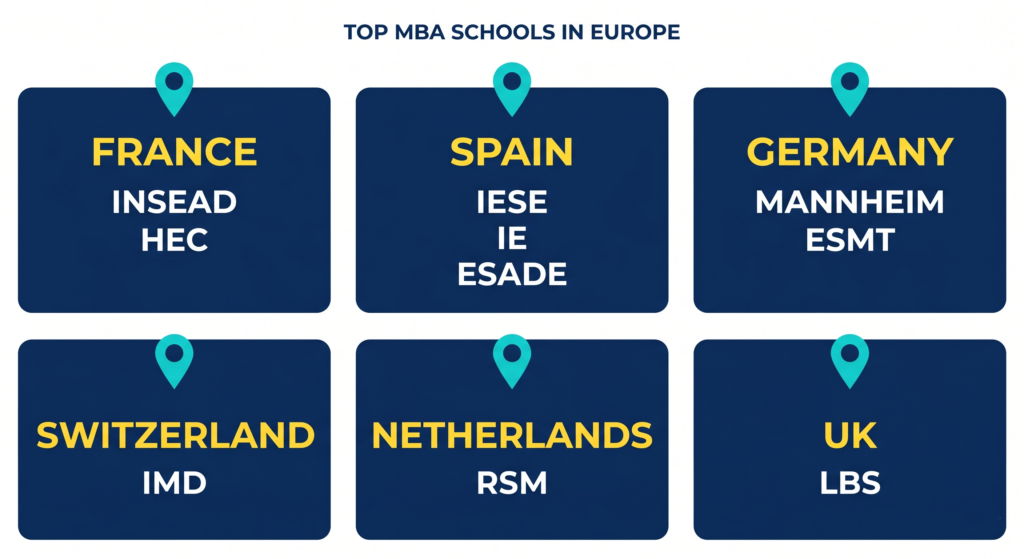
Let me rank the best european mba programs honestly – not by FT ranking, but by what actually matters for Indian career outcomes. The best european mba programs serve very different purposes depending on your goals, and treating them as interchangeable is the first mistake Indian applicants make.
School | Country | Duration | Tuition | FT Rank | Best For Indians |
INSEAD | France/Singapore | 10 months | EUR 99,000 | Top 3 | Consulting, global careers, fastest ROI |
LBS | UK | 15-21 mo | GBP 100,600 | Top 5 | Finance, consulting, London careers |
HEC Paris | France | 16 months | EUR 72,000 | Top 5 | Luxury, strategy, entrepreneurship |
IESE | Spain | 19 months | EUR 97,200 | Top 10 | General management, case method |
IE Business School | Spain | 1 year | EUR 72,200 | Top 15 | Tech, entrepreneurship, younger profiles |
IMD | Switzerland | 11 months | CHF 95,000 | Top 20 | Senior leaders, industry immersion |
ESADE | Spain | 12-18 mo | EUR 74,600 | Top 20 | Consulting, social impact, Barcelona |
Oxford Said | UK | 1 year | GBP 72,100 | Top 10 | Strategy, brand power, entrepreneurship |
Cambridge Judge | UK | 1 year | GBP 67,000 | Top 15 | Tech, healthcare, social enterprise |
ESSEC | France | 12 months | EUR 48,000 | Top 25 | Luxury, finance, Paris network |
SDA Bocconi | Italy | 1 year | EUR 66,000 | Top 25 | Luxury, fashion, consumer goods |
RSM Rotterdam | Netherlands | 15 months | EUR 62,500 | Top 30 | Multinationals, English-friendly market |
ESMT Berlin | Germany | 1 year | EUR 42,000 | Top 30 | Tech, startups, Berlin ecosystem |
Imperial | UK | 1 year | GBP 57,200 | Top 30 | Finance, analytics, London location |
EDHEC | France | 10 months | EUR 42,000 | Top 35 | Finance, affordable France option |
WHU Otto Beisheim | Germany | 1 year | EUR 44,500 | Top 40 | German industry, family business |
St. Gallen | Switzerland | 1 year | CHF 64,600 | Top 40 | Finance, Swiss banking, management |
Warwick | UK | 1 year | GBP 47,800 | Top 35 | Consulting, general management |
Mannheim | Germany | 1 year | EUR 31,000 | Top 60 | Best value, German industry careers |
HHL Leipzig | Germany | 15-21 mo | EUR 36,000 | Top 70 | Entrepreneurship, affordable Germany |
My honest take: INSEAD is the only European MBA that truly competes with US M7 schools in global brand power and career outcomes. LBS is close behind, especially for London-based careers. HEC Paris, IESE, and IE are strong but a clear tier below INSEAD/LBS for Indian applicant outcomes. Everything below that is a value play – good programs, lower costs, but narrower recruiting. For the full global school comparison, see our guide on best MBA colleges abroad for Indian students.
One pattern I’ve noticed about best european mba programs over the years: the class diversity at European schools is genuinely unmatched. INSEAD’s class has 90+ nationalities. HEC Paris draws from 60+. Even IESE and IE regularly have 70+ nationalities in their MBA cohorts. For Indian applicants, this means your peer group includes people from every major business market – not just the US-India axis that dominates many US MBA programmes. If your career plan involves working across multiple geographies – Europe, Middle East, Southeast Asia – this diversity isn’t a nice-to-have. It’s the network you’ll need to execute that plan. I’ve seen Indian graduates of INSEAD and HEC build cross-border careers spanning 3-4 countries within 5 years – something that’s much harder to do with a purely US-centric alumni network.
Affordable MBA in Europe: Where Cost Meets Quality
The affordable mba in europe conversation is where the continent really shines compared to the US and UK. An affordable mba in europe doesn’t mean a compromise on quality – it means accessing strong programs at a fraction of the cost of a US T15 MBA. Here’s how the math works for Indian students.
Near-zero tuition: German public universities like Mannheim and TU Munich charge EUR 500-1,500 per semester. Total tuition for a full MBA: under ₹3 lakhs. Add living costs of ₹10-15 lakhs and you have a complete MBA for ₹15-18 lakhs. No other major MBA destination comes close to this. For the full Germany breakdown, see our MBA in Germany guide for Indian students.
Mid-range value: French programs like EDHEC (EUR 42,000), Grenoble (EUR 32,000), and ESSEC (EUR 48,000) offer solid European placements at ₹35-55 lakhs total investment. Spanish programs at IE (EUR 72,200) and ESADE (EUR 74,600) are pricier but still significantly below US equivalents.
Premium but still below US: Even the most expensive European MBAs – INSEAD at EUR 99,000, IESE at EUR 97,200 – cost less than US M7 schools when you factor in the shorter duration. A 10-month INSEAD MBA has roughly half the living costs of a 2-year Wharton MBA, making the total investment ₹30-50 lakhs lower despite similar tuition.
I also want to add something here about what makes European MBA programs genuinely affordable beyond tuition: the living cost variation across Europe. Munich is expensive. Paris is expensive. But Barcelona, Madrid, Lisbon, Mannheim, and Leipzig are surprisingly affordable by international standards. A student in Barcelona can live comfortably on EUR 900-1,100 per month. That’s roughly half of what London costs. For Indians on a tight budget, the combination of moderate tuition and affordable city makes Southern and Central European programs especially attractive. For scholarship options that can reduce costs further, see our guide on MBA scholarships abroad for Indian students.
And don’t overlook the scholarship side of affordable mba in europe. INSEAD offers 40+ named scholarships. HEC Paris has generous merit awards. IE offers early-decision scholarships. ESADE has the Responsible Leaders Fellowship. Even German public universities offer DAAD scholarships that cover living costs. When you combine low European tuition with a well-targeted scholarship application, the total out-of-pocket cost of a top European MBA can be genuinely lower than an IIM fee-paying seat – with dramatically better career outcomes.
One Year MBA Europe: The Speed Advantage
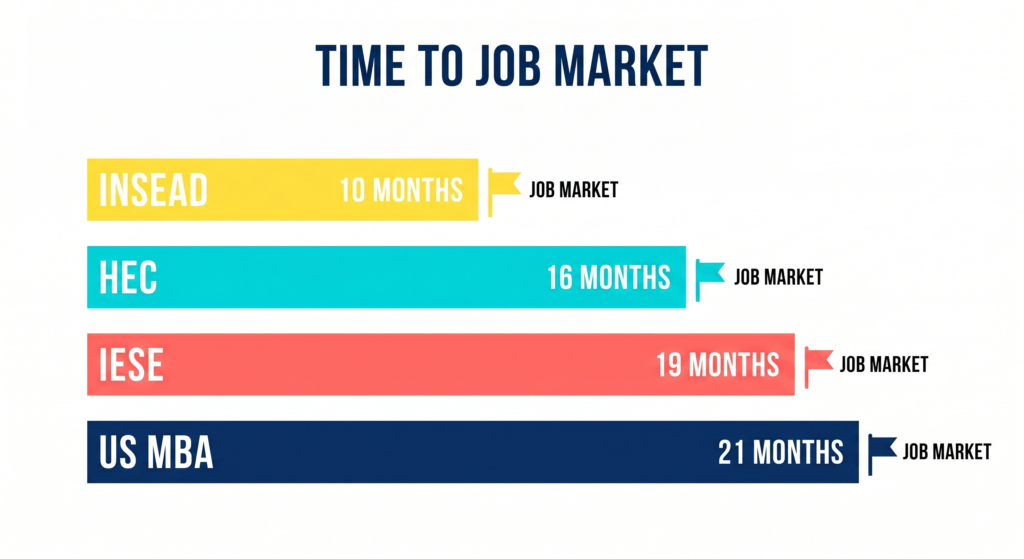
The one year mba europe format is the structural advantage that makes European business education uniquely attractive for Indians. Most European MBA programs run for 10-16 months – dramatically shorter than the standard 21-month US MBA. Here’s why the one year mba europe model matters so much for Indian professionals.
INSEAD’s 10-month model: The fastest top-tier MBA in the world. You start in January or September and graduate 10 months later. The pace is brutal – INSEAD compresses everything into an intense academic sprint. But for Indians with 5+ years of experience who know what they want from their MBA, this intensity is a feature. You’re back in the job market before your US counterparts have even started their second year.
HEC Paris 16-month model: A middle ground between the 10-month INSEAD sprint and the 21-month US marathon. HEC includes a required internship in the middle of the programme, which gives career switchers a transition opportunity similar to the US summer internship – but in a shorter overall timeline.
The trade-off: One-year European MBAs don’t include the structured summer internship that US programmes do. For Indians switching from IT to MBB consulting, the US summer internship at McKinsey or BCG is your audition – and it doesn’t exist in most European formats. INSEAD compensates with a powerful alumni network and direct recruiting relationships with MBB offices in London, Dubai, and Singapore. But if you need a structured internship to make your career switch, factor that into your decision.
The whole idea is this: the one year mba europe format isn’t about getting an MBA faster. It’s about getting the right MBA at the right speed for your career stage. If you have 5+ years of experience and clear post-MBA goals, the European one-year format eliminates unnecessary time away from the market. If you have 2-3 years and need more time to explore, the US two-year format gives you breathing room.
I also want to flag something specific about one-year European MBA programmes and Indian applicants. The compressed timeline means your pre-MBA preparation matters even more than in a US programme. If you show up at INSEAD without having done your career research, your networking, and your goals articulation, you’ll spend half the programme figuring out what you want – and by then, recruiting season is over. European MBAs reward applicants who arrive prepared. This is why our process starts with goals and employability months before the application, not after admission.
MBA Europe Cost: The Full Investment Picture
The mba europe cost depends enormously on which country and which school you choose. Let me lay out the realistic mba europe cost for Indian students across the major European destinations, including living expenses that most guides ignore.
France (INSEAD, HEC, ESSEC, EDHEC): Tuition ranges from EUR 42,000 (EDHEC) to EUR 99,000 (INSEAD). Living costs in Paris: EUR 1,200-1,500/month. In Fontainebleau (INSEAD): EUR 1,000-1,200/month. Total investment: ₹50-120 lakhs depending on programme.
Spain (IESE, IE, ESADE): Tuition ranges from EUR 72,200 (IE) to EUR 97,200 (IESE). Living costs in Barcelona/Madrid: EUR 900-1,200/month. Total investment: ₹70-110 lakhs. Spain offers some of the best quality-of-life-to-cost ratios in Europe.
Switzerland (IMD, St. Gallen): Tuition at IMD is CHF 95,000 (approximately ₹88 lakhs). Living costs in Lausanne are high – CHF 2,000-2,500/month. Total investment: ₹110-130 lakhs. The most expensive European MBA destination, but salary outcomes are also the highest in continental Europe.
Germany (Mannheim, ESMT, WHU): Tuition ranges from near-zero at public universities to EUR 42,000 at ESMT. Living costs: EUR 850-1,200/month. Total investment: ₹15-65 lakhs. The most affordable option with strong European placement.
Here’s a pattern I’ve seen over 19 years: Indian applicants who choose European MBAs based purely on cost end up disappointed. And applicants who choose based on the right fit between their career goals and the school’s placement strength end up thriving. The cheapest programme isn’t always the best value. The best value is the programme that delivers the strongest career outcome relative to what you invested. For a broader cost comparison across all destinations, see our guide on best countries for MBA for Indian students.
Let me also address the funding question specifically. Indian education loan providers like SBI, HDFC Credila, and Prodigy Finance all cover European MBA programmes. Prodigy Finance is particularly useful for European MBAs because they don’t require collateral or a co-signer – they assess your loan eligibility based on your future earning potential rather than your family’s current assets. For INSEAD and HEC specifically, Prodigy Finance has dedicated loan products with competitive rates. The mba europe cost conversation shouldn’t end with “how much does it cost” – it should end with “how much do I actually need to pay out of pocket after loans and scholarships.” And that number, for most Indian applicants at top European programmes, is significantly lower than you’d expect.
Best Countries in Europe for MBA: Where to Study
The best countries in europe for mba depend on what you’re optimizing for. Each country has a distinct MBA culture, career market, and post-study visa regime. Here are the best countries in europe for mba from an Indian applicant’s perspective.
France: Home to INSEAD (the #1 European programme for global careers) and HEC Paris (the strongest French-headquartered MBA). France offers a 1-year post-study work visa for MBA graduates. Paris is a major hub for luxury, fashion, consulting, and finance. The downside: French language skills help significantly for non-consulting roles.
Spain: IESE (Barcelona), IE (Madrid), and ESADE (Barcelona) make Spain the country with the most top-ranked MBA options per capita. The lifestyle is outstanding. Post-study work visa allows you to stay and work. Career outcomes for Indians are strongest in consulting and general management. Barcelona’s startup scene is growing but still small compared to London or Berlin.
Germany: The cost leader. Near-zero tuition at public universities, strong industrial economy, and an 18-month job seeker visa. The constraint: German language skills matter enormously for non-consulting roles, and the MBA job market is narrower than in the UK or France. Best for Indians targeting German industry – automotive, manufacturing, logistics, engineering management.
Switzerland: IMD in Lausanne is the standout – highly international, extremely focused, small class size. Switzerland’s post-study visa is restrictive (6 months), but employers who want to hire you will sponsor your work permit. Salaries in Switzerland are among the highest in Europe.
Netherlands: Rotterdam School of Management (RSM) offers a strong MBA with a favourable orientation year visa. The Netherlands is English-friendly, internationally oriented, and home to major multinationals (Shell, Unilever, Philips, ASML). An underrated option for Indians who want European exposure without learning a new language.
Italy: SDA Bocconi in Milan offers a competitive 1-year MBA with strong placement into Italian and European luxury, fashion, and consumer goods companies. Milan’s fashion and design industry is unique – no other MBA destination gives you direct access to that world. The tuition (EUR 66,000) is moderate by European standards, and living costs in Milan are lower than London or Paris.
The best countries in europe for mba ultimately depend on which industry you’re targeting. For consulting: France (INSEAD) or Spain (IESE). For finance: UK (LBS) or Switzerland (IMD). For tech: Spain (IE) or Germany (ESMT). For luxury and consumer goods: France (HEC) or Italy (Bocconi). For the lowest cost with solid outcomes: Germany. Map the country to your career goal – that’s how the decision gets made.
MBA in Europe Fees: Country-by-Country Breakdown for Indians
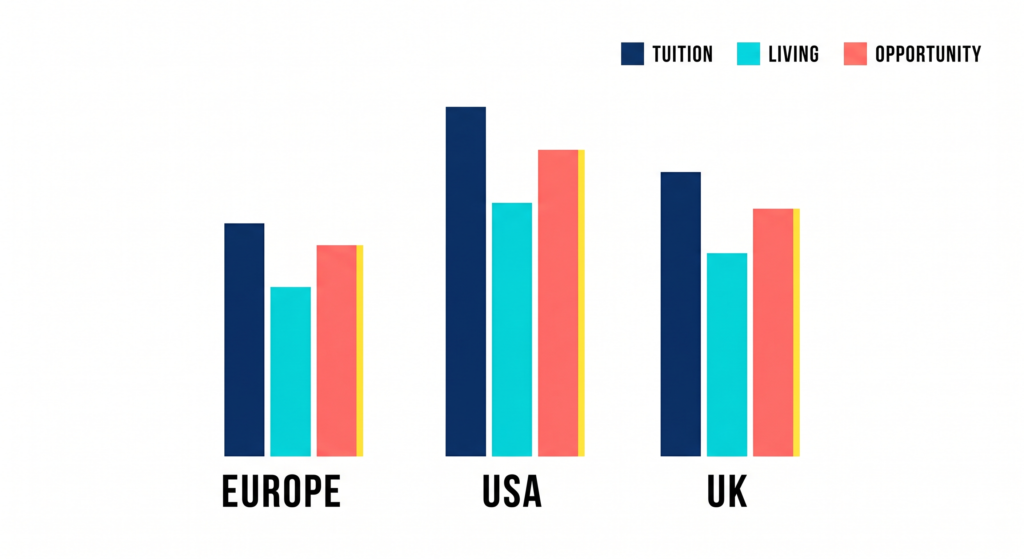
Understanding mba in europe fees requires looking at each country individually, because the variation is enormous. The fee range stretches from near-zero in Germany to EUR 99,000 at INSEAD – a wider spread than any other MBA region in the world.
I’ve already covered the detailed tuition figures in the cost section above, so here I want to focus on what the mba in europe fees actually buy you. At INSEAD, you’re paying for the world’s most internationally diverse class (90+ nationalities), a 10-month format that minimizes opportunity cost, and direct MBB recruiting relationships across London, Dubai, and Singapore. At HEC Paris, you’re paying for access to Europe’s luxury and fashion industry headquarters, strong consulting placement, and a required internship that career switchers need. At Mannheim, you’re paying essentially nothing for tuition – but the career outcomes are German-focused, which limits your options if you want global mobility.
The question isn’t how much are the fees. The question is what do you get per euro spent. And by that metric, European MBAs often deliver better value than US programmes because the total investment is lower while the career outcomes – particularly for consulting, general management, and roles in Europe/Asia – are competitive.
I also want to share something that changes the mba in europe fees calculation for many Indian applicants: the currency advantage. Indian professionals earning in rupees are at a disadvantage when paying US tuition in dollars – the INR-USD rate makes everything more expensive. But the Euro is historically weaker against the dollar, which means European tuition in Euro terms is more favourable for Indian savings than US tuition in dollar terms. A EUR 72,000 HEC tuition converts to roughly ₹65-70 lakhs depending on rates. A $120,000 Kellogg tuition converts to ₹1 crore+. That currency differential, combined with shorter programme duration, is why the European fee story is genuinely compelling for budget-conscious Indian applicants who still want a world-class education. That’s the value equation that makes Europe worth serious consideration for every budget-conscious Indian applicant.
Here’s a pattern I’ve tracked over 19 years of guiding Indian applicants into European MBAs. The clients who get the strongest ROI from European programmes are those who commit to building careers in Europe or Asia-Pacific for the first 3-5 years after graduation. The salary progression for INSEAD and HEC graduates who stay in Europe or move to Singapore/Dubai is competitive with US MBA graduates – EUR 90,000-120,000 within 3 years, rising to EUR 150,000-200,000+ at the 5-year mark in consulting or general management roles. Where the ROI breaks down: Indian applicants who do a European MBA and then try to return to India within 1-2 years. The Indian job market doesn’t differentiate well between a HEC Paris MBA and a mid-tier US school, which means you’re not getting the full salary premium your European MBA should command. My advice: if you’re going to invest in a European MBA, invest in a European career for at least 3-5 years. That’s where the compounding happens.
Top MBA Schools in Europe: Career Outcomes for Indian Graduates
What matters most about top mba schools in europe for Indian applicants is what happens after graduation. The career placement from top mba schools in europe varies significantly by school, country, and industry – more so than in the US, where the recruiting infrastructure is more standardized.
Consulting: INSEAD dominates European consulting placement. McKinsey, BCG, and Bain recruit heavily from INSEAD’s campuses in both Fontainebleau and Singapore. HEC Paris also places well into consulting, particularly French offices. IESE and ESADE place into Spanish and Latin American consulting markets. For Indians targeting MBB, INSEAD is the clear European choice.
Finance: LBS is the undisputed leader for European finance careers. For continental European finance – private equity, asset management, corporate finance – HEC Paris and ESADE have growing networks. Switzerland (IMD) places well into Swiss banking and wealth management.
Tech and product management: IE Business School in Madrid has positioned itself as Europe’s tech-forward MBA. Berlin’s startup scene recruits from ESMT. Cambridge Judge (UK) has the strongest tech pipeline. For Indians targeting European tech PM roles, IE and ESMT are worth considering.
General management and industry: IESE, IMD, and Mannheim produce graduates who go into corporate leadership roles at European multinationals. If your goal is leading a business unit at Siemens, L’Oreal, Nestle, or Volkswagen, these schools have the connections that matter.
I also want to add something about the post-study work visa picture, because this is where Europe has improved dramatically for Indians. France offers a 1-year recherche d’emploi visa. Spain offers a 12-month post-study work permit. Germany gives you 18 months. The Netherlands offers an orientation year. Switzerland gives 6 months. None of these match the UK’s 2-year Graduate Route or Canada’s 3-year PGWP, but they’re significantly better than what Europe offered even 5 years ago. The trend is clear: European countries are competing for international MBA talent, and visa policies are improving.
Here’s the career outcome pattern I see most consistently with Indian graduates of top mba schools in europe: the ones who target roles in Europe or Asia-Pacific do exceptionally well. The ones who try to use a European MBA to break into the US job market struggle. A European MBA gives you access to European and increasingly Asian employers. It does not give you the same access to US employers that a Wharton or Booth degree would. Know which market you’re playing in, and the European MBA becomes one of the strongest investments you can make.
MBA in Europe Eligibility: What Indian Applicants Need
The mba in europe eligibility requirements are broadly similar across programmes but with important variations. Here’s the full eligibility picture for Indian applicants.
Academic requirements: A recognised bachelor’s degree from an accredited university. European schools generally don’t impose hard GPA minimums, but competitive Indian applicants typically have 60%+ (first class or strong second class). INSEAD, HEC, and IESE look at the quality of your undergraduate institution alongside your grades.
Work experience: INSEAD requires 3+ years minimum (class average is 6). HEC Paris wants 3-5 years. IESE prefers 3-5 years. IE accepts applicants with as little as 2 years. IMD wants 5+ years (they skew senior). Match your experience level to the programme – applying to IMD with 3 years is a waste; applying to IE with 8 years means you’ll be significantly older than your classmates.
Test scores: GMAT or GRE is required. A GMAT Focus score of 685+ is competitive for INSEAD and HEC. IESE and IE are competitive at 665+. German programmes like Mannheim and ESMT accept 645+. Some European programmes (IE, for example) accept the IELTS or their own proprietary assessment instead of GMAT – but I’d still recommend taking the GMAT for the strongest possible application.
Language requirements: English-taught programmes require IELTS 7.0+ or TOEFL 100+. INSEAD uniquely requires proficiency in a third language by graduation (you don’t need it at admission, but you must learn one during the programme). Some French and Spanish programmes offer courses in the local language – useful for career building but not required for admission.
The mba in europe eligibility bar is generally similar to US schools. The key difference: European programmes often weigh international exposure and linguistic diversity more heavily than US schools do. If you’ve worked across borders, speak multiple languages, or have lived outside India, these are genuine advantages in European admissions that wouldn’t carry the same weight in the US.
One more practical point about mba in europe eligibility that Indian applicants often overlook: the application timeline. European programmes generally have multiple intake rounds – INSEAD has January and September starts, HEC has September and January intakes. This gives you more flexibility than US schools, which typically have only a September start. If you miss the US Round 1 deadline, you might need to wait an entire year. In Europe, the next intake could be just 4-6 months away. For applicants on a tight timeline, this scheduling flexibility is a genuine advantage.
Frequently Asked Questions: MBA in Europe
Q: Is a European MBA as respected as a US MBA?
INSEAD and LBS are globally respected at the M7/T5 level. HEC Paris, IESE, and IE are respected in Europe and increasingly in Asia. For careers in the US specifically, a US MBA carries more weight. For careers in Europe, Asia, or the Middle East, top European MBAs are equally strong or stronger than mid-tier US programmes.
Q: Can I stay and work in Europe after my MBA?
Yes, with limitations. Most European countries now offer post-study work visas ranging from 6 months (Switzerland) to 18 months (Germany). The UK offers 2 years via the Graduate Route. None match Canada’s 3-year PGWP, but the trend is clearly towards more openness.
Q: INSEAD vs US M7 – which should I choose?
For consulting or global roles: INSEAD’s 10-month format and 90+ nationality class are hard to beat. For US-specific careers (Wall Street, Silicon Valley): a US M7 is clearly better. For the fastest ROI: INSEAD wins because of the shorter programme. It’s a career-goal question, not a ranking question.
Q: Do I need to speak French/Spanish for European MBA?
Not for admission to English-taught programmes. But for post-MBA careers in France, Spain, or Germany, local language skills dramatically expand your job market. At INSEAD, you must achieve basic proficiency in a third language by graduation. Start learning early – it’s both an admissions differentiator and a career investment.
PythaGURUS Success Stories: Indians Who Cracked Top European MBA Programs
Want to see what this looks like in practice? Our client Siddhesh, a management consultant from India, worked with us to crack two top European programmes – HEC Paris and IE Spain – with scholarships, and launched his MBB consulting career.
And our client Vritti worked with PythaGURUS to crack the INSEAD MBA programme – one of the most competitive MBA admissions in the world
Is Europe the Right MBA Destination for You?
The mba in europe for indian students decision depends on your career goals, your budget, your experience level, and where you want to build your life. Europe isn’t better or worse than the US – it’s different. And for the right profile, it’s the smarter choice.
If you want an honest assessment of whether Europe is the right MBA destination for your specific situation – and which European schools give you the strongest combination of admission probability, career outcomes, and financial value – that’s what our Comprehensive Profile Analysis delivers. Direct, data-backed advice from someone who has guided 2,700+ applicants through exactly this decision.