MBA in USA for Indian Students: Cost, Top Schools and the ROI Reality Check

Every year, I watch Indian professionals commit ₹1.5 to ₹3 crore to an MBA in USA for Indian students – and a significant number of them pick schools that will never return that investment. In 19 years of guiding 1,500+ applicants, the pattern is unmistakable: the ones who succeed don’t chase brand names blindly. They treat school selection as an ROI equation – matching total cost against realistic post-MBA earnings, visa probability, and career trajectory.
The ones who struggle? They follow generic “top 10 schools” listicles, take on massive loans for programs ranked outside the top 25, and discover too late that a $150,000 debt with a $75,000 starting salary is a financial trap, not a career accelerator.
This guide isn’t a dream-school roundup. It’s a decision framework built from watching what actually works – and what doesn’t – for Indian applicants targeting US MBA programs. If you’re looking for a broader view of all destination countries, start with our comprehensive MBA abroad for Indian students guide, then come back here for the USA-specific deep dive.
Why USA MBA Programs for Indians Still Lead - And Where They Fall Short

Let me be direct. USA MBA programs for Indians remain the strongest option for one reason that no other country matches: recruiting infrastructure. The scale of on-campus recruiting, summer internship pipelines, and employer relationships that top US business schools have built over decades is unparalleled. McKinsey, BCG, Bain, Goldman Sachs, Google, Amazon, Apple – they all recruit heavily from M7 and T15 campuses. No European or Asian school comes close to that density of employer access.
The salary gap is real and it’s massive. Post-MBA median base salaries at M7 schools now range from $175,000 to $215,000. The Wharton Class of 2025 reported a median base salary of $185,000. Harvard’s Class of 2025 hit $184,500. Compare that to ISB’s average placement of ₹35–40 lakhs, or European programs where starting consulting salaries hover around €70,000–80,000. On pure compensation, the US wins by a factor of two or three.
But here’s the uncomfortable truth that most “MBA in USA” guides conveniently skip: visa risk. The H-1B lottery means that even graduates from Wharton and Harvard face genuine uncertainty about staying in the US to work. In any given year, roughly 30% of H-1B petitions are selected. That’s not a rounding error – that’s a fundamental variable in your ROI calculation that most articles pretend doesn’t exist.
I’ve seen Booth graduates with $200,000 offers from top consulting firms forced to pivot their entire career plan because they didn’t get selected in the lottery. And I’ve seen Darden graduates land H-1B on their first attempt and build extraordinary careers in the US. The point isn’t to scare you away from USA programs. It’s to make sure you factor this variable into your school selection and career planning from day one.
The real question for Indian applicants isn’t “should I do an MBA in the USA?” It’s “which tier of US school justifies a $200K+ bet given my specific profile, goals, and risk tolerance?” If you’re evaluating the US against other destinations, our best countries for MBA comparison lays out the tradeoffs across the US, UK, Canada, Europe, and Singapore.
I want to share something here that I think changes how you should think about the US vs other destinations. Over 19 years, I’ve worked with applicants who went to US schools, European schools, and schools in Asia. And the pattern I’ve seen repeatedly is this: students who went to top US schools – Columbia, Wharton, Darden, Tuck, Kellogg, Duke – came back to me in later years and said something very specific. They said it was so much easier for them to crack their internships and full-time roles because of the training they got during the admissions consulting process itself. The depth of networking, the clarity of goals, the understanding of employability – all of that didn’t just get them into the school. It prepared them for what came after.
And this is something nobody talks about. MBA admissions consulting, when done right, isn’t just about convincing the gatekeeper to let you in. It’s about preparing you for the intense game that comes after. When I train someone on how to network with 20–30 strangers across three continents, when I train them on understanding their goals so deeply that you could wake them up at 3 AM and they’d tell you exactly why they need an MBA – that same training becomes the reason they outperform their peers in internship searches 6 months into the program. The best scholarships I’ve seen – ₹4.6 crores, ₹3.2 crores, 100% fellowships – have come from applicants who went through this depth of preparation. And most of those were at US schools, because the US recruiting infrastructure rewards this level of preparation more than any other market.
MBA Cost Breakdown in USA: What Indian Students Actually Pay
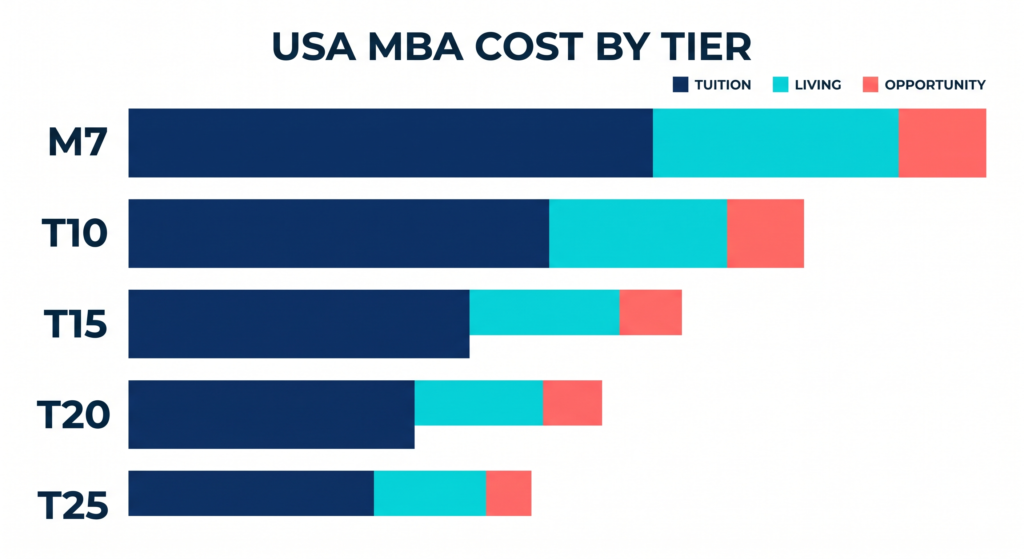
Here’s where most articles fail Indian readers completely. They’ll quote tuition and stop there, as if that’s the whole picture. The real MBA cost breakdown in USA includes tuition, university fees, living expenses, health insurance, travel, GMAT prep, application fees, visa costs, and the elephant in the room that nobody wants to talk about – opportunity cost.
Let me show you what the numbers actually look like across school tiers. All INR figures use a conversion rate of approximately ₹83–84 per dollar.
School Tier / Example | Annual Tuition | Annual Living | 2-Year Total (USD) | 2-Year Total (₹ Approx.) |
M7 – Harvard | $78,700 | $47,800 | ~$253,000 | ₹2.1 Cr |
M7 – Wharton | $87,970 | $39,500 | ~$265,000 | ₹2.2 Cr |
M7 – Kellogg | $83,610 | $21,150 | ~$210,000 | ₹1.75 Cr |
T15 – Yale SOM | $84,900 | $29,200 | ~$228,000 | ₹1.9 Cr |
T15 – Darden | $81,940 | $24,570 | ~$213,000 | ₹1.77 Cr |
T15 – Fuqua (Duke) | $77,925 | $24,048 | ~$204,000 | ₹1.7 Cr |
T25 – McCombs (Texas) | $59,684 | $17,300 | ~$154,000 | ₹1.28 Cr |
Sources: Official school Cost of Attendance pages for the 2025–2026 academic year. INR conversions at ₹83/USD.
But these sticker prices don’t tell the full story. Here’s what most guides leave out:
Pre-MBA costs that add up fast: GMAT/GRE coaching (₹50,000–1.5 lakhs), application fees ($250 per school × 6–8 schools = $1,500–2,000), TOEFL/IELTS (₹15,000–20,000), and if you work with an admissions consultant, that’s additional. Before you’ve set foot on campus, you’re already ₹2–4 lakhs deep.
Opportunity cost is the number nobody wants to calculate. If you’re earning ₹25 lakhs per year in India, two years off means ₹50 lakhs in forgone salary. Add that to your total investment and the real cost of an M7 MBA for an Indian professional is closer to ₹2.5–3 crore all-in. That changes the ROI conversation entirely.
This is precisely why school selection can’t be a prestige exercise. At ₹3 crore total investment, you need a school that delivers $175,000+ starting salaries with strong visa sponsorship rates. Anything less, and you’re underwater for a decade.
Top MBA Colleges in USA: Which Schools Actually Deliver for Indian Applicants
Every article on this topic gives you the same ranked list. Harvard, Stanford, Wharton – in that order or some variation. That’s not useful. What Indian applicants actually need to know about top MBA colleges in USA is which schools deliver strong career outcomes for their specific profile, not which school has the highest ranking on US News.
I’ve guided 1,500+ applicants through this process. And the school that’s “best” for an Indian IT engineer with 5 years at TCS is often very different from what’s best for a consultant from McKinsey India or a construction leader breaking into management consulting.
The M7: When They Make Sense for Indians
The M7 schools – Harvard, Stanford, Wharton, Booth, Kellogg, Columbia, MIT Sloan – are the gold standard. Post-MBA median salaries of $175,000 to $215,000, 90%+ placement rates, and employer brand recognition that opens doors for decades. But getting in as an Indian applicant means competing in the most over-represented pool in global MBA admissions.
Here’s what matters more than rankings. Each M7 school has a distinct culture and selection philosophy. HBS values intellectual vitality – they want people who shape rooms, not fill them. Stanford GSB values deep self-awareness – their essay asks “What matters most to you and why?” and they mean it. Wharton values collaborative leadership, Kellogg values teamwork, and Booth values analytical rigour. Ignoring these differences and applying with the same generic essays across all seven is why strong Indian profiles get rejected.
When Reethika came to me with barely 20–30 days before her deadlines, she had been working with another admissions consultant and things weren’t coming together. Her background was in construction and real estate – she’d led teams in an overwhelmingly male-dominated industry and delivered results at a scale that spoke for itself. But her applications needed different emphases for different schools. For Kellogg, we leaned into her ability to drive collaboration and innovation in real estate – connecting directly to Kellogg’s culture of teamwork. For Yale SOM, we emphasised sustainability and societal impact, particularly her vision of empowering women in construction. Same person, same career, completely different applications.
Both said yes. Yale added a $40,000 (₹32 lakhs) scholarship.
This is the part most people miss. School selection and application strategy are inseparable. You don’t apply to schools. You match yourself to schools.
The T15–T25 Sweet Spot for Indian Applicants
Here’s where I’ll say something contrarian. For many Indian applicants – particularly those from IT, engineering, or mid-tier consulting backgrounds – the T15–T25 range offers better ROI than the M7. Why? Lower tuition (see the cost table above), higher scholarship probability, and post-MBA salaries that still range from $140,000 to $175,000 in consulting and tech roles.
Schools like Darden (strong case-method training, excellent consulting placements), Fuqua (collaborative culture, strong tech and healthcare recruiting), and Cornell Johnson (excellent tech placements and strong scholarship culture) consistently deliver outstanding outcomes for Indian applicants who strategically target them.
School | 2-Year Tuition | Int’l % | Median Salary | Key Strength for Indians |
Harvard (M7) | $157,400 | 26% | $184,500 | Lowest M7 tuition; 50% get aid; brand power |
Wharton (M7) | $184,560 | 26% | $185,000 | Finance + consulting powerhouse; strong analytics |
Kellogg (M7) | $172,740 | 39% | $200,000 | Teamwork culture; 39% international; strong consulting |
Booth (M7) | $168,396 | 35% | $206,000 | Flexible curriculum; highest reported salary; quant-heavy |
Yale SOM (T10) | $169,800 | 44% | $170,000 | Mission-driven; 44% international; strong scholarships |
Darden (T15) | $163,880 | 37% | $175,000 | Case method; strong consulting; lower living cost |
Fuqua (T15) | $155,850 | 40% | $170,000 | Team Fuqua culture; strong tech + healthcare |
McCombs (T25) | $119,368 | 33% | $155,000 | Strong Texas economy; lowest M7/T25 cost; tech growth |
Sources: Official school employment reports (Class of 2024/2025) and admissions class profile data. Salary figures represent median base salary.
I also want to add something here that I think is important. People have this myth that if you come from IT – TCS, Infosys, Wipro, Cognizant – you’re a commodity and you won’t crack top schools, let alone get scholarships. I’ve spent 19 years proving this wrong. Some of the best scholarship outcomes I’ve ever had came from IT professionals. Salika, who came from an IT background, secured ₹3.2 crores in scholarships across top US schools.
Alisha, also from IT, got ₹4.6 crores. And the total across all our clients? Over ₹200 crores in MBA scholarships.
The trick isn’t the background you come from. It’s how we reposition that background. When I work with someone from IT, the first thing I do is strip out the technical jargon from their resume and make it business-centric. I train them to see their accomplishments from the perspective of money – how much revenue did their work protect, how much cost did their optimisation save, how many people did they lead and develop. Once you translate a technical career into business language, and then connect it to specific, credible post-MBA goals, schools start seeing you completely differently. Anchal is another example – she got rejected without interviews from Duke and Tuck, but Michigan Ross admitted her with a 100% scholarship. Same profile, different positioning. That’s what school-specific strategy does.
MBA USA Admission Process: What Indian Applicants Get Wrong
The MBA USA admission process is not a checklist. It’s not “score a 720 GMAT, write three essays, get two recommendations, submit.” That’s the mechanical process. The real process is a strategic positioning exercise where every element – your goals statement, your essay narratives, your school selection, your round choice – must work together to answer one question the admissions committee is asking: “Will this person succeed after our MBA, and will they make our class better?”
Most Indian applicants get this wrong in three predictable ways.
Mistake 1: Goals That Sound Good But Fail the 5-Company Rule
This is the single most common problem I see. Applicants write beautiful goals statements about “bridging the gap between technology and business strategy in emerging markets” – and it sounds impressive. But I have a simple test I apply to every client’s goals. I call it the 5-Company Rule: if you can’t name five companies that would realistically hire you for the role you’re describing as your post-MBA goal – and for international applicants, five companies that would also sponsor your visa – the goal has a problem.
When Reethika first came to me, the employability in her goals was very low. I couldn’t pinpoint five organisations that would hire for the kind of positions her goals were targeting. When you can’t name those five companies, the goal becomes theoretical. It sounds good on paper, but a career development office can’t work with it, and an admissions committee can see through it.
We recalibrated her goals toward management consulting at a firm like McKinsey, Bain, or BCG as the short-term step. Mid-term, transitioning into a strategy leadership role in global real estate. Long-term, building a boutique consulting firm focused on real estate with a mission to empower women in the construction sector. That arc connected her industry experience to a credible post-MBA path – and it passed the 5-Company Rule.
Mistake 2: Ignoring the Over-Represented Pool Problem
Indian applicants are the single largest international applicant pool at most US business schools. That means your 740 GMAT, your TCS/Infosys/Wipro background, and your “I want to transition to consulting” story aren’t just competing against the general applicant pool – they’re competing against hundreds of other Indian IT professionals with near-identical profiles. Your GMAT score is a threshold, not a differentiator. Once you’re past 720, what separates you is your narrative, your leadership evidence, and the specificity of your goals. If you’re planning your test strategy, our GMAT vs GRE complete guide breaks down which test gives Indian applicants a strategic advantage.
Mistake 3: Applying to the Same Schools With the Same Essays
Reethika’s story illustrates this perfectly. Kellogg and Yale needed completely different applications from the same person. For Kellogg, we led with collaboration and innovation in real estate. For Yale, we led with sustainability and women’s empowerment. Same profile, same career, different emphasis based on what each school values. Applicants who submit near-identical applications to six schools because “my story is my story” get rejected from all six.
Let me tell you what MBA admissions strategy actually means in my practice, because I think this is the part most people don’t understand. When most consultants talk about “strategy,” they mean shortlisting recommenders, shortlisting schools, and editing essays. That’s surface-level. That’s maybe 30–40% of the job.
At PythaGURUS, the strategy starts with transformation. Before I touch the first word on an essay, I train applicants through what I call the Handicaps Framework. Here’s how it works: we identify 8 specific gaps – I call them handicaps – that are stopping this person from achieving their post-MBA goals without an MBA. These aren’t generic reasons like “I need networking” or “I want campus placements.” These are specific, measurable gaps. For example: “I don’t understand how private equity firms assess valuations of manufacturing companies” or “I’ve never led a cross-functional team across three geographies.” Once we have 8 crisp handicaps, every networking call has purpose, every essay has depth, and every “why this school” answer becomes specific to what that school uniquely offers for those gaps.
On top of this, I created something no other consultant in India has: proprietary Mastery Modules. Management Consulting Mastery, Investment Banking Mastery, Product Management Mastery, Supply Chain Mastery, General Management Mastery – these are rigorous courses built from what I learned at Darden’s career development centre, refined over 19 years. When an applicant completes these modules, their understanding of their goals shifts from surface-level to genuine conviction. You could wake them up at 3 AM and ask “why do you need an MBA?” and they wouldn’t have to look at their essay. They’d answer from deep understanding. That organic conviction is what admissions committees can feel – and it’s what separates a scholarship offer from a rejection.
Affordable MBA in USA: Scholarship Strategy That Actually Works for Indians
Making an affordable MBA in USA a reality for Indian students isn’t about finding a cheap school. It’s about building a scholarship strategy into your school selection from the start. And this is where most applicants leave lakhs of rupees on the table.
Here’s the reality. About 50% of Harvard MBA students receive need-based scholarships – and that percentage is reported to be even higher among international students. At Yale SOM, 44% of the class is international, and the school actively funds strong global profiles. Reethika received a $40,000 scholarship (₹32 lakhs) from Yale – and that’s not unusual for strong Indian applicants who target the right schools with the right positioning.
But scholarships don’t fall from the sky. There are three things I’ve seen consistently drive scholarship outcomes for Indian applicants over 19 years:
First, target schools where your profile is above the median, not at it. If the school’s median GMAT is 710 and you have a 740, you’re a scholarship candidate. If the median is 740 and you have a 740, you’re a regular admit. Sounds obvious, but most applicants do the opposite – they stretch for the highest-ranked school they can get into and end up with no scholarship at a school they can barely afford.
Second, negotiate using competing admits. This is not taught anywhere in India, but it’s standard practice in US MBA admissions. If you have admits from Yale and Kellogg, you can approach both schools about scholarship increases. Schools compete for admitted students, and they will move on money if they believe you’re seriously considering a peer school. Reethika had both Kellogg and Yale – that’s exactly the kind of positioning that makes scholarship negotiation possible.
Third, apply to a strategic mix of M7, T15, and T25 schools. Don’t apply to six M7 schools and hope for the best. Build a portfolio: 2–3 stretch schools, 2–3 target schools, and 1–2 where you’re an above-median candidate. The target and below schools are where scholarships happen. For a detailed breakdown of scholarship types and amounts, read our guide on MBA scholarships abroad.
I want to be very real with you about scholarships, because there’s a formula to this that I’ve refined over 19 years and ₹200+ crores in total scholarship outcomes.
The formula is simple: make the business school insecure about losing you. That’s it. When a school sees that you have a very strong understanding of why their program is the right fit for your specific goals, when your employability is crystal clear, when your recommendations are in sync with what your essays say, and when you’re not just trying to impress them but behaving like a customer who is objectively evaluating their service – that’s when they don’t want to let you go. And when they don’t want to let you go, they put money on the table.
I tell my applicants: stop trying to impress the business school. Start behaving like you’re buying a service. You’re evaluating how this school will help you move from where you are to where you’re headed. Break down the reasons analytically. When you do that, your entire approach changes – you’re no longer doing a stage performance with irrelevant information. You’re conducting a professional assessment. And schools respond to that with scholarships, because they see someone who will actually use their program, succeed after it, and reflect well on the school’s employment reports.
And I’ll share the math: I recommend applicants apply to 9–10 programs across 2 rounds. Out of those, 4–5 with me, 4–5 on their own. The ones they do with me are chosen for the toughest, most mutually exclusive combination of essay topics – so the work they do with me enables them to handle the remaining schools independently. This portfolio approach is what generates multiple admits with scholarships, which then gives you the negotiation power to push for more.
American MBA for Indian Students: The Post-MBA ROI Math You Must Do
An American MBA for Indian students only makes financial sense when the post-MBA earnings trajectory significantly exceeds what you’d earn without the degree – after accounting for the full cost of the investment. Too many applicants look at the median salary number and conclude “it’s worth it.” That’s incomplete math.
Let me walk you through the real ROI calculation. Take an M7 graduate: total cost of ₹2.2 crore plus opportunity cost of ₹50–70 lakhs (two years of forgone Indian salary). Total investment: approximately ₹2.7–3 crore. Post-MBA starting salary: $185,000 (roughly ₹1.5 crore per year). After US taxes, you take home approximately $130,000–$140,000 (₹1.05–1.15 crore). Even if you use half your take-home to repay loans, you’re looking at a 3–4 year payback period – which is exceptional by any investment standard.
But that calculation only holds if you land a US job. And this is where visa reality enters the equation.
The H-1B Factor: What Indians Need to Plan For
The uncomfortable question: what if you don’t get H-1B on your first attempt? Most top MBA programs give international students OPT (Optional Practical Training) for one year, sometimes three years for STEM-designated MBA programs. Schools like Booth, MIT Sloan, Darden, and Cornell offer STEM-designated MBAs, which give you three years of OPT – meaning three chances at the H-1B lottery instead of one. This is a genuine school selection factor that almost no “top MBA schools” article mentions.
For Indian applicants who plan to return to India after 3–5 years, the ROI math is different but still favourable. An M7 brand on your resume commands a significant premium in India’s corporate market. Graduates returning from Wharton, HBS, or Booth routinely command ₹50–80 lakh packages in India – two to three times what their peers without a US MBA earn.
And when does an American MBA for Indian students not make sense? If you plan to return to India immediately after graduation and your target is a role that ISB or IIM-A could place you in equally well, the additional ₹1–1.5 crore cost of a US MBA over ISB doesn’t compute. Be honest about your career path before committing the capital. For Indian-specific strategy considerations, our guide on MBA strategy for Indian applicants covers the profile-level decisions in much more depth.
FAQ: MBA in USA for Indian Students
Is MBA in USA worth it for Indian students?
Yes, but only at the right school and with the right cost structure. An M7 or strong T15 MBA with post-MBA salaries of $170,000+ and a clear career plan delivers a 3–4 year payback. A school ranked outside the top 40 with $70,000–80,000 starting salaries and ₹1.5 crore in loans does not. The question isn’t “is it worth it?” – it’s “is it worth it at this school for your profile?”
What GMAT score do Indian students need for top US MBA programs?
For M7 schools, aim for 720+ as a threshold. The Wharton Class of 2027 averaged 735 on the classic GMAT. But past 720, the GMAT is a threshold, not a differentiator. I’ve seen 760 scorers get rejected from all M7 schools because their essays and goals were generic. And I’ve seen 700 scorers get into Kellogg because their profile positioning was sharp.
Can Indian students get scholarships for MBA in USA?
Absolutely. About 50% of Harvard students receive need-based scholarships. Schools like Yale, Darden, Fuqua, and Cornell actively offer merit scholarships to strong international applicants. PythaGURUS clients have collectively secured over ₹200 crores in MBA scholarships. The key is targeting schools where your profile is above the class median.
How long does it take to recover the cost of an MBA in the USA?
At M7 schools with $185,000+ starting salaries, the typical payback period is 3–4 years when you factor in all costs including opportunity cost. At T15–T25 schools with lower tuition and $150,000–$170,000 salaries, the payback can be similar or better because the initial investment is lower. Scholarships accelerate this significantly.
Which US MBA programs have the highest Indian student enrollment?
While schools don’t publish India-specific numbers, programs with high international student percentages tend to have strong Indian cohorts. Yale SOM (44% international), Fuqua (40%), Kellogg (39%), Darden (37%), and Booth (35%) all have significant Indian representation. That translates to strong alumni networks in India, which matters for long-term career value.
What’s Your Next Step?
If you’re serious about pursuing an MBA in the USA, the worst thing you can do is apply without a strategy. The right school portfolio, the right positioning, and the right scholarship approach can mean the difference between ₹1 crore in scholarships and zero.
Start with a Comprehensive Profile Analysis from PythaGURUS. Jatin Bhandari (Darden MBA, 19+ years, 1,500+ applicants guided, 2,700+ admits secured) will personally evaluate your profile, identify your strongest school targets, and give you a clear action plan – including scholarship probability and career outcome projections.
This isn’t a generic consultation. It’s a strategic assessment from someone who’s been doing this longer than most consultants have been in the industry.